
Uncontrolled weed growth significantly reduces crop yields. Shogun eradicates most annual and perennial grass weeds. This herbicide is easy to use and requires minimal maintenance (since the active ingredient literally "sticks" to the weeds' leaves).
What is included in the composition and dosage form
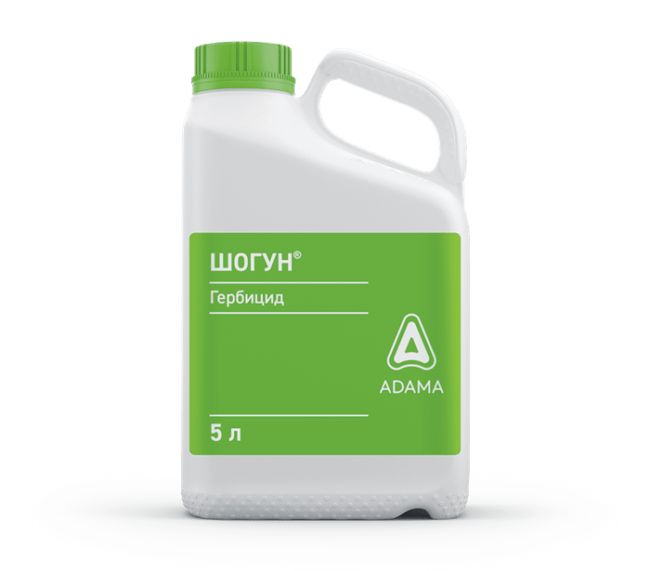
Shogun is produced as a concentrated emulsion. The active ingredient is propaquizafop (100 g/l), which acts as a systemic post-emergence herbicide. It is used to control annual and perennial grass weeds. The herbicide is sold in five-liter plastic canisters.
Mechanism of action and purpose
Propaquizafop is absorbed by weed leaves and quickly penetrates all plant systems. As it spreads, fatty acid synthesis is suppressed within cells, which disrupts vital plant functions. Weed growth is halted within 1-2 days after treatment.
The first symptoms of damage include yellowing of leaf blades and drying of stems and roots. Complete weed death occurs within 11-20 days (depending on weather conditions, weed type, and the concentration of the working solution). The herbicide is effective when spraying creeping wheatgrass, volunteer grass, field foxtail, common broom, barnyard grass, foxtail, multicolored ryegrass, wild oats, annual bluegrass, and barley.
Instructions for use
To ensure quality treatment, it is important to adhere to the consumption rates of the drug and the specific application instructions.
| Plants to be processed | Consumption rates (l/ha) | Types of weeds | Nuances of use |
| Potatoes, beets, peas | 0.60-0.90 | annual cereals | single treatment during the period of active weed growth (couch grass 10-15 cm high) or at the early stage of development |
| 1.0-1.20 | perennial cereals | ||
| Sunflower, onions, tomatoes, cabbage | 1.0-1.20 | perennial cereals | |
| 0.60-0.80 | annual cereals |
Uniform spraying of weed foliage significantly increases the effectiveness of the active ingredient. If precipitation occurs 50-60 minutes after spraying, the effectiveness of the product is not reduced. If spraying is carried out during a dry period, the application rate should be increased.


Safety precautions
Concentrated emulsion "Shogun" is classified as a Class 3 herbicide, posing a hazard to bees and humans. It is important to observe safety precautions during application:
- It is recommended to work using personal protective equipment (gloves, shoes, safety glasses, respirator, special clothing);
- the area is sprayed in dry, windless weather;
- During the work process, it is prohibited to remove protective equipment, drink, eat or smoke.

How toxic is it?
The product is not considered highly harmful. When in contact with the body, the working solution does not damage the skin and is a mild irritant to the mucous membranes of the eyes. In cases of acute poisoning with the concentrated emulsion, the following symptoms occur: lethargy, fatigue, and nausea. In this situation, it is recommended to seek medical attention.
Is compatibility possible?
It is not permitted to mix preparations containing propaquizafop as an active ingredient with other herbicides.

How and how long can it be stored?
The herbicide has a shelf life of 36 months in unopened packaging. Pesticides should be stored in a separate, dry, ventilated room protected from direct sunlight. Do not store herbicides, food, animal feed, or drinking water in the same room. The recommended temperature range is -10°C to +35°C.

Substitute products
To destroy perennial and annual grass weeds, various herbicides can be used, the active ingredient of which is propaquizafop.
"Vidblok Plus" controls grass and broadleaf weeds in soybean and sunflower crops. Its active ingredients are propaquizafop (25 g/L) and imazethapyr (37.5 g/L). Advantages: it affects weeds through leaf blades and soil, and has a wide application window (apply to sunflower crops in the cotyledon to eight-leaf stage).
Take a look Also
Manufacturers warn against creating tank mixes of pesticides based on Shogun. However, spraying crops with other herbicides is permitted one to one and a half weeks after treatment with propaquizafop.