Selective herbicides help effectively combat harmful crops without harming cultivated plants. Spraying a plot with Grand Plus stops weed growth within a few hours. It's economical to use, non-toxic, and makes an effective base for tank mixes.
What is included in the composition and dosage form
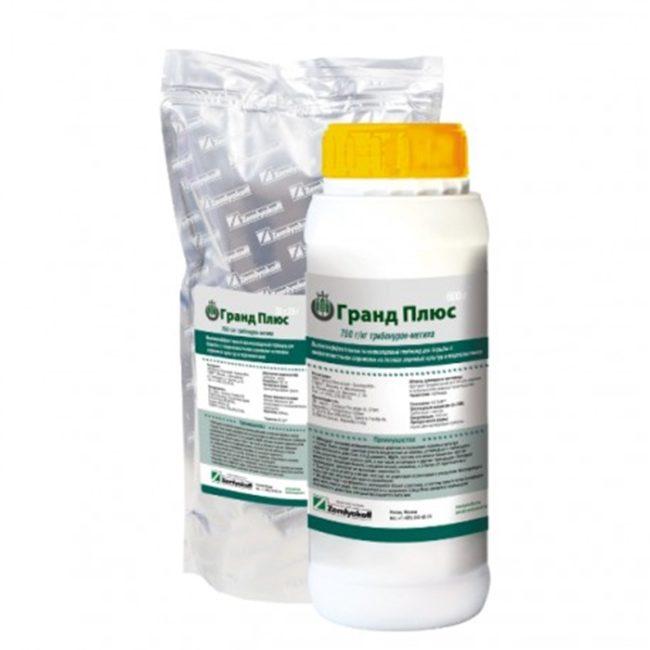
The product is produced as water-dispersible granules and is used as a selective post-emergence herbicide. The active ingredient is tribenuron-methyl (750 g/kg), which effectively controls broadleaf weeds.
How does the product work and what is it for?
Grand Plus is used to control numerous types of weeds, including those resistant to other herbicides. When applied to harmful crops, the active ingredient is absorbed by the foliage and roots and quickly spreads throughout the plant. Tribenuron-methyl blocks a specific enzyme in susceptible weeds that promotes the synthesis of essential acids. As a result, the growth of harmful crops is inhibited and they die.
"Grand Plus" destroys annual and some perennial dicotyledonous weeds (convolvulus knotweed, common chickweed, perennial thistle, chamomile, field tormentil, chickweed, shepherd's purse, yarrow, buttercup, mallow, white goosefoot, medicinal dandelion, hemlock, wild radish, common chrysanthemum, forked campion, retroflexed amaranth, stinging distichous, field pennycress).
Consumption rates and instructions for use
For active weed control, it is recommended to follow the manufacturer's instructions for granule consumption rates and the rules for using the working solution.
| Processing object | Consumption rates (g/ha) | Type of weed | Features of application |
| Sunflower varieties resistant to tribenuron-methyl | 25.0-50.0
|
annual dicotyledons and some perennials | weeds are sprayed in the phase of 2-4 leaves |
| Barley and wheat, spring and winter | 20.0-25.0 | annual dicotyledons, thistle | early stages of weed growth |
| Oats, spring barley and wheat | 15.0-20.0 | dicotyledonous annuals | early stages of weed growth |
When spraying plants, monitor the area to be treated to prevent the solution from coming into contact with other crops susceptible to the herbicide. Potatoes, beets (fodder, sugar, and table), and buckwheat are the most sensitive.
Safety precautions
Grand Plus is classified as a Class 3 hazard to bees and humans. However, when working with any herbicide, safety precautions must be observed:
- when preparing the working solution and during the spraying process, use personal protective equipment (respirator, safety glasses, special clothing, rubber gloves and shoes);
- Spraying is carried out in dry, windless weather;
- During work, it is prohibited to drink, eat, smoke, or remove protective equipment.
The duration of the spraying period should not exceed 5-6 hours.
If the solution comes into contact with skin, rinse the affected area with clean running water. A first aid kit should be available at any work area where herbicides are used.
Is compatibility possible?
The product can be used to prepare tank mixes with various insecticides and phytoncides. Do not mix Grand Plus with organophosphorus insecticides. To ensure the expected results, it is advisable to test the mixture beforehand. If a precipitate forms in the working solution or the mixture heats up, do not mix the substances.
How to store properly
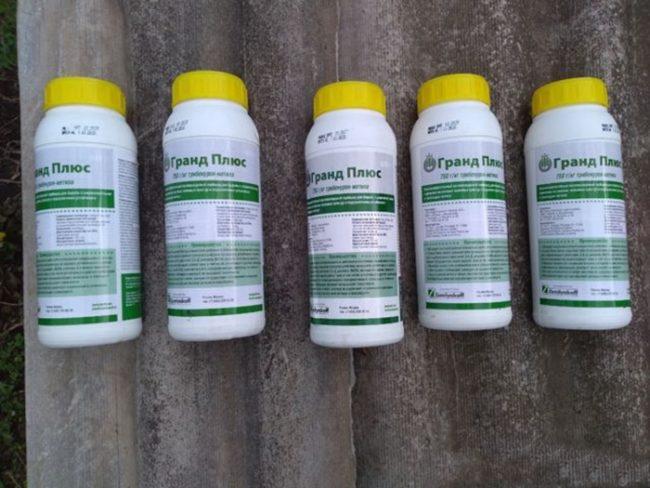
The product should be stored in a designated, dry, ventilated area. Do not store the herbicide with food, animal feed, or forage. The recommended storage temperature is 0-30°C. The shelf life of the granules is 3 years from the date of manufacture.
Substitute products
Various preparations whose active ingredient is tribenuron-methyl exhibit a similar effect on weeds.
- "Argamak" promotes active weed control in grain crops. The herbicide reliably clears the area of harmful plants from the cruciferous and Asteraceae families. It does not harm subsequent crops in the crop rotation plan.
- The advantages of the herbicide "Granat" are the absence of crop rotation restrictions, effectiveness at minimal application rates, selectivity of action, ease of use and storage.
- Magnum Super is a two-component herbicide used to control perennial broadleaf weeds in cereal crops. Its advantages include a wide application window, suitability for all crop rotations, low application rates, and a reasonable price.
- Status Grand is a post-emergence systemic herbicide used to protect cereal crops from broadleaf weeds. This product is particularly effective at killing overgrown weeds at maximum doses. Since the active ingredients decompose quickly in the soil, there are no restrictions on use in different crop rotations. The herbicide also maintains its activity when used in tank mixes.
Grand Plus kills weeds within one and a half to two weeks after application. The herbicide is affordable and easy to use. To ensure maximum benefit, it's important to follow the instructions.