
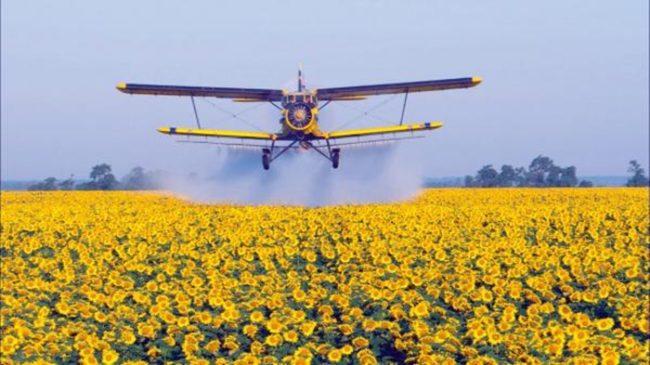
Unfavorable weather conditions can negatively impact crop yields. Tongara desiccant makes it easy to ensure uniform and accelerated ripening of certain crops. It promotes the drying of green plant matter, thus simplifying harvesting while simultaneously helping to control weeds.
Composition and dosage form
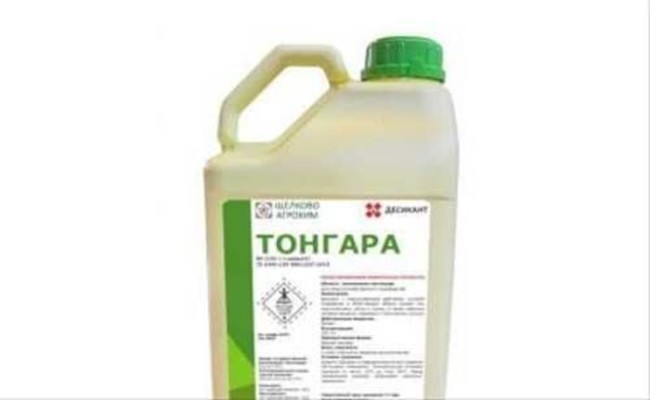
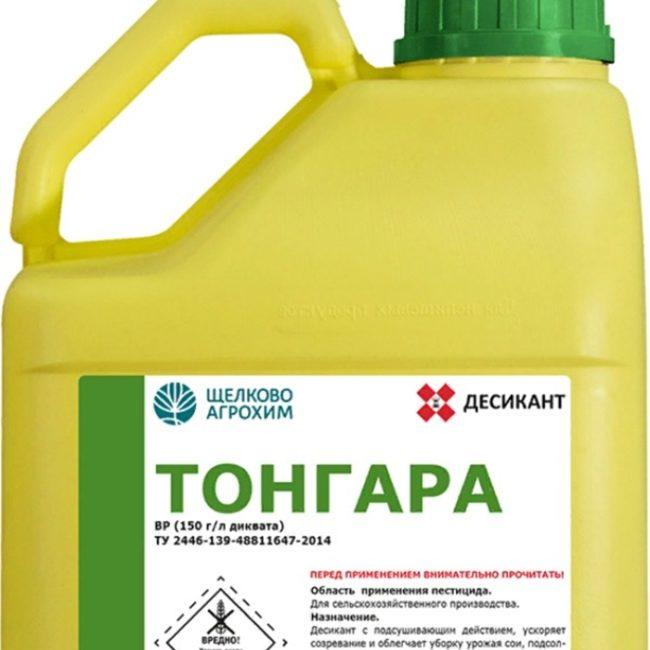
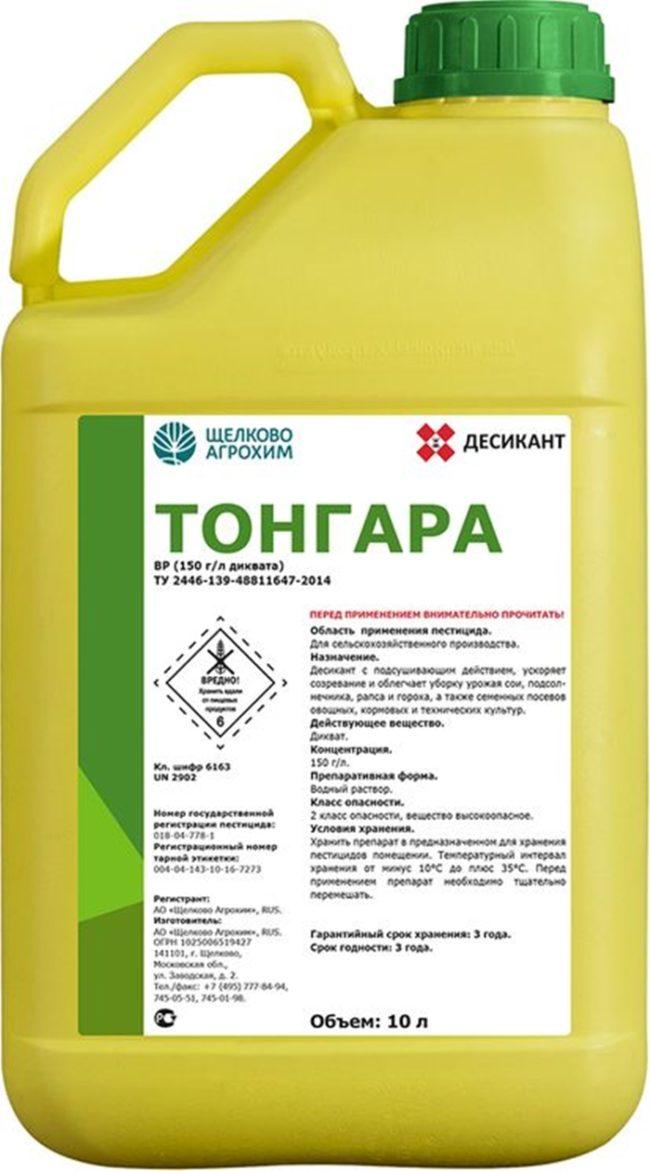
Tongara is available as an aqueous solution. Diquat (150 g/l) is the active ingredient, acting as both a desiccant and a herbicide. When using, keep in mind that the substance acts on plants by contact and is non-selective. Tongara is sold in 10-liter plastic canisters.
Mechanism of action and what it is used for
Diquat is a contact herbicide and, when applied to any plant, destroys plant tissue at the point of contact, causing the green mass to dry out. When using the working solution, it's important to pay attention to the dosage.
In small doses, the preparation is used as a desiccant on sunflower, rice, soybean, sugar beet, flax, pea, carrot, clover, and radish crops for pre-harvest desiccation.
The working solution is also often used to treat grain crops to obtain seed material.
Higher doses of the working solution are used to control annual weeds (in gardens, grapevines, vegetable and ornamental crops). Damage to plants manifests as wilting, necrotic spots on leaf blades, and death of the above-ground parts of the weeds.
Dosage and instructions for use
To avoid harming cultivated plants, it is important to adhere to the manufacturer's recommended application rates during pre-harvest desiccation.
| The object being processed | Consumption rates | Features of application |
| Sunflower | 1.50-2.0 | spray the plantings at the initial stage of browning of the baskets |
| Peas for grain | 1.50-2.0 | the crop is processed when it reaches full biological maturity (1-1.5 weeks before harvesting) |
| Cereal crops | 1.50-2.0 | spraying crops at the beginning of the ripening phase (provided that the grain moisture content is not higher than 30%) |
| Potato | 2.0 | The plantings are processed at the final stage of tuber formation (when the skin becomes rough) |
| Carrots for seeds | 2.50-3.0 | the crop plantings are processed at the stage of full seed maturity |
| Cabbage for seeds | 2.0-3.0 | spray the crop plantings at the stage of full seed maturity |
Safety precautions
The product is classified as hazard class 3 for bees and hazard class 2 for humans. Therefore, safety precautions must be observed during the work process:
- When spraying crops, wear personal protective equipment (respirator, safety glasses, special clothing, rubber gloves and shoes);
- During work, it is prohibited to drink, smoke, eat, or remove protective equipment;
- The presence of children and animals on the site during the processing of plant crops is not allowed.
Is compatibility possible?
The manufacturer permits the simultaneous use of Tongara desiccant and urea on sunflower crops. When preparing tank mixes with other desiccants or herbicides, it is advisable to conduct a preliminary test. The resulting mixture should not exhibit sedimentation or a rise in temperature.
How and how long can it be stored?
A dry, ventilated area is designated for storing the product. Canisters containing the aqueous solution are stored in a location protected from sunlight. Do not store the herbicide in the same room with food or animal feed.
The product can be stored for 36 months from the date of manufacture. Ideally, store the aqueous solution in a tightly sealed original container.
Substitute products
Various products are produced for desiccation of plant crops, the active ingredient of which is diquat.
- The Sukhovey desiccant is fast-acting (harvesting can begin 5-7 days after treatment). Spraying crops reduces the cost of drying and processing seed.
- Reglon Forte is available as a more concentrated aqueous solution of diquat (200 g/l). This allows for a more effective solution for rapid harvesting without compromising crop quality.
Take a look Also

Using Tongara desiccant is environmentally friendly, as the active ingredient does not accumulate in the soil or crops. Treating crops facilitates harvesting, reduces weeds, and reduces seed loss.