
- Composition, existing forms of release and purpose
- How does the product work?
- Symptoms of exposure
- Pros and cons
- Calculation of consumption
- Rules for preparing the working mixture
- Instructions for use of the product
- Safety precautions
- How toxic is it?
- Is compatibility possible?
- Storage terms and conditions
- Analogues
Herbicide treatments of corn crops are applied pre- or post-emergence. These products protect the crop from harmful vegetation. Let's explore the capabilities of the herbicide "Octava," its composition, purpose, and action. We'll also explore the characteristics of the herbicide's effect, as well as its advantages and disadvantages. We'll also discuss how to prepare the solution and how to use it. We'll also discuss how to use the product according to the instructions, its compatibility, and its alternatives.
Composition, existing forms of release and purpose
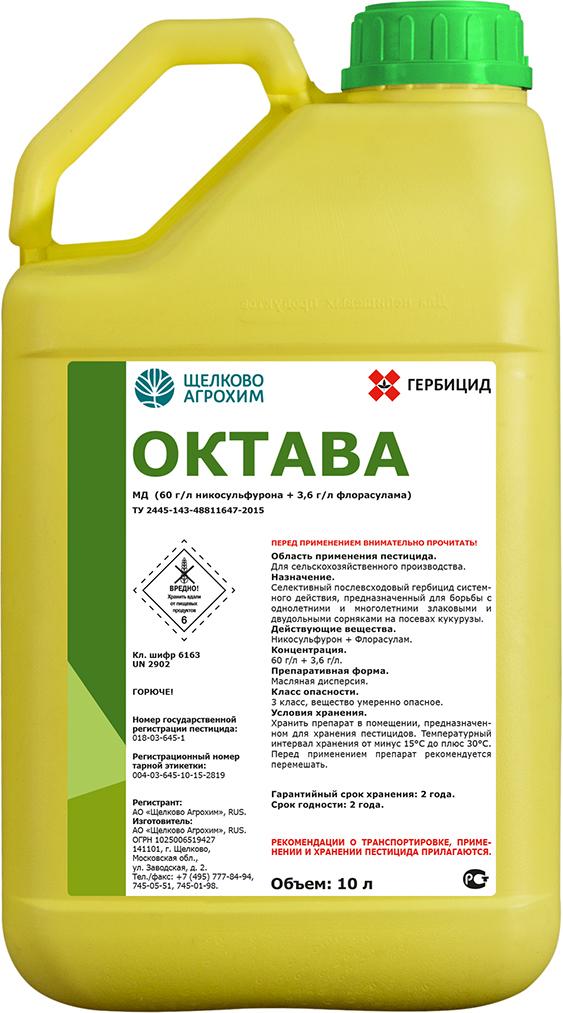
Oktava, manufactured by Shchelkovo Agrokhim JSC, is available in 10-liter canisters. It is an oil dispersion containing 60 g of nicosulfuron per liter and 3.6 g of florasulam per liter. It is a systemic herbicide by its mode of penetration and a selective herbicide by its mode of action.
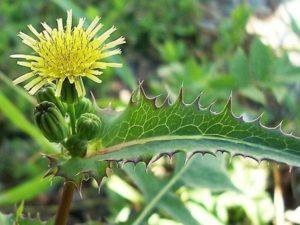
"Octava" is a 2-component herbicide that can be used to control annual and perennial bilobate weeds and cereal weeds growing in corn crops.
How does the product work?
Nicosulfuron inhibits weed cell division by blocking acetolactate synthase, an enzyme involved in the production of essential amino acids. Blocking cell division leads to the cessation of plant tissue growth. The Octava herbicide solution is absorbed primarily by the leaves and then migrates into the meristematic tissues of the entire plant.
Symptoms of exposure
The herbicide begins to work within 4-6 hours after application. After a few days, the sprayed weeds begin to show discoloration of their foliage, followed by necrosis. Weed death occurs within 2-4 weeks after application. The protective effect lasts for 2-2.5 months, depending on weather, climate and soil conditions, and the weed species.
Pros and cons
Calculation of consumption
The application rate is 0.8-1 liter per hectare. Spray crops when the corn reaches the 3-6 leaf stage. One-year-old weeds should be at the 2-6 leaf stage, and perennial weeds should be no taller than 10-20 cm. The solution consumption rate is 100-200 liters per hectare. The waiting period is 2 months.
Rules for preparing the working mixture
Prepare the solution just before spraying. First, pour 10-20 liters of water into a separate container, then add the required amount of product. Stir for 1 minute. Pour the concentrated solution into the sprayer tank, and top up with water to the final volume. Mix everything until smooth.

The "Octava" solution should be prepared at the filling stations, where the sprayer should also be refilled. Corn should be sprayed using standard sprayers with slotted nozzles, which are specifically designed for spraying herbicide solutions.
Instructions for use of the product
"Octava" does not cause resistance, but to prevent such cases from arising, it is necessary to alternate herbicides in which the active ingredients are compounds of different chemical classes and have a different mechanism of action.
Safety precautions
When working with the product and its solution, wear protective clothing that covers all parts of the body. Wear a respirator and goggles, and protect your hands with rubber gardening gloves. Do not remove protective clothing while working.

How toxic is it?
No phytotoxicity has been observed with Oktava when used at the recommended concentration and application rates. Occasionally, slight discoloration of corn leaves may be observed, but this quickly resolves and does not affect subsequent crop development. It does not affect harvested yield.
The product is of low hazard to humans and belongs to toxicity class 3. Do not apply to corn near water sources, bodies of water, or fish farms. The substances it contains may be toxic to fish.
Take a look Also
Is compatibility possible?
When diluting Octava with other pesticides, pre-mix a small amount of both products in a separate container. This is done to check the compatibility of these specific substances. If an undesirable chemical reaction occurs, other pesticides should be selected.

Storage terms and conditions
According to the manufacturer's instructions, the product has a shelf life of two years after production. During this time, the liquid must be kept in a sealed container with a tightly closed lid.
The storage temperature range for Oktava is from -15°C to +30°C. Store in a dark and dry place. Do not store food, medications, or animal feed near the herbicide. After the expiration date, the product loses its properties and must be disposed of. Prepare the spray solution for one day of use. Pour any remaining solution onto a plot of land not used for plant growth.
Analogues
The following products can replace the herbicide "Octava": "Agronika", "Dublon", "Innovate", "Kordus", "Kornikos", "Melion", "Milena", "Nikos", "Nissin", "Prioritet", "Squash", "Strateg", "Supercorn", "Phaeton", "Khors", "Elyumis", and "Yantar". All of these products contain nicosulfuron, so they have similar effects.
"Octava" is an effective herbicide used to treat corn crops against common weeds. One application is sufficient for effective control. Protection lasts until the end of the growing season.
Related posts:
 How to propagate and grow peas, cultivation technology, and care in open ground
 Description of varieties of sowing peas and cultivation, to which family they belong
 The best eggplant varieties for growing in a polycarbonate greenhouse: planting and care
 How to control onion flies using natural and chemical methods
 Instructions for use and composition of the herbicide Neo, dosage and analogues
 Is it possible to soak treated cucumber seeds before planting and how to do it correctly?
 Instructions for using ferrous sulfate for treating grapes
 How to use and prepare manure as a fertilizer, its types and composition
