
- Herbicide composition
- Existing forms of release
- What plants is it intended for?
- Mode of action and how quickly it works
- Signs of exposure
- How long does the protective effect last?
- Pros and cons
- Calculation of consumption
- How to prepare a working mixture and use it correctly
- Precautionary measures
- How toxic is it?
- What to do in case of poisoning
- Is compatibility possible?
- How to store it correctly and for how long
- Similar means
Grass weeds can infest agricultural crops, interfering with their normal growth. Specialized products are used to control these harmful plants. Let's look at the composition, mechanism of action, and purpose of the herbicide "Quickstep," including its speed of action, advantages and disadvantages, application rates, and solution preparation. We'll also examine the product's toxicity, compatibility, and alternatives.
Herbicide composition
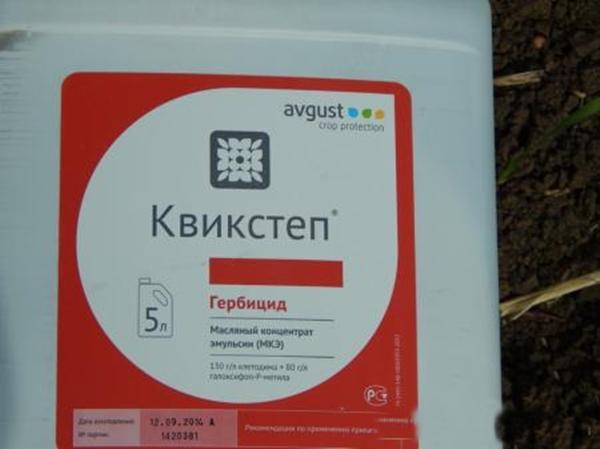
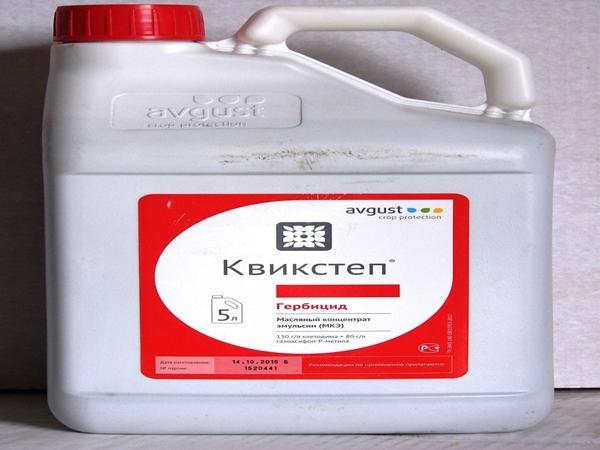
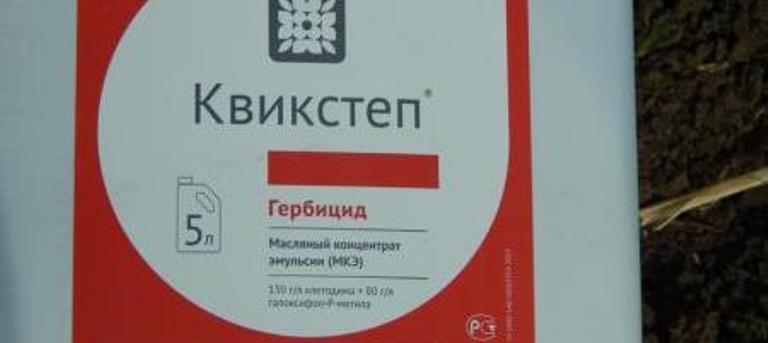
"Quickstep" contains two active ingredients: haloxyfop-P-methyl at a concentration of 80 g per liter and clethodim at a concentration of 130 g per liter. It is a systemic pesticide with selective action.
Existing forms of release
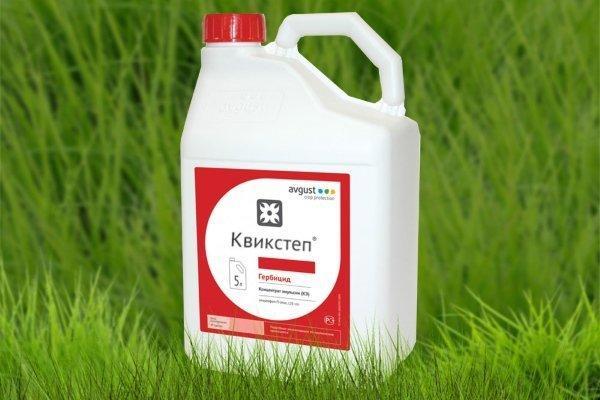
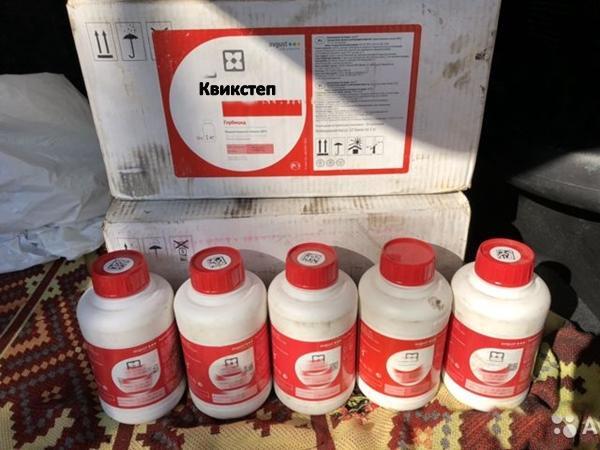
The herbicide manufacturer, August, produces Quickstep as a microemulsion. For agricultural use, it is packaged in industrial containers—5-liter canisters.
What plants is it intended for?
The herbicide is used to control annual and perennial grass weeds. Crops targeted include beets, rapeseed, soybeans, flax, potatoes, and sunflowers.
Mode of action and how quickly it works
The substances in Quickstep inhibit fatty acid synthesis. Haloxyfop-P-methyl enters weeds through foliage and root systems, where it forms haloxyfop-P. This compound inhibits meristem growth. Clethodim acts on the growing points and roots of weeds.
Signs of weed suppression can be noticed within 1-3 days after spraying. Weeds are completely killed within 1-2 weeks, depending on the weather, stage of development, and weed species.
Signs of exposure
Quickstep inhibits the development and growth of weeds. Signs of disruption include chlorosis, reddening of midribs on leaves, and then tissue necrosis. Foliage becomes anthocyanin-colored, wilts, and dries out. These are sure signs of plant death.
How long does the protective effect last?
The herbicide doesn't penetrate the soil and doesn't affect grasses that grow after treatment. However, its effectiveness is so high that a single treatment is sufficient to protect crops for the entire growing season.

Pros and cons
Calculation of consumption
The application rate of "Quickstep" is the same for all crops: 0.4 liters per hectare for first-year weeds and twice as much for perennial weeds, or 0.8 liters per hectare. Spray the herbicide when the weeds are in the 2-4 leaf stage, and perennials, such as couch grass, are 10-15 cm tall. The solution consumption rate is 200-300 liters per hectare. The waiting period is two months, and the number of sprayings is one.
How to prepare a working mixture and use it correctly
The instructions for use state that for Quickstep to be effective, weeds must have sufficient green mass to absorb the liquid. It's also important that the crops be at a stage of development that doesn't obscure the weeds.
Then add the remaining water and mix again. Stir the liquid throughout the process to maintain uniformity.
Precautionary measures
As with all agricultural products, when working with Quickstep herbicide, you must wear protective clothing that covers your exposed body parts. Wear a respirator (or a gas mask) and plastic goggles with side shields. Hands should be protected with thick rubber gloves. While working with Quickstep—diluting the solution and spraying—do not smoke, drink, or eat. Keep unauthorized persons away from the field being treated.
Take a look Also

How toxic is it?
The herbicide "Quickstep" does not penetrate the soil or accumulate in it. Therefore, there are no restrictions on its use in crop rotation. It is classified as a Class 3 toxicity product for bees and humans. It can be used near apiaries.
The herbicide is non-phytotoxic to cultivated plants and does not inhibit or stop growth, so it can be sprayed at any stage of development, even on young plants.
There are also restrictions on use: like many pesticides, Quickstep is not permitted for use near bodies of water. It may be toxic to fish and aquatic life.
What to do in case of poisoning
Poisoning with the herbicide "Quickstep" is rare, as the ingredients are low-hazard. However, if signs of intoxication (headache, nausea, weakness) occur after use, drink plenty of water and several tablets of activated charcoal. After a few minutes, induce vomiting. If the condition persists, call a doctor. If splashed on skin or eyes, rinse with warm water for 15 minutes.
Is compatibility possible?
Quickstep can be combined in the same solution with fungicides, other herbicides, and insecticides. It should not be mixed with pesticides that produce an alkaline reaction. If there is no precise compatibility data, a test should be performed: mix a small amount of the products in the same solution and check for a chemical reaction. If there is no reaction, the products can be used together.
How to store it correctly and for how long
Quickstep can be stored for two years from the date of production without losing its properties. The manufacturer advises storing the product in its sealed industrial packaging.
Agrochemicals are stored in a chemical storage room; fertilizers and pesticides can also be stored there. However, food products, animal feed, medications, hygiene products, and household cleaning products should not be stored there. The room should be securely locked to prevent access by animals and children. Proper storage conditions include a positive temperature, a darkened room, and dry air.
After two years of storage, discard any unused product. The prepared Quickstep solution can be stored for only one day. After that, it loses its properties and becomes unusable. It is recommended to dilute the solution enough to use it within a day. If any remains, pour the liquid onto an area where plants are not intended to be grown.
Similar means
The herbicide "Quickstep" for haloxyfop-R-methyl has the following substitutes: "Agrotech-Garant-Zelektin", "Accent", "GalactAlt", "Galaktik Super", "Galaktion", "Galant", "Gallon", "Galmet", "Galoshans", "Huron", "Zellek-super", "Zelor", "Zlakosuper", "Canon", "Oreol", "Orion", "Rangoli Galsityl", "Sokol".
Clethodim also has numerous alternatives, including Accent, Beryl, Graminion, Zlakoff, Zlakterra, Clethoshans, Legat, Legion Combi, Ligat, Secach, Selector, Censor, Centurinol, Chevron, Evolution, Elephant, and Efes. Any of these can be substituted for Quickstep if similar weed control is desired.
The herbicide "Quickstep" is effective against many types of weeds. It is widely used to treat sugar beets, sunflowers, potatoes, flax, rapeseed, and soybeans. Its action begins immediately after the solution hits the weeds, killing them faster than with other herbicides. One treatment is sufficient, although the waiting period is long. However, harvesting most crops occurs later than the specified time, so the herbicide's compounds will not be present in the fruits and seeds. The herbicide is cost-effective and economical to use.
Related posts:
 How to properly grow a peach tree from a seed at home, planting and care
 Is it possible to grow an apricot tree from a seed in your garden? How to plant and care for it?
 Planting and caring for cherries, feeding and growing rules
 Carrot care guidelines for outdoor cultivation to ensure a good harvest
 The best eggplant varieties for growing in a polycarbonate greenhouse: planting and care
 How to grow grapes in the Moscow region in open ground without a greenhouse
 How and whether it is possible to graft an apricot, the choice of rootstock, timing and methods of budding
 How to propagate grapes in summer using green cuttings at home