Due to the ever-increasing prices of groceries, residents have begun canning fruits and vegetables more often. Each preserve has its own unique recipe. Fruits and berries deserve special attention, as they not only taste delicious but also contain a wealth of vitamins.
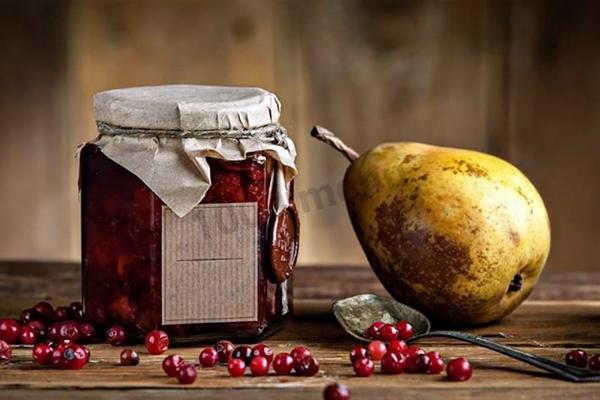
Lingonberry jam with added pears is packed with vitamins. That's why it's important to examine the recipe for this delicacy in detail.
Cooking Features
To cook this dessert without wasting its beneficial properties, you need to consider a number of factors that you'll encounter during the cooking process:
- It is necessary to take into account the taste qualities (this will allow you to calculate the required amount of sugar for preparation).
- Lingonberries themselves have an inherent acidity, which is why it is necessary to maintain proportions.
- It is necessary to use only ripe lingonberries and pears to ensure that the jam turns out healthy and tasty.
- The fruits used must be thoroughly washed and then dried.
- When preparing, it is necessary to follow the technology, otherwise the preserves will not be stored for long.
- If you are making jam, rather than preserves or marmalade, use whole berries and chopped pear slices.
- During the canning process, it is necessary to sterilize the jars in which the preserves will be stored.
By taking all factors into account, you can create a stunning composition that will fill your body with the necessary amount of nutrients and vitamins during the winter.
During the cooking process, you need to monitor the cooking process (depending on your preference, the mixture is left on the stove for a certain amount of time to obtain a thick or more liquid jam).
Preparing the ingredients
The initial stage of preparing this delicacy involves preparing the necessary ingredients. For lingonberry and pear jam, you'll need the following:
- lingonberries (thoroughly washed fruits that have been cleaned of grass and twigs, as well as leaves and other components);
- pears (thoroughly washed with water and also cleaned to remove any excess components);
- regular granulated sugar in the amount of one and a half kilograms (it is necessary to use traditional refined sugar);
- boiled water in a volume of 200-250 milliliters (the use of ordinary purified water is allowed).
The fruits for preparation are prepared in equal proportions. Typically, one kilogram of fruit is sufficient for making a small amount of jam.
Before cooking, fruits must be thoroughly washed, especially if the ingredients are store-bought and not grown and picked yourself.
How to make pear jam with lingonberries
There are many recipes for preparing this mixture, but they have minor differences, so it is worth focusing on the traditional recipe:
- lingonberries are sorted and then poured with prepared water;
- the mixture is infused for 2-3 minutes, after which the water is drained (this allows the bitterness to be removed);
- The pears are washed and peeled, after which the core is removed (the fruits are cut into small slices);
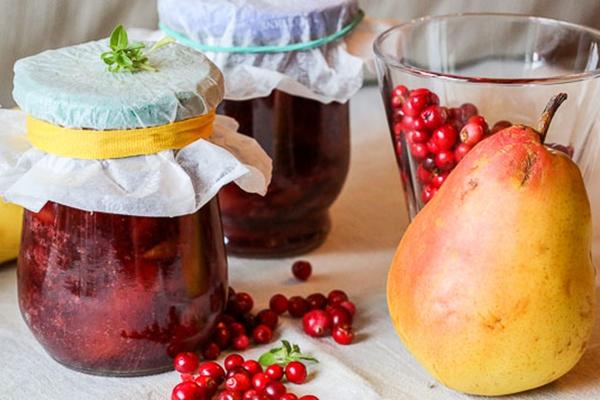
- After that, the chopped fruits need to be kept in boiling water for a couple of minutes (no more);
- half of the prepared sugar is mixed with water, after which the mixture is brought to a boil;
- then add pears and lingonberries, after which the mixture needs to be stirred regularly;
- at the end, the remaining sugar is added when the lingonberries release their characteristic juice;
- Afterwards, the prepared jam is left to sit at room temperature for several hours.
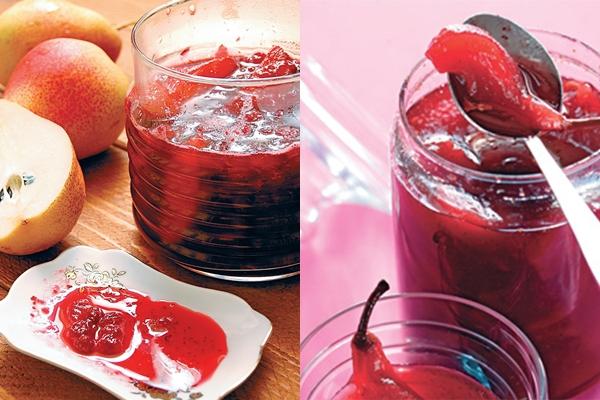
To finish cooking, bring the mixture back to a boil and then simmer for another 10 minutes over low heat. Then pour the mixture into jars and seal with metal lids.
Lingonberries should be cooked whole if making jam. If making jellied or marmalade, all the berries should be ground in a meat grinder or blender.
How long can this jam be stored?
The shelf life of a treat depends on a number of factors. Let's look at the key factors that can help extend the shelf life of a canned product:
- Storage in a room with constant low temperatures.
- There is a sufficient level of humidity in the storage area.
- There is no natural light or sunlight entering the room.
- The technology for making jam was followed.
- Before being lowered into storage, the preserved material cooled to room temperature.
- All technological aspects of preservation were observed.
Taking these nuances into account, it is possible to extend the shelf life of canned goods.
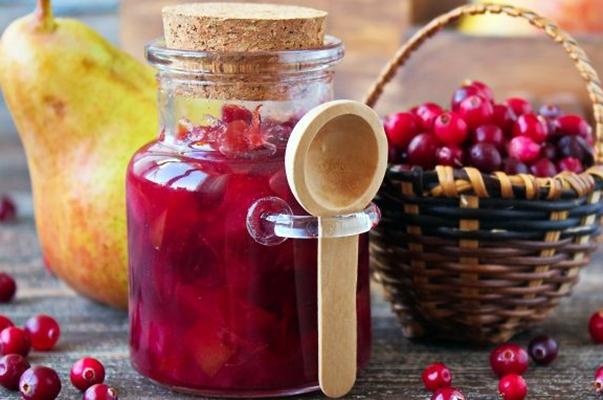
Canned lingonberry and pear jam can typically be stored for several years, but if stored improperly, the shelf life is reduced to one season. Under normal conditions, the jam can last up to a couple of weeks; if refrigerated afterward, the jam may ferment.
Related posts:
 Simple step-by-step recipes for making lingonberry jam for the winter
 When and how to properly pick lingonberries with your own hands, equipment
 Useful properties and contraindications of lingonberries, use for medicinal purposes
 Timeframes and rules for storing lingonberries at home for the winter
 Simple recipes for frozen lingonberry compote for the winter, how to can it with and without sterilization
 Simple recipes for making cherry plum jam with and without pits for the winter
 15 simple recipes for making blueberry jam at home with apple and lemon in a slow cooker
 TOP 10 recipes for pickled lingonberries for the winter, at home, cold and hot methods