
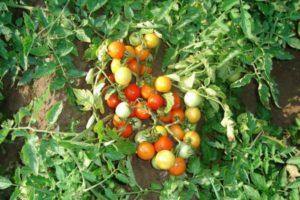
The Finish tomato is a determinate variety. The bushes grow up to 75 cm tall and have a moderate number of leaves.
What is the Finish tomato?
Characteristics and description of the variety:
- The fruits are round, slightly flattened.
- Tomatoes are medium sized, weighing about 80 g.
- The seeds are located in 4-6 chambers.
- Tomatoes have excellent taste.
- The Finish variety is designed for planting in open ground and under film.
- The ovary is formed after the 5th leaf, the next ones after every 2 leaves.
- It takes 120 days from seed germination to harvest ripening.
- The yield of the variety is high and ranges from 260 to 610 c/ha.
How are tomatoes grown?
Finish tomatoes are grown from seedlings. Seeds are sown in seedling containers a month before planting in the ground. If planted too early, the sprouts will become too elongated, which may reduce the yield. In southern regions, seeds are sown in late February to mid-March.
In central regions, sowing begins in the second half of March. In northern regions, it's recommended to sow seeds in early April. If you plan to grow tomatoes in a greenhouse, you can sow the seeds two weeks earlier.

Before sowing, the seeds need to be prepared. The planting material should be disinfected to protect the plants from diseases. The seeds should be soaked in a weak pink solution of potassium permanganate for 15 minutes. The soil also needs to be disinfected. First, preheat the soil in the oven for 10 minutes at 180ºC.
Then, pour boiling water over the soil. After treatment, water the soil and keep it in a warm room for 10 days to allow beneficial microorganisms to develop. After this, sow the seeds.

Pour the soil into the containers and compact it slightly. Make furrows in the soil 1 cm deep, spaced 4 cm apart. Place the seeds in the furrows, leaving at least 1 cm between them. Sprinkle with soil. Then cover the containers with plastic wrap or glass and leave them in a room with an air temperature of 25ºC.
Take a look Also
If the soil becomes too dry, mist it with a spray bottle. Watering should be moderate. Overwatering can cause mold. If mold does appear, remove the affected layer of soil, water with a potassium permanganate solution, and top with good soil. If the room is warm, seedlings will appear in a few days. If the air is cooler, it will take a little longer.

Place the seedling containers on a windowsill, as the plants require plenty of light. If the light level is low, provide phytolamps. Keep the room humidity high. If the air is too dry, install a humidifier. Water the seedlings as the soil dries out, avoiding water from getting on the leaves. Therefore, it's best to water with a syringe.
Hardening off seedlings is necessary. To do this, place them in a cold environment. Start with 5 minutes, then increase the hardening time. Hardened seedlings have slightly purple leaves and sturdy stems. These seedlings are resistant to wind and bright sun. After the sprouts develop true leaves, they are transplanted into individual pots. Fertilizer is added before transplanting.

Prepare the pots and fill them with soil. Water the seedlings to prevent damage to the roots during transplanting. Using a trowel or knife, lift the soil so that the entire plant root comes out along with the soil ball. You can transplant the seedlings once or twice. This procedure strengthens the root system.
Seedlings are transplanted into open ground only after the ground is frost-free. This occurs in late May or early June. Choose a well-lit, open area; you can plant tomatoes in light shade from trees. Tomatoes are planted in beds previously occupied by cucumbers, onions, and carrots. Avoid planting tomatoes after peppers, potatoes, and eggplants.


Fertilize. If the soil is highly acidic, add slaked lime; if it's low, add sulfur. In the south, tomatoes should be planted 50 cm apart. If plants are often affected by late blight, the distance between bushes should be increased to 70 cm. Plants can be planted using the square-nested method, with a distance of 70 cm between seedlings. Up to three seedlings are planted in each hole.

You can plant using the strip-and-nest method. This involves creating irrigation furrows 1.4 m apart. Tomatoes are planted on either side, 60 cm apart. Two seedlings are planted per hole. Tomatoes need regular watering, hilling, and weeding.
Reviews from those who have planted this variety are positive. Gardeners praise the tomato's high yield and excellent taste. Most people write, "I tried growing the Finish tomato variety once, and now I grow it every year."
Related posts:
 Description of the best varieties of black tomatoes for open ground and greenhouses
 11 Best Recipes for Preserving Tomato Slices for Winter
 TOP 17 recipes for pickled sweet tomatoes for the winter
 Delicious recipes for canned tomatoes with honey for the winter, preparation steps
 Recipes for amazing tomatoes in jelly for the winter, with and without sterilization, you'll lick your fingers
 Is it possible to grow an apricot tree from a seed in your garden? How to plant and care for it?
 The 14 Best Tomato and Aspirin Recipes for a 3-liter Jar for the Winter
 Recipes for pickled tomatoes in apple juice for the winter – finger-licking good