
- Composition and purpose
- Existing forms of release and mechanism of action
- Advantages of the drug
- Calculation of consumption for different crops
- For apple and pear trees
- For flower crops
- For planting grapes
- For tomatoes and cucumbers
- For gooseberries and currant bushes
- How to carry out processing
- Safety precautions and toxicity levels
- Is compatibility possible?
- Storage rules
- Best before date
- Similar fungicides
Modern fungicides offer a variety of effects and address several agricultural problems simultaneously. Using the fungicide "Tiovit Jet" according to the instructions allows you to protect vegetable crops, grapes, fruit trees, and shrubs from common fungal diseases and mites. At the same time, as a macronutrient, the product provides plants with additional nutrition.
Composition and purpose
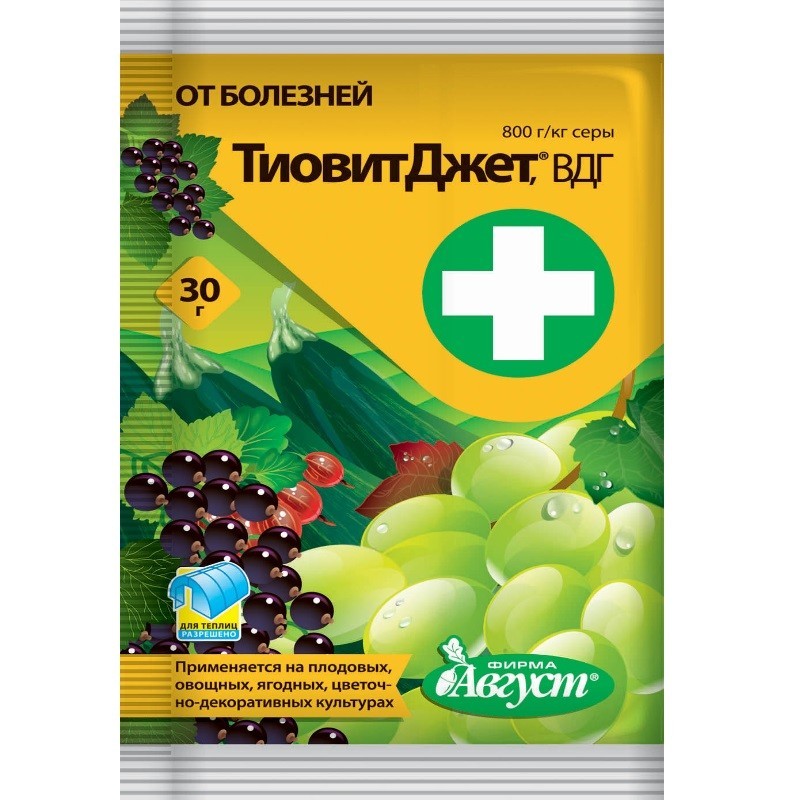
"Tiovit Jet" is a product based on inorganic sulfur, which is included in the composition in the amount of 800 grams per 1 kilogram of the total mass of the supporting base. A fungicide designed to combat powdery mildew, oidium, and spider mites, used to treat the following crops:
- tomatoes;
- cucumbers;
- zucchini;
- apple trees;
- pears;
- grape;
- currant;
- gooseberry.
The drug is also used on ornamental plants.
Existing forms of release and mechanism of action
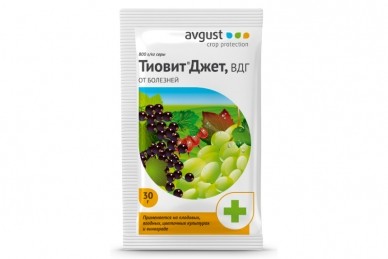
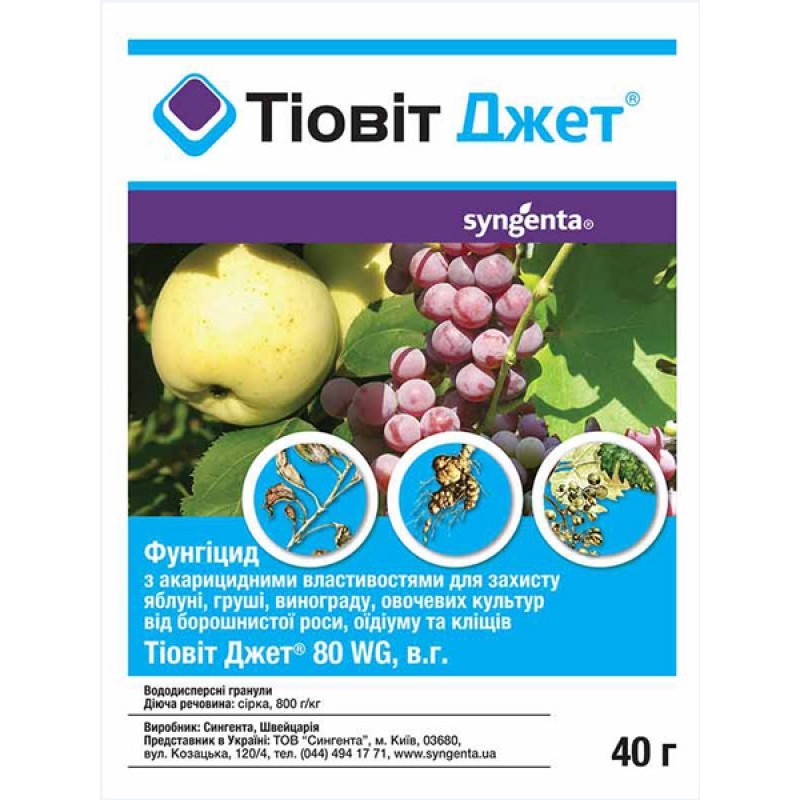
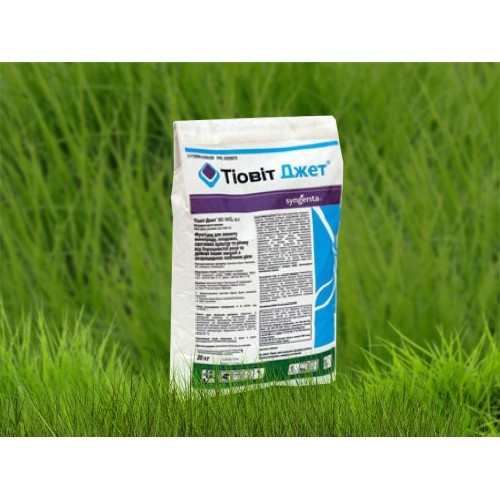
Thiovit Jet is produced in the form of water-soluble granules, packaged in foil bags of 15, 30, 40 grams, as well as in polyethylene bags of 1, 10, 20 kilograms.
Sulfur-containing vapors penetrate the mycelium and fungal spores, where they form hydrogen sulfide, inhibiting the pathogens' respiratory function. Elemental sulfur also reacts with metals to form sulfides. These processes disrupt the metabolism of fungal cells, resulting in the death of the fungi.
Thanks to sulfur vapor, Thiovit Jet has fungicidal, acaricidal and insecticidal effects.
Advantages of the drug
The fungicide has a number of advantages, due to which it is often used in agriculture, gardens and summer cottages.
Thiovit Jet has the following advantages:
- complex fungicidal and acaricidal action;
- persistent preventive effect for up to 10 days;
- no crop rotation restrictions;
- rapid onset of action;
- easy-to-use granulated form;
- affordable price.
The fungicide is safe for plants if the application conditions and recommended dosages are observed.
Calculation of consumption for different crops
The dosage of the drug depends on the type of object being treated.
For apple and pear trees
For every 100 square meters of planting, 10 liters of working solution is required, which requires 30-80 grams of fungicide. Trees are treated during the growing season from one to six times per season.
For flower crops
Ornamental plants are sprayed with a solution of 20-30 grams of granules in 5-10 liters of water. This volume of solution is sufficient to treat 100 square meters of plantings. The procedure is repeated 2-4 times per season.
For planting grapes
To treat 100 square meters of vineyard, dissolve 30-40 grams of fungicide (up to 50 grams for powdery mildew) in 10 liters of water. One spraying is sufficient for protection against spider mites, while two to four applications are required for powdery mildew.
For tomatoes and cucumbers
For vegetable crops, prepare a solution of the product at a rate of 15-20 grams of granules per 5 liters of water. For 1 square meter, 0.5 liters of working solution is sufficient.
For gooseberries and currant bushes
To prepare 10 liters of working solution for treating 100 square meters of berry bushes, you will need 20-30 grams of granules. Gooseberries are sprayed up to six times per season, and currants – up to three times.
How to carry out processing
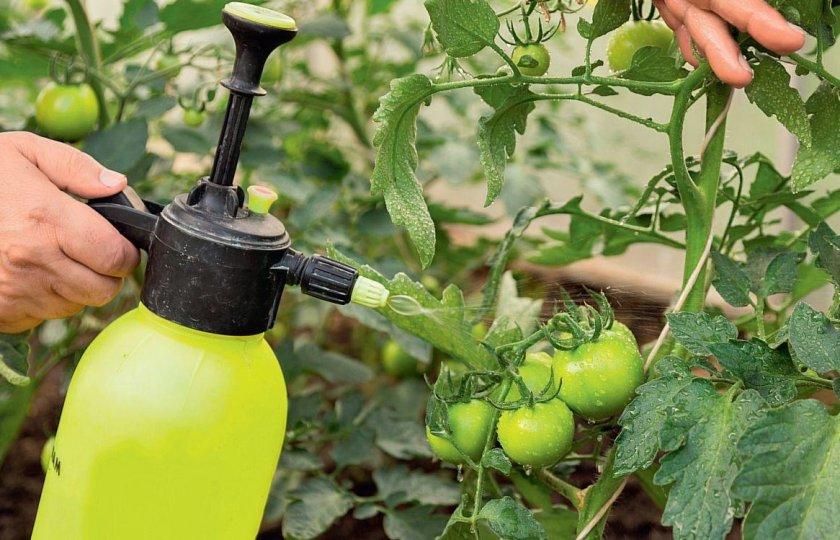
Treatment is carried out with a freshly prepared aqueous solution of fungicide granules by spraying the above-ground parts of plants.
To make a working solution, you need to dissolve the required number of granules in a third of the total volume of water, then add the remaining water.
Spray precisely and thoroughly to ensure maximum contact. Ideally, spray in the evening when weather conditions are favorable. The safe air temperature for Thiovit Jeta is between 18°C and 28°C. At lower temperatures, the product's effectiveness is reduced, and at temperatures of 35°C or higher, the fungicide may cause leaf burn and leaf drop.
Safety precautions and toxicity levels
The drug is classified as a chemical hazard class 3 (moderately hazardous) for humans and bees.
When working with fungicide, the following rules should be observed:
- use protective equipment;
- restrict access to the processing area for third parties and animals;
- Avoid direct contact of the composition with the skin, mucous membranes and respiratory tract.
It is recommended to monitor the flight of bees in the first hours after spraying.
Is compatibility possible?
The preparation is compatible with other fungicides except for oil-based products.
Storage rules
The fungicide should be stored isolated from household items, out of the reach of children and animals at temperatures from -10 °C to +40 °C.
Best before date
3 years.
Similar fungicides
A similar product is colloidal sulfur. "Thiovit Jet" has better solubility and is convenient and safe to use.
Related posts:
 Instructions for use of Thiovit Jet for grapes and processing rules
 How to treat grapes for mildew, the best control measures and treatment rules
 How to feed and what fertilizers are best for blueberries, soil acidification
 Instructions for using the Skor fungicide for treating grapes
 Description of 30 varieties and types of Muscat grapes, planting, cultivation and care
 Nitrophoska composition and instructions for use of fertilizer, errors
 Composition and instructions for use of the fungicide Kumulus, application rates and analogues
 The best way to treat weeds on strawberries: top 3 herbicides and other methods