
The Matryoshka tomato is a hybrid (cross). The seed packet label for these plants always indicates F1. This characteristic means that when attempting to propagate them at home, gardeners risk producing plants with different characteristics than the tomatoes from which the seeds were taken. Those wishing to grow Matryoshka in subsequent seasons will have to purchase a new seed packet each time.
What do the bush and fruits look like?
The Matryoshka tomato variety is determinate. The bushes reach a height of about 70 cm, after which the main stem stops growing. They can be grown outdoors, in a greenhouse, or even in low-rise greenhouses. Compact bushes grown outdoors don't require staking, but in a greenhouse, they can be trained into two stems and tied to a trellis.
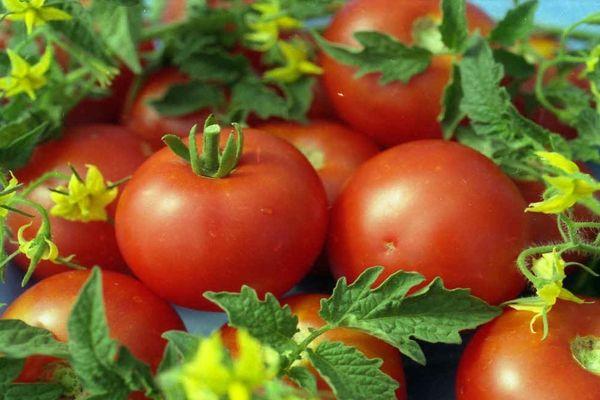
A distinctive feature of the Matryoshka tomato variety is the uniform setting and ripening of the crop. During the fruiting period, the bush is covered with small fruits (100-200 g), collected in clusters of 6-9.
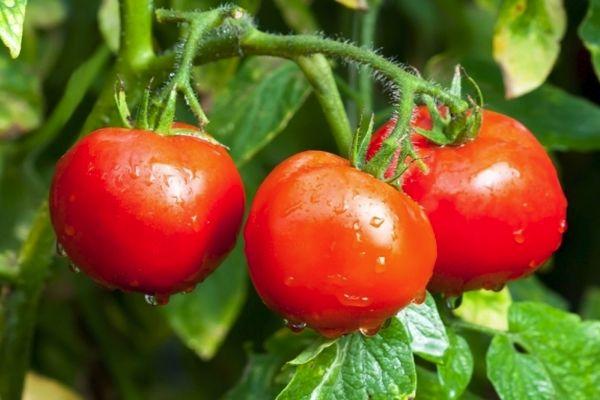
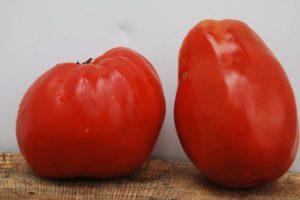
A description of the Matryoshka tomato fruit notes its unusual pear-shaped form, reminiscent of the famous Russian toy. Ripe tomatoes are a rich red. Gardeners describe the fruit as sweet, with a distinct tomato flavor. The flesh is firm, with 3-4 seed chambers that are not very well developed. The skin is thick, preventing cracking.
Matryoshka tomatoes are suitable for fresh consumption and canning. Their unusual shape and small size make marinades and pickles very decorative and attractive, and their thick skin prevents them from bursting. The average yield per bush is 9-10 kg.
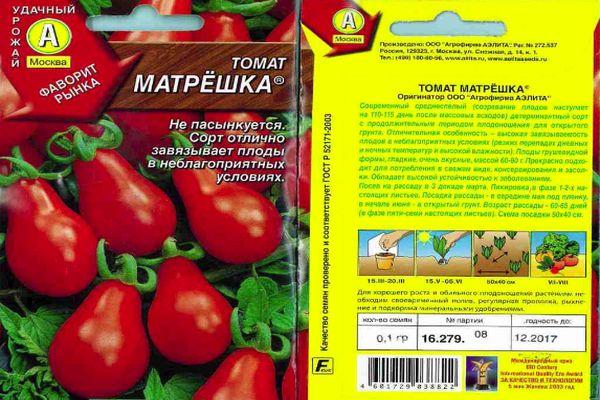
Agricultural technology of the variety
Matryoshka tomatoes can be grown in both greenhouses and open ground in southern Russia. The seeds are sown directly into their permanent location, and the seedlings are thinned out, leaving 40-60 cm between them. Row spacing can be 60-70 cm.
In temperate climates, the Matryoshka variety is grown from seedlings. For this purpose, seeds are sown in boxes at the end of March. Seedlings emerge uniformly, appearing 6-7 days after sowing. After 1-2 true leaves appear, seedlings should be transplanted into boxes, spacing them 7 cm apart.
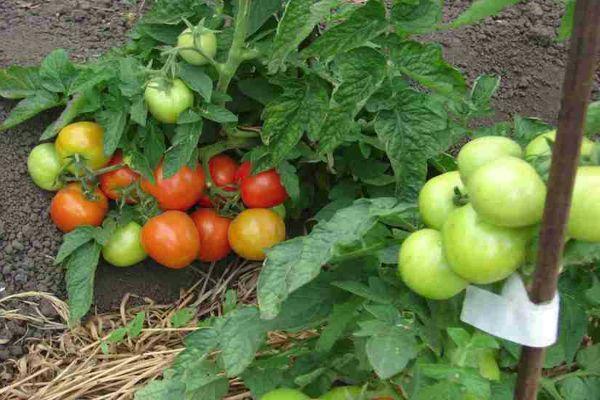
Tomatoes can be planted outdoors at the end of May, after the frost period has passed. In a greenhouse or hotbed, tomatoes will be ready to grow as early as early May.
After the first fruiting, the bushes should not be removed. They will bear fruit again on shoots growing near the soil surface. The yield of the second fruiting cycle is lower.
Watering tomatoes should only be done in dry weather. Wait until the soil is thoroughly dry (5-10 cm deep). Then, pour about 10 liters of water under each plant and let the soil dry again. With this method, you'll only need to water the tomatoes about once every 7-8 days. This amount of moisture will be optimal for filling and ripening large quantities of fruit without causing watery pulp.
Fertilize the bushes two weeks after planting. Fertilizer can be reapplied after 10-14 days. Fresh organic fertilizers should not be used. To ensure a good harvest, the soil must be rich in potassium and phosphorus. It's best to use complex mineral fertilizers with an optimal ratio of nitrogen, potassium, and phosphorus (Kemira, Nitrophoska, and others).
Pros and cons of the variety
According to reviews from those who have planted Matryoshka tomatoes, the bushes in open ground are capable of producing fruit well even in cold and rainy summers. Matryoshka tomatoes have the following advantages:
- resistance to fusarium wilt;
- immunity to verticillium;
- uniform color of the fruit without greenery near the stalk;
- dense skin and pulp;
- compact size of bushes.
Among the drawbacks noted by some gardeners is a watery taste. Those who have grown this variety also note poor yields, which may be due to care requirements or local climate.
Proper care and adherence to cultivation guidelines for the Matryoshka tomato variety will yield the desired result: firm, long-lasting, and delicious fruits. The first harvest can begin as early as mid-July.
Related posts:
 Description of the best varieties of black tomatoes for open ground and greenhouses
 TOP 17 recipes for pickled sweet tomatoes for the winter
 Delicious recipes for canned tomatoes with honey for the winter, preparation steps
 11 Best Recipes for Preserving Tomato Slices for Winter
 Characteristics and cultivation of the best varieties of pear-shaped tomatoes
 What varieties of tomatoes are best to plant in a polycarbonate greenhouse?
 Recipes for amazing tomatoes in jelly for the winter, with and without sterilization, you'll lick your fingers
 80 Best Eggplant Varieties for Different Regions with Descriptions and Characteristics