
The Niagara tomato is a relatively new variety, but those who have grown it in their gardens have been captivated by the cascades of vibrant tomatoes that cover the stems during fruiting. Besides their decorative qualities, these tomatoes have excellent consumer qualities. They are suitable for both greenhouse and open-field cultivation.
General description of the plant
The bushes are indeterminate, with unlimited growth. The tomato stem reaches 2 meters in height, but in open ground, its growth must be limited by pinching the tops in mid-August. This is done to speed up fruit set.
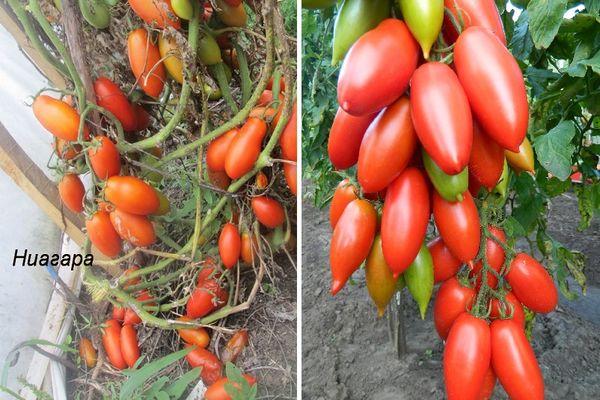
The plant's stem is not too thin and is quite strong, but it does require staking. To increase yield, this type of tomato is trained into 2-3 stems. Side shoots should be removed to prevent them from becoming too dense. It's also advisable to remove lower leaves to a height of 1/3 of the stems.
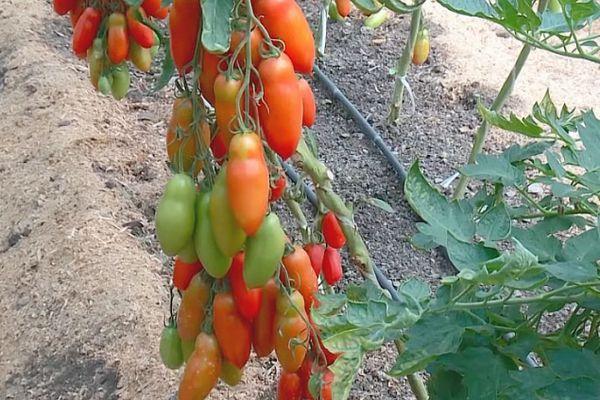
Fruiting is clustered and extended. Ovaries and new clusters form throughout the season. During the growing season, up to 10 complex, multi-locular clusters can form on a single stem. Each cluster produces up to 14 medium-sized tomatoes. Reviews from those who have planted Niagara tomatoes indicate that large fruits can be obtained using a simple technique: leaving 8-10 ovaries per cluster.

Gardeners themselves develop the characteristics and descriptions of the Niagara tomato variety. They particularly emphasize the variety's high yield. A single plant can produce approximately 10 kg of high-quality vegetables per season. The yield is relatively unaffected by weather conditions, but the fruit's flavor may vary: plants grown in damp or shady locations produce berries that are more tart.
The variety is virtually disease-resistant. Niagara tomatoes are resistant to fungal infections and tobacco mosaic virus, and they are resistant to late blight. Like all long-fruited varieties, they can be affected by blossom-end rot. Reviews note their resistance to stress, including sudden changes in weather conditions, prolonged rains, and cold snaps.
Tomatoes can tolerate dry soil. During hot seasons, the fruit contains more sugars and dry matter.
Fruit characteristics
The Niagara variety is considered a mid-early variety. The first ripe tomatoes can be harvested only in mid- to late July, 110-120 days after the sprouts emerge. The tomatoes are shaped like elongated plums with a pointed tip. The length-to-width ratio is estimated to be approximately 3:1. The average tomato weight is 80-100 g, but larger tomatoes, weighing 120-130 g, can be grown if desired.

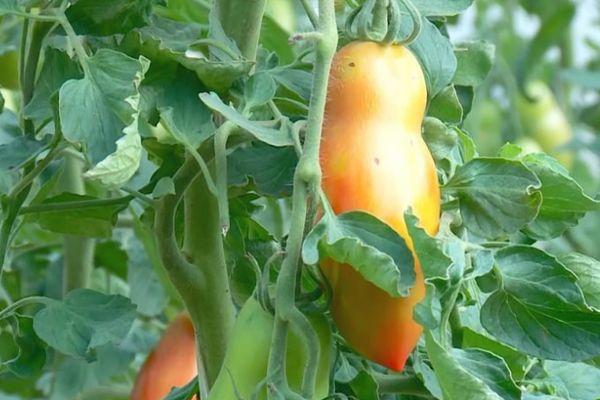
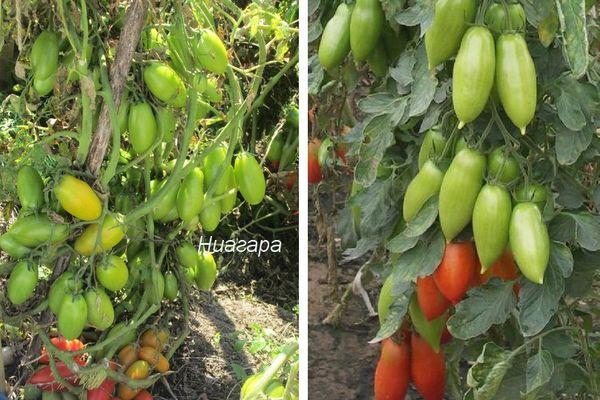
The skin is firm but not rough. The fruits do not crack when exposed to excess moisture during growth or heat treatment during canning. They store well both ripe and unripe, ripen easily, and are transported without losing their marketable appearance. The skin is red, with a beautiful gloss. At commercial maturity, the tomatoes are green, without a dark spot at the base.
The flesh is dense and well-colored; under unfavorable growing conditions, a clear section of the core remains near the stalk. The fruit contains two large seed chambers. The berry walls are firm and juicy, reaching 0.5-0.7 cm in thickness.
The taste will delight any homemaker who plants Niagara tomatoes in their garden. In a sunny spot and with a slight lack of moisture, the tomatoes develop a rich, sweet flavor with a hint of tartness. Due to their high dry matter content, the tomatoes' aroma is distinct. Niagara tomatoes' flavor is similar to that of varieties grown in Italy for tomato paste and sun-dried tomatoes. Prolonged rainfall and artificial ripening can cause the tomatoes to become overly acidic.
The Niagara variety is considered versatile: it can be used to prepare delicious appetizers and garnish holiday dishes. Sweet tomatoes add unexpected flavor to salads and sandwiches, and they also look impressive when sliced. They can be added to hot dishes in Italian and Caucasian cuisine, and they make delicious tomato soups and sauces.
You can choose any method for preserving for the winter. A vegetable platter with colorful fruits will look bright and beautiful both in the jar and when served.
They retain their flesh structure well, without bursting or falling apart. Both unripe and ripe tomatoes can be used for whole-fruit canning. Fully ripe tomatoes are great for sun-drying: they'll acquire the traditional flavor of this Mediterranean snack.

How to grow a good harvest?
To ensure Niagara tomatoes produce tasty fruit, they need to be planted in a well-lit area with warm, loose soil. In heavy soils, tomatoes often suffer from blossom-end rot, which is caused by a calcium deficiency. It's best to till the soil in the fall, adding organic matter and a phosphorus-potassium mixture. To ensure Niagara tomatoes have adequate calcium, add 1-1.5 kg of ground chalk, slaked clay, dolomite flour, or similar material per 1 m².
The Niagara tomato variety is not a first-generation hybrid. Its seeds can be used for propagation next season. To do this, leave 1-2 of the best tomatoes on the lower trusses, closest to the stem, and ripen them until fully ripe. Remove the seeds from the seed chambers, rinse, and dry. Many homeowners leave reviews like this: "I planted Niagara seeds, but only 1 seed out of 10 sprouted. Now I use several times more than necessary." Before sowing, soak the seeds in a solution of potassium permanganate.
It's a good idea to disinfect the soil to protect young plants from fungal diseases (blackleg and others). You can warm the soil in the oven, soak it in boiling water, or soak it in a hot solution of potassium permanganate.
Sow in very moist soil, spreading the seeds over the surface. Cover with a 0.5 cm layer of dry soil or sand. Cover the trays with plastic wrap and place in a warm place (25°C) to germinate. Once sprouts appear, remove the plastic wrap.
Picking is done in the phase of 2-3 true leaves. Seedlings can be transplanted into peat pots, individual containers with a capacity of approximately 0.5 liters, or shared boxes in a 10x10 cm pattern. After 2-2.5 months, the plants can be transplanted into a garden bed or greenhouse. Space the plants 40 cm apart, and about 70 cm between rows. Staking is done once the tomatoes have established themselves.

Form the bushes after the first flower cluster has formed. Until then, simply remove all side shoots from the stem. Leave one side shoot above the inflorescence and then pinch out both shoots, tying them to a support. Leave one more side shoot above the second flower cluster on the main stem. Once three stems have formed, remove all remaining side shoots for the remainder of the season.
Related posts:
 Description of the best varieties of black tomatoes for open ground and greenhouses
 The best eggplant varieties for growing in a polycarbonate greenhouse: planting and care
 What varieties of tomatoes are best to plant in a polycarbonate greenhouse?
 Description of the best tomato varieties for open ground in the central zone
 The best tomato varieties for growing in the Leningrad region for greenhouses and open ground
 Making finger-licking good eggplant caviar with peppers and tomatoes
 16 Best Quick Pickled Tomato Recipes for the Winter
 Which tomato varieties are best for open ground?