
The Wolford Wonder tomato is a collectible variety bred in the USA. In central Russia, it can be grown outdoors, but it will perform best in a greenhouse.
General characteristics of the variety
The Walford's Miracle tomato variety is an indeterminate variety. Plants reach 1.7–2 m in height when grown in a greenhouse. In the open field, growth stops with the onset of cool nights and reaches about 1.5 m.
In terms of ripening time, Walford's Miracle is a mid-season variety. It takes 115-130 days from sowing to harvesting the first tomatoes. In central Russia, ripe tomatoes will only be available in mid-August. Most of the harvest will have to be picked unripe. When grown in a greenhouse, the growing season lasts slightly longer, allowing gardeners to harvest more ripe tomatoes.

Walford's Miracle tomato bushes are distinguished by their low foliage. This eliminates the need for unnecessary pruning. The plants require pinching, as they branch well. To increase yield, the bush is trained into two stems.
The description of the Walford's Miracle tomato notes its main drawback: a thin stem. This makes the seedlings appear elongated and weak, but when transplanted, they quickly begin to grow and soon form a flower cluster (above the 6th to 8th leaf). To prevent young plants from being broken by the wind in open ground, they should be tied up immediately after transplanting. Subsequently, tie up each inflorescence to prevent the stem from breaking as the fruit develops.
The variety's yield may vary depending on the site's location and weather conditions. When planted in fertile, organically rich soil in a sunny, dry summer, a single tomato plant can yield up to 7-8 kg. Similar yields can be achieved in a greenhouse. However, in a damp and cold summer, Walford's Miracle may not live up to the gardener's expectations.

What kind of fruits does the Walford Miracle tomato have?
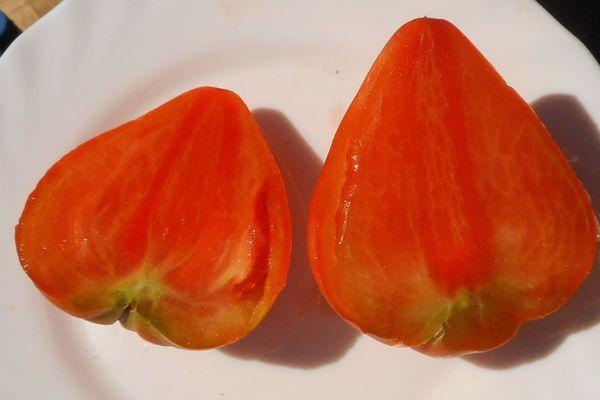
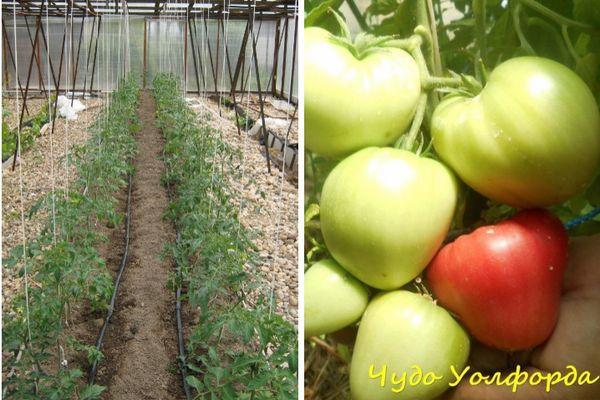
This variety is distinguished by its beautiful, heart-shaped fruits. The skin and flesh are a rich scarlet hue. Sometimes a greenish spot develops near the stem. The bushes with ripening fruits look decorative and can be a highlight in any gardener's tomato collection.

Reviews from those who have grown Walford's Miracle note the fruit's excellent taste. The tomatoes have a high sugar content (up to 6.5%). The sweet flavor is especially noticeable when grown in a greenhouse, but in a favorable summer, good results can also be achieved in open ground.
The Walford Miracle variety is large-fruited. Each tomato grows to a weight of 250-300 g. The largest tomatoes, reaching 400-500 g, often form on the lower clusters. Depending on growing conditions, a cluster can contain 3-4 or up to 8 tomatoes of approximately equal size.
Large, tasty tomatoes are perfect for salads and appetizers. The small number of seeds allows the fleshy fruits to be used for canning, but only if sliced, as they are quite large. Walford's Miracle tomatoes make delicious juices, tomato sauces, and lecho.
Features of cultivation
In our country, the company "Siberian Garden" distributes seeds. The company also sells Ukrainian-bred seeds. Miracle of the Earth tomatoBoth varieties are similar in fruit shape and sweet taste, which suggests that the Miracle of the Earth tomato is similar to American tomatoes.
In Russia, mid-season varieties are grown from seedlings. The soil for sowing should be prepared in advance: generously watered with a hot, dark pink solution of potassium permanganate. This will protect the seedlings from fungal infections. Sowing can be done immediately after the soil has cooled to room temperature.
Spread the seeds over the surface of moist soil, cover them with dry soil, and cover the box with glass or plastic. Place it in a warm place (25°C). Seedlings will appear within a few days.
When the seedlings have 2-3 true leaves, transplant them. Space the seedlings in a 7x7 cm pattern. It's recommended to provide supplemental lighting, increasing the daylight hours to 10-12 hours. This will ensure the seedlings are strong and don't stretch out.
Planting in a permanent location is carried out at the age of about 60 days. One week after transplanting, the plants need to be fed with nitrogen fertilizer: a solution of nitrophoska (1 tablespoon of granules per 10 liters of water). Add 0.5 liters of nutrient liquid under each bush.

To get a good harvest, repeat the fertilizing 2 more times:
- when 1 flower brush is formed;
- 14-15 days after the previous one.
For top dressing, use any complex fertilizer containing phosphorus and potassium (Kemira Plus, Signor Tomato). Prepare and apply the solution according to the instructions.
Related posts:
 Description and characteristics of the miracle cherry hybrid, planting and care of the variety
 Description of the Miracle of the Land tomato, characteristics, cultivation and yield of the variety
 Description and characteristics of Balcony Miracle tomatoes, growing at home
 Description of the tomato variety Miracle of the Market, features of cultivation and care
 Description of the Raspberry Miracle tomato variety, its characteristics and cultivation
 Description of the Lazy Miracle tomato and growing seedlings
 Description of the hybrid tomato Chudo-Grozd F1, cultivation of the variety
 Description of the Miracle of the World tomato variety, its characteristics and yield