
The Miracle of the World tomato is sure to attract farmers' interest. Agricultural producers face fierce competition from each other and from foreign farmers. The battle for consumers is underway. The winner is the one who can generate interest in their product.
There are plenty of tomatoes in stores and markets. The taste is ordinary, unremarkable. Growers prioritize yield, transportability, and marketability among other characteristics. Meanwhile, consumers want tomatoes with unusual shapes, flavors, and colors.
These fruits are grown on small private farms. They can be purchased at farmers' markets. However, quantities are minimal. This is understandable: unusual varieties have low yields and marketability. Chudo Sveta tomatoes combine all the required characteristics. Farmers can confidently plant them in their fields. The resulting produce will easily find a buyer.
Description of the variety
Russian breeders are proud of the "Chudo Sveta" tomato variety. It was created in 2002 by breeders from the Semena Altaya company. Trial plantings confirmed its stated qualities. Over time, the tomato has gained widespread popularity.
Farmers immediately appreciated it. They were attracted by its technical characteristics. Description of the plant:
- designed for planting in open and protected ground;
- has an average ripening period (from germination to the first fruits it takes 110 days);
- tall (in a greenhouse it grows up to 2.1 m);
- resistant to major tomato diseases;
- 4–5 brushes are formed on the stem;
- the brush has up to 10 fruits;
- easily tolerates short-term drought;
- the plant has medium foliage.
Farmers in southern regions grow Chudo Sveta outdoors. It requires a long, warm period. However, residents of problematic areas get excellent harvests in unheated greenhouses.
What fruits grow?
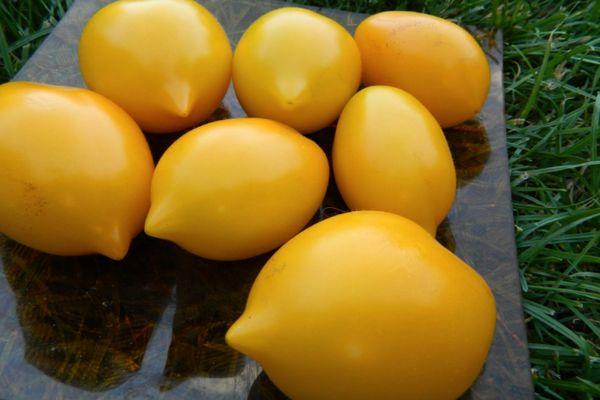
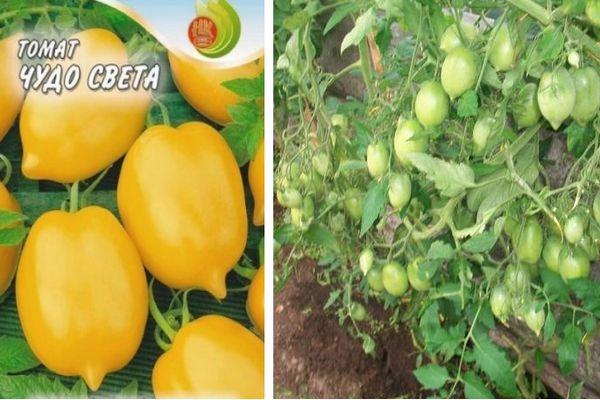
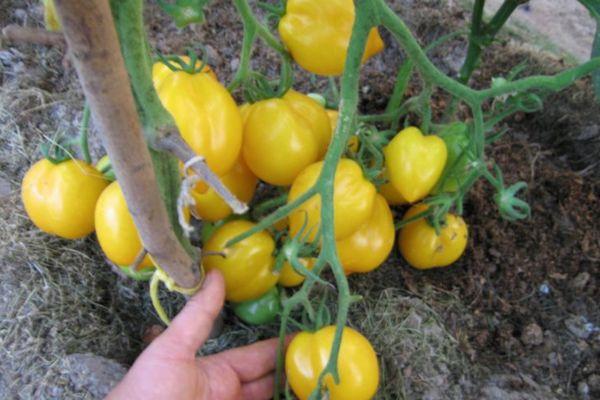
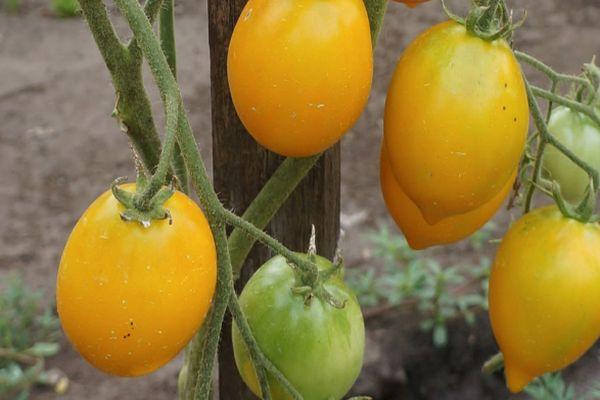
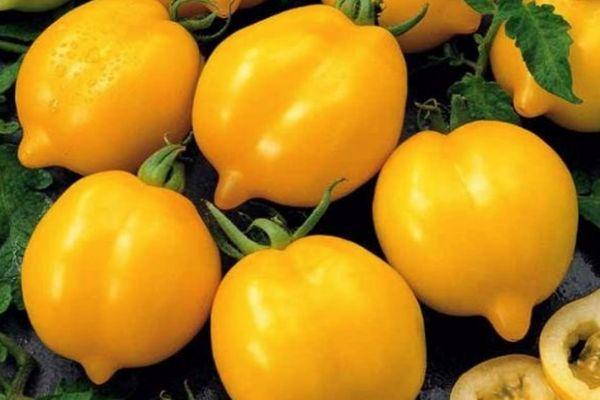
A distinctive feature of this variety is the shape and color of the fruit. They resemble small lemons. Berry characteristics:
- elongated shape, with a “nose” at the bottom;
- color: from light yellow to golden;
- berry weight - 70-100 g;
- the fruit contains dry matter within 6%;
- 3-4 seed chambers;
- a small number of small seeds;
- the skin is dense, not rough;
- the taste is sweet, the acidity is not felt;
- the pulp is dense, not watery.

Tomatoes are easily transported over long distances. Farmers have found that the fruit retains its marketability for 2–3 weeks without refrigeration. This reduces production costs.
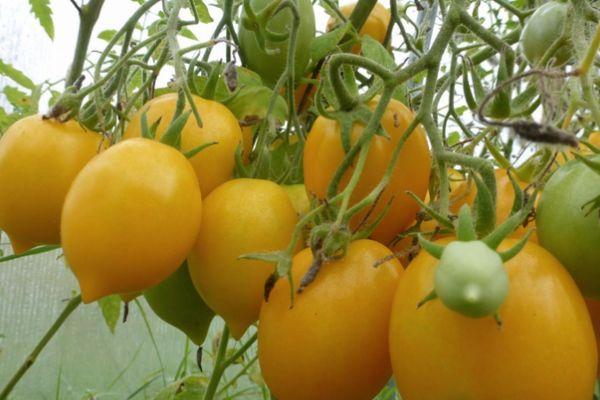 Tomatoes displayed on the counter attract the attention of customers: selling the harvest is easy.
Growing
Farmers appreciate the variety's undemanding nature regarding weather conditions. Successful cultivation depends on following proper growing practices. Agronomists recommend:
- When using your own seeds, it is recommended to carry out pre-planting preparation. First, you should assess the germination rate. This is necessary for an accurate calculation of the amount of planting material. They should be disinfected in a light pink solution of potassium permanganate. Then, stimulate growth with any preparation (treatment with potassium humate).
- To enjoy the Wonder of the World harvest, it's recommended to grow seedlings. Sow in the third ten days of March.
- Plants must be pricked out to the cotyledon leaves. This should be done after the first true leaf emerges.
- Planting in permanent beds should be done after the last frost.
- This variety requires light, fertile soil. The soil should be prepared in advance: add mature organic matter, and after 5-7 days, add a mineral complex.
- It is recommended to water the miracle of the world moderately.
- Fertilize with phosphorus and potassium three times during the growing season. The first time is 14 days after planting, the second time is when buds appear, and the third time is when the fruit begins to ripen.
- The highest yield (12 kg per bush) is achieved when growing the variety in 2–3 stems.
- The Wonder of the World is characterized by insignificant growth of lateral shoots. It is recommended to pinch out side shoots.
- Tomatoes require regular loosening and weed removal.
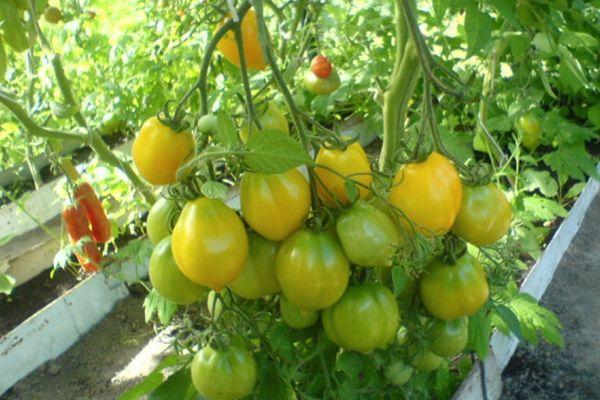
This variety is characterized by a prolonged fruiting period. It is recommended to harvest ripe berries to speed up the ripening of the remaining ones.
Care Features
Farmers should take into account the specific care requirements for this "Wonder of the World." In a greenhouse, the plants grow taller and produce more tomatoes.
Outdoors, tying the bushes to a sturdy support is essential: the stems are thin and easily broken by the wind. The clusters should also be tied up: this "miracle of the world" overloads itself with fruit.
For marketability, it's important to have uniform fruit. This can only be achieved with regular fertilizing and cultivating 2-3 stems per bush.

Svetlana is easy to grow. However, there's no protection against late blight. It's recommended to harvest the berries before temperatures drop to 15 degrees Celsius.
Advantages and disadvantages
Farmers highlight the advantages of the variety:
- drought resistance;
- undemanding to weather conditions (lighting);
- unusual shape and color;
- excellent taste;
- marketability;
- transportability;
- resistance to viral diseases;
- ease of marketing;
- ease of growing large crops.
But the Wonder of the World's shortcomings prevent you from enjoying the tomatoes:
- tall bush size (difficult to grow in greenhouses);
- difficulty of growing in regions with strong winds: bushes break;
- the need for pinching and gartering.
The advantages of the variety outweigh the disadvantages: farmers easily obtain good harvests of unusual fruits.
Pests and diseases
If cultivation practices are not followed, the market miracle is susceptible to TMV and brown spot. At the first sign of spotting, it is recommended to treat the plantings with an antifungal agent (as per the instructions). Affected TMV bushes should be removed and burned. The soil should be watered with a dark pink solution of potassium permanganate at 40 degrees Celsius.
Scattered crushed eggshells will help prevent slug infestations. They should be spread in a continuous strip 4–5 cm wide.
Whiteflies and spider mites damage greenhouse crops. Insecticides are used to kill whiteflies. Spider mites are killed by increasing humidity in the greenhouse. Ventilation eliminates these pests.
Ant nests near the beds should be destroyed. These insects spread aphids to the tomato plants. At the same time, it is recommended to spray the plants with a tobacco infusion mixed with green soap.
The mole cricket causes damage to plantings. It gnaws at the roots of bushes, causing the plants to die. To combat this pest, it is recommended to remove egg clutches in the spring. In the fall, piles of manure should be laid out. Ground crickets settle in these piles for the winter. The piles should be collected and burned.
Harvesting and storage
The Wonder of the World has a prolonged fruiting period. The fruits should be harvested when the characteristic coloring appears. Regular harvesting will speed up the ripening of the remaining tomatoes. It is important to pick the berries without damaging the bushes.

Tomatoes should be placed in plastic or wooden boxes in 2-3 layers, with parchment paper between each layer.
If long-distance transportation is anticipated, it's recommended to pick brown tomatoes from the bush; they will ripen en route. Ensure adequate ventilation during transport.
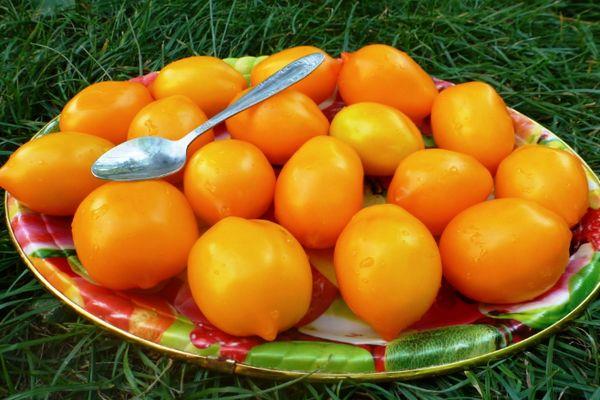
Tomatoes remain marketable for 2–3 weeks without refrigeration. However, they should be stored in a dry, cool, and ventilated area. Refrigerated storage extends the shelf life of the berries for up to 1.5 months.
Gardeners' reviews
Farmers are pleased with the Chudo Sveta variety, giving positive reviews of the tomato. Farmers have assessed the quality of the tomato as being consistent with the actual characteristics. They appreciate the ease of harvesting, and the fruit's marketability and shelf life are commendable. It is grown on small private farms and large farms in the southern regions.
Gardeners cite the ripening period as a disadvantage for agricultural producers: this makes planting in open ground in problematic areas (Central Region, North-West Region) difficult.
Related posts:
 Description and characteristics of the miracle cherry hybrid, planting and care of the variety
 Description of the Miracle of the Land tomato, characteristics, cultivation and yield of the variety
 Description of the tomato variety Miracle of the Market, features of cultivation and care
 Description of the Raspberry Miracle tomato variety, its characteristics and cultivation
 Description and characteristics of Balcony Miracle tomatoes, growing at home
 Description of the heart-shaped tomato Miracle of Walford and its growing characteristics
 Description of the remontant raspberry variety Orange Miracle, planting and care
 Description and characteristics of the California Miracle pepper variety, cultivation