
Gardeners have long loved the fruitful and early-ripening Khorovod tomato: its characteristics and description allow it to be classified as a cherry tomato. However, there are some slight differences, as many small-fruited varieties fall off when slightly overripe. Khorovod's fruits hold more firmly to their stems. But this valuable quality isn't the only reason this tomato is loved.
General characteristics of the plant
The Khorovod tomato variety is classified as an indeterminate crop. The bush has an unlimited main stem growth rate: in greenhouse conditions, it can reach a height of 2 meters or more. Tall stems require staking and training into 1-2 trunks.
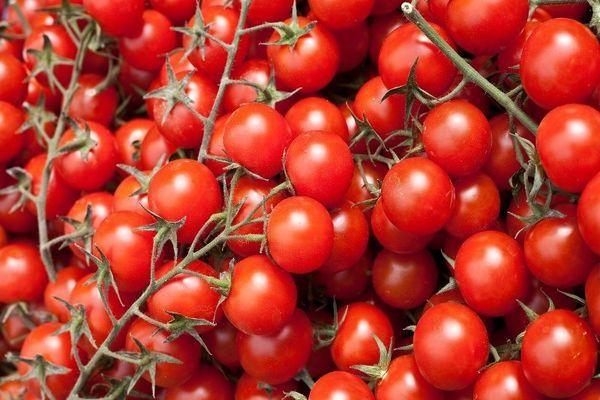
The Khorovod variety is suitable for cultivation in open ground, under temporary shelters, or in a greenhouse. The plant produces abundant harvests in any conditions and is resistant to both mild drying and cold, prolonged rains. Gardeners report only an excessively acidic taste when grown outdoors during rainy seasons.
But in well-warmed soil and in bright sun, the sugar content of tomatoes increases significantly.
Khorovod tomatoes have another valuable quality: they ripen as early as mid-July. Their early maturity (95-110 days from germination to harvest) is combined with a uniform filling and ripening process. When the harvest is in full swing, the bushes look very decorative, completely covered with long clusters of neat, round tomatoes of varying degrees of ripeness.
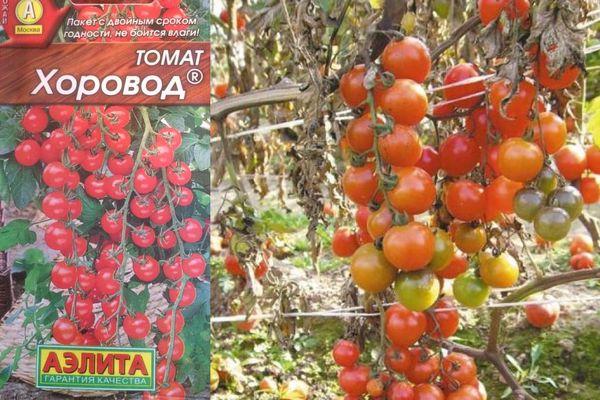
The variety is resistant to most fungal diseases. In dense plantings or during cold summers with heavy rainfall, it is recommended to remove some of the foliage in the lower tier of the bushes. This protects the tomatoes from early-onset blight, allowing you to preserve the entire harvest.
Description of the Khorovod tomato fruit
Cherry tomatoes are quite productive. Despite their small size and fruit weight (up to 15 g), each plant produces up to 10 clusters. Each plant can produce approximately 3 kg of calibrated tomatoes over the summer. When planting 3-4 plants per square meter, the average yield reaches 10-12 kg per unit area.
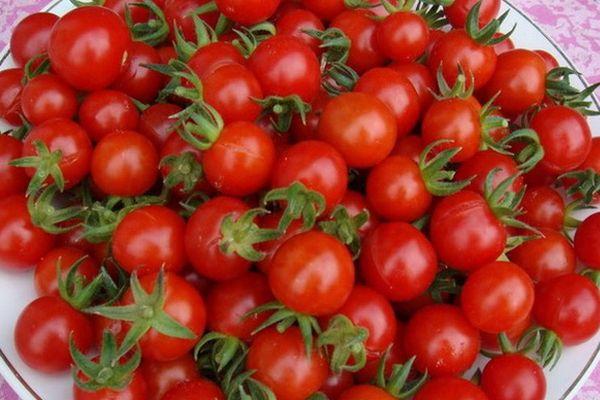
The skin of mini tomatoes is very strong. It doesn't crack during ripening and ripening, and it's resistant to heat. When eaten fresh, the skin may feel a bit rough.
The fruit's flesh is fleshy and juicy. Each tomato produces two seed chambers containing a few seeds. In greenhouse conditions, some fruits may be seedless, which should be taken into account when growing your own seed.
The flavor characteristics of the Khorovod tomato vary among gardeners and depend on how the vegetable is grown. In a greenhouse or during hot, dry summers, the tomatoes produce sweet, richly flavored fruits, similar to Italian varieties used for tomato sauces. However, with insufficient sun or overwatering, the flavor becomes noticeably tart, approaching a classic sweet and sour.
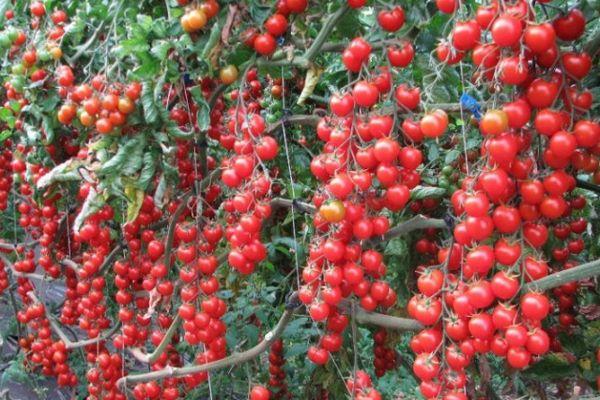
Khorovod cherry tomatoes are versatile. They're used to make and garnish salads and appetizers. The red fruits are perfect for sandwiches and eaten raw. As a cocktail variety, Khorovod tomatoes are also suitable for decorating alcoholic or non-alcoholic beverages.
Russian gardeners place great importance on the suitability of tomatoes for canning. Khorovod tomatoes are excellent for making assorted platters: paired with gherkins, the preserves look impressive. If the harvest is abundant, cherry tomatoes can be processed into juice and tomato puree for sauces and lecho. Their high dry matter content allows for a high-quality product with a rich flavor. Small tomatoes are easy to dry and cur.
Growing seedlings of the variety
Early-ripening tomatoes are recommended to be sown for seedlings two months before planting in their permanent location. The soil for sowing should be composed of equal parts garden soil, sand, and humus. If the soil in the area is heavy and saline, you need to add a little chalk (1-2 tablespoons per 5 kg of mixture). Instead of chalk, you can use fluff, ground eggshells, dolomite or marble flour, etc.
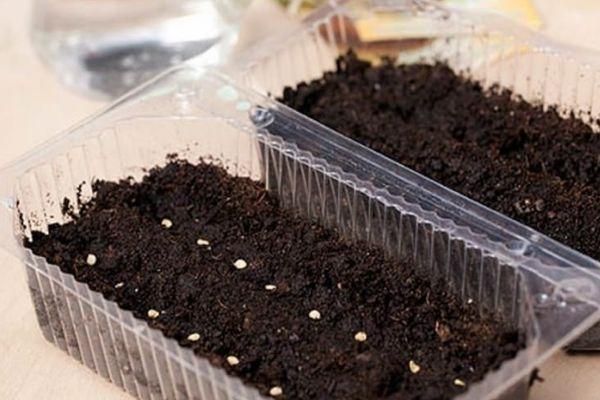
Before sowing, the prepared substrate, right in the box, should be generously soaked with a hot solution of potassium permanganate (dark pink). Sowing occurs after the soil has cooled. The seeds should be planted to a depth of no more than 0.5 cm, otherwise the seedlings will take a long time to emerge and will be weak. Cover the boxes with glass and place them in a warm place. At a temperature of +25°C, tomatoes will germinate in 4-5 days.
Seedlings are transplanted into individual pots or boxes, spaced 10 cm apart. If natural light is insufficient, small plants will require supplemental illumination with phytolamps. Seedling care consists of regular watering. Plant 3-4 plants per square meter.
Related posts:
 Description of the best varieties of black tomatoes for open ground and greenhouses
 The best eggplant varieties for growing in a polycarbonate greenhouse: planting and care
 Description of the best tomato varieties for open ground in the central zone
 What varieties of tomatoes are best to plant in a polycarbonate greenhouse?
 The best tomato varieties for growing in the Leningrad region for greenhouses and open ground
 Methods for planting and propagating cherries at home
 The best and most productive tomato varieties for greenhouse cultivation in the Urals, with descriptions
 Description of the best tomato varieties for open ground and greenhouses in the Krasnodar region