
Gardeners who have decided to plant tomatoes outdoors may be interested in the General f1 tomato. Currently, breeders around the world are expanding the range of vegetables and fruits with new hybrids. It's well known that tomatoes don't grow in the same conditions: some require cold, while others prefer warmth. Let's take a look at the General variety.
Description of the General tomato
Characteristics and description of the variety:
- General f1 tomatoes were developed by Japanese breeders.
- Plants of this variety are determinate, meaning they self-limit their growth after the first inflorescences appear.
- In the Russian Federation, these tomatoes can be planted in any region, in open ground and in greenhouses.
- This early-ripening variety matures in 107–110 days from seeding. The bushes reach only 60–70 cm in height.
- The color of the bushes and leaves is dark green, with pubescence.
- Numerous shoots form 4-6 inflorescences, from which a bunch of tomatoes later grows.
- There is no need to remove side shoots from plants.
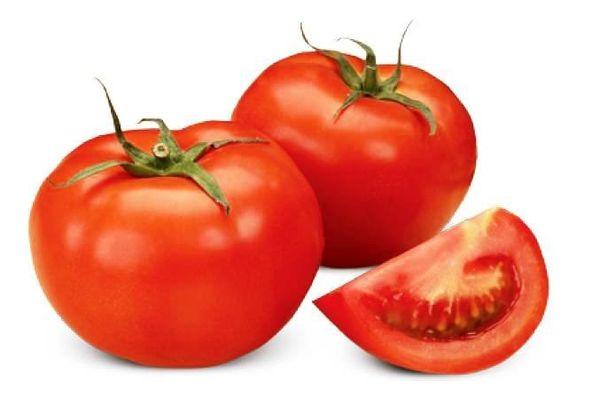
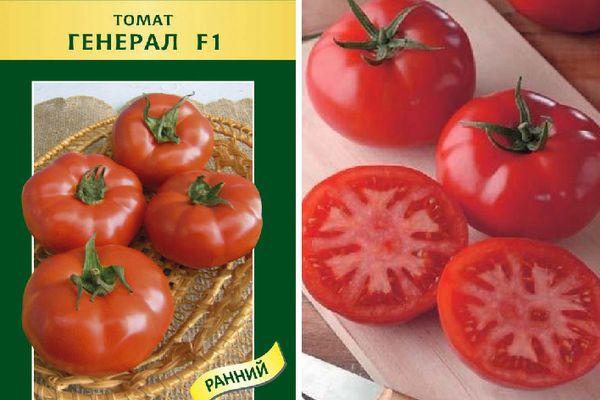
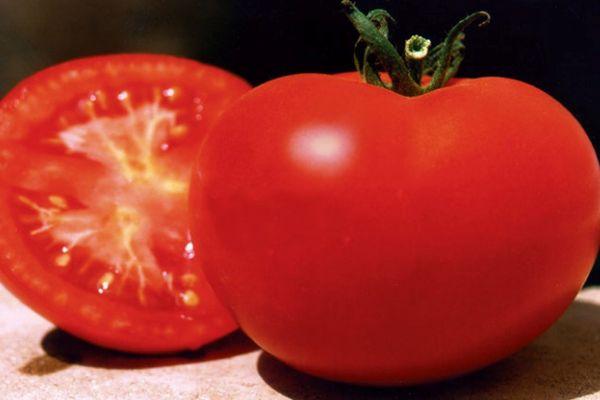
The average tomato weight is 220–250 g, sometimes reaching up to 280 g. The fruit is round, slightly flattened, and bright red in color, without any blotches or spots.
When you cut a tomato, you can see that the vegetable has many chambers, few seeds, and uniform, fleshy, and juicy pulp.
The tomato skin is dense and doesn't crack in the sun or during transportation. Furthermore, General tomatoes have an excellent marketable appearance.
The fruit's flavor is truly tomato-like, with a slight tartness. The juice's dry matter content is approximately 6.6%.
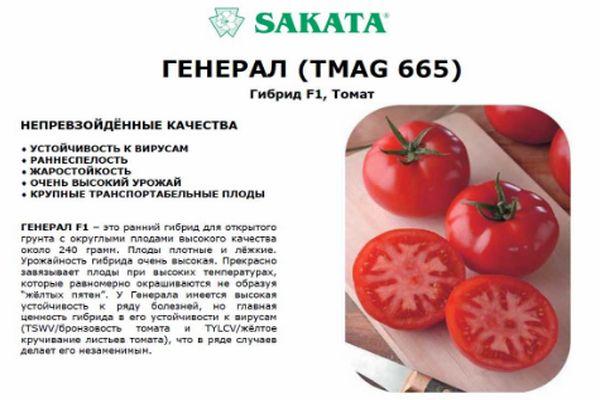
So, judging by the variety's characteristics and reviews from gardeners, this vegetable is suitable for whole canning, making tomato paste, juice, lecho, salads, and, of course, eating raw. The variety yields up to 12 kg per square meter.
Let's consider the pros and cons of this variety. The pros include:
- High yield.
- Simultaneous ripening of bushes.
- Stability during transportation.
- Attractive appearance.
- Strong immunity to viral and fungal diseases: verticillium wilt, fusarium wilt, leaf bronzing.
The disadvantages include:
- Insufficiency to late blight disease.
- The quality of the variety is unstable when planting a hybrid the following season, so you will have to buy seeds every year.
How to Grow General Tomatoes
Let's look at how to grow the General tomato and describe the necessary agricultural practices. Due to its susceptibility to late blight, it is not recommended to plant the seeds outdoors.
The description of the Red General tomato states that its plants are determinate and early-ripening. By the time they are transplanted into the ground, they should be 1–1.5 months old and have been hardened off for 1–2 weeks.
In regions with a temperate climate, seeds are planted indoors beginning in late March to mid-April.
Tomato tools should be clean and preferably treated with a weak solution of potassium permanganate (potassium permanganate).
Pricking out is done after the first 3-4 true leaves appear. The soil where the tomatoes will be planted is fertilized with manure or compost and watered with a saturated solution of potassium permanganate to prevent many plant diseases.
Germinated seeds in seedling boxes are covered with plastic wrap to achieve a greenhouse effect. The transplanted plants require periodic loosening of the soil to improve oxygen supply to the roots and, consequently, their growth.
1-2 weeks before transplanting into the garden, seedlings need to be hardened off: take them outside for a while, ventilate the room. When planting seedlings, it's important to pay attention to the stems of the bushes. They should be strong and sturdy, as shown in the photo below.
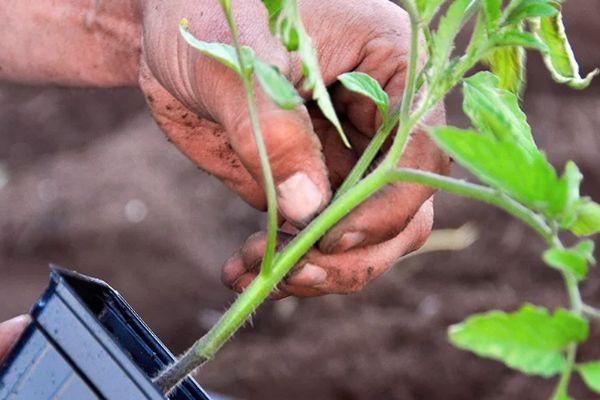
The soil for transplanting should be warmed by the sun, fertilized with organic fertilizers (usually compost), and rested from previous plantings, especially from potatoes, eggplants, and zucchini.
The distance between bushes should be 40-70 cm, and since the plants are small, you can plant 1-2 bushes together.
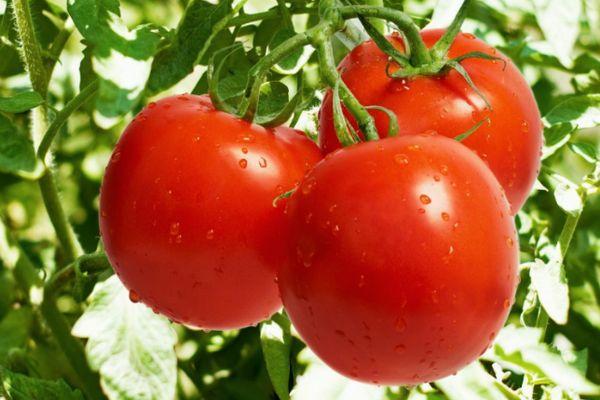
Tomatoes need to be fed 3-4 times per season with inorganic fertilizers containing nitrogen, potassium, and phosphorus. Watering thoroughly, weeding, loosening the soil, and hilling are frequent processes during the growing season.
During the breeding season, pest beetles and aphids should be controlled. However, it's best to do this before the fruit appears.
General F1 tomatoes are receiving positive reviews. Everyone who has reviewed them says this variety has a high yield, a slightly tart flavor (though not everyone likes it), and a wide range of uses. The fruits can be preserved, used to make lecho, adjika, winter salads, and tomato juice. Photos of the tomatoes can be found online.
Related posts:
 Tomato variety Bravy General, fruit characteristics, cultivation
 Description of the best varieties of black tomatoes for open ground and greenhouses
 Description and characteristics of the best tomato varieties for outdoor cultivation in the Urals
 The best and most productive tomato varieties for greenhouse cultivation in the Urals, with descriptions
 What varieties of tomatoes are best to plant in a polycarbonate greenhouse?
 TOP 17 recipes for pickled sweet tomatoes for the winter
 Description and characteristics of the best seeds of pea varieties and types
 Delicious recipes for canned tomatoes with honey for the winter, preparation steps