
Every vegetable grower chooses nightshade varieties to suit their tastes, and many prefer large, high-quality tomatoes like the Lopatinsky tomato. Despite the common misconception that larger tomatoes have inferior flavor, this variety is extremely popular and completely disproves that assumption.
The Lopatinsky tomato variety has received excellent reviews from those who have grown it in their gardens. It is described as a hardy and robust plant, resistant to many fungi, weather-resistant, and consistently producing a high yield.
The Lopatinskie tomato variety can be grown outdoors, in a greenhouse, or in a hothouse. The plant tolerates temperature fluctuations and short-term droughts well.
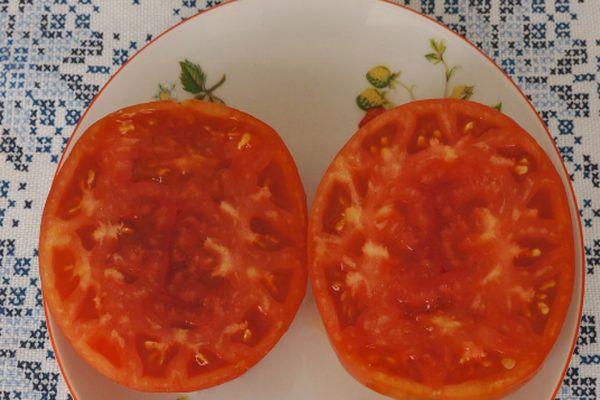
Advantages of the variety
The description of the variety includes the following information:
- Lopatinsky tomatoes are indeterminate. The bushes reach a height of 0.8-1 m. Mature plants require additional support and staking, as they grow and develop as vines.
- Requires training into 2-3 trunks. This will help increase yield and improve the quality of the tomatoes. Gardeners recommend pinching out the side shoots of the plant, which will increase the number of clusters.
- The variety is mid-season, the first fruits appear 115 days after the first shoots.
- The bush has a strong root system. The foliage is dense and large. The branches are long and wide, often lying on the ground. They need to be tied up.
- The plant is hardy and easy to care for, easily adapting to weather changes without dropping fruit. Gardeners who have grown this tomato note that it is tolerant of soil but requires regular fertilization.
- This tomato variety is resistant to late blight and tobacco mosaic. It requires pest control spraying.
- The Lopatinskie variety produces excellent yields. A single plant yields 10 kg of tomatoes per season. The plants bear fruit continuously, virtually without interruption.
- Tomatoes store for about 1-1.5 months. They ripen best when semi-ripe. Gardeners prefer to pick them at the ripening stage, when they turn a milky color.
- The Lopatinskie tomato variety requires regular watering during the fruiting period. This is due to the tomato's size and volume.
- The taste is rated as excellent. The tomatoes contain a sufficient amount of sugar and dry matter, and have a bright tomato aroma. The flavor is distinct, with moderate acidity.
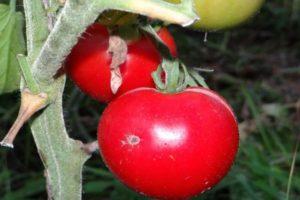
The Lopatinskie variety is suitable for all-purpose use. A homemaker who has already planted these tomatoes in her garden appreciates their quality and says she will continue to grow them.
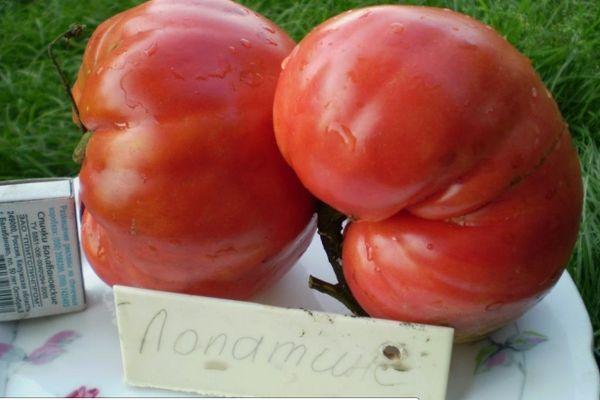
Fruit characteristics:
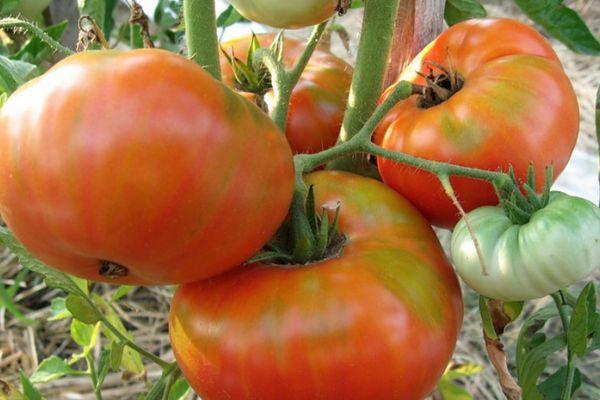
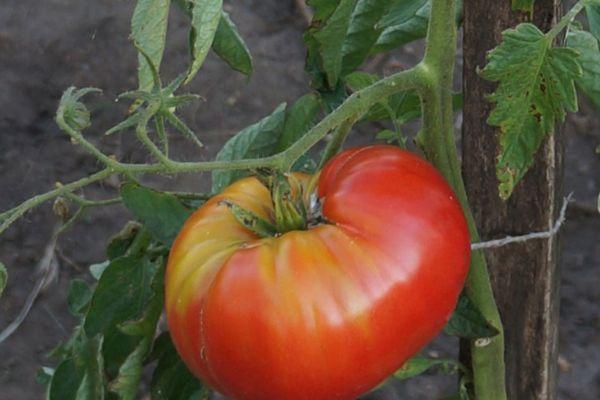
- The fruits are large. With proper cultivation practices, a single tomato can weigh up to 700-800 g.
- The tomatoes are round in shape, but slightly compressed at the top and bottom.
- The color is deep red. There are inclusions and barely noticeable stripes of light yellow or green hues extending from the stem.
- The tomato pulp is dense, juicy, and contains several chambers with small seeds.
- The skin is thick, but at the same time easy to remove from the fruit.
- The fruits are smooth with noticeable ribbing.
- Suitable for long-distance transportation.
- Tomatoes ripen gradually. Each cluster produces about 4-5 large tomatoes.
In order for tomatoes to gain juice and flavor, they need enough light and do not require additional shade.
Agricultural technology of tomatoes
Tomatoes are grown using seedlings.
Sowing is carried out 60-65 days before planting in open ground or a greenhouse.
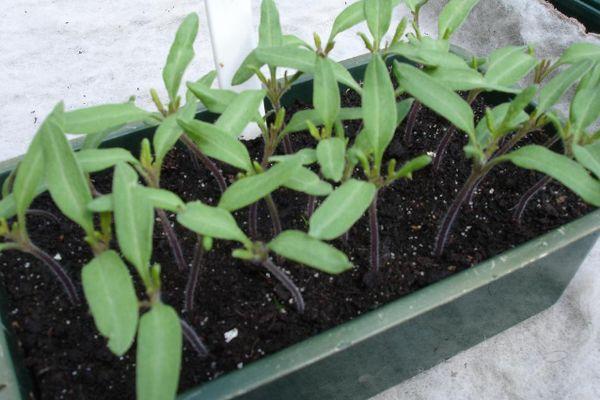
Before planting, seeds should be disinfected with a weak solution of potassium permanganate. Soak them in the solution for 30 minutes, then lay them out on a sheet of paper and dry in sunlight. A growth stimulant can be used before planting.
The soil for seedlings must be nutritious, so the soil should be mixed with peat and sand. All components are taken in equal quantities.
The seeds are planted 2 cm deep in the soil and immediately watered with warm water. The seed tray is covered with plastic and stored in a room with a temperature of at least 20°C. As soon as the first sprouts emerge, the plastic is removed and the tray is moved into the light. It's important for young shoots to be warm and receive plenty of sunlight. Pricking out occurs when the sprouts develop two leaves.
The seedlings are planted in the beds according to the following pattern: 50 cm between holes and 70-75 cm between rows. After 10 days, the seedlings are fertilized. Water the plants as needed, preferably using settled water. Regularly loosen the soil and weed the beds.
Related posts:
 Description and characteristics of the best indeterminate tomato varieties for greenhouses
 Description of the best tomato varieties for Transbaikalia, their planting times and care
 Description of the best tomato varieties for pickling and canning
 Description of blight-resistant tomato varieties for open ground and greenhouses
 Description of the best Dutch tomato varieties for greenhouses and open ground
 Description of the best varieties of black tomatoes for open ground and greenhouses
 Description of the best tomato varieties for greenhouses in the Kirov region
 Which tomato varieties are best for open ground?