
The Red Sugar Plum tomato was developed by Russian breeders. The variety was added to the State Register of the Russian Federation in 2008 for cultivation throughout the country. The manufacturer recommends growing tomatoes in greenhouses and hotbeds, but does not deny the possibility of obtaining a good harvest in open ground. Farmer reviews indicate that this tomato has a high survival rate, a good marketable appearance, excellent taste, and is versatile in cooking.
Characteristics and properties
This semi-determinate variety has a limited trunk growth. Its height, depending on weather and care, ranges from 120-140 cm. The stem is dense and strong, bending well. The root system is extensive and deeply buried. The foliage on the crown is dense, with medium-sized, bright green leaves.
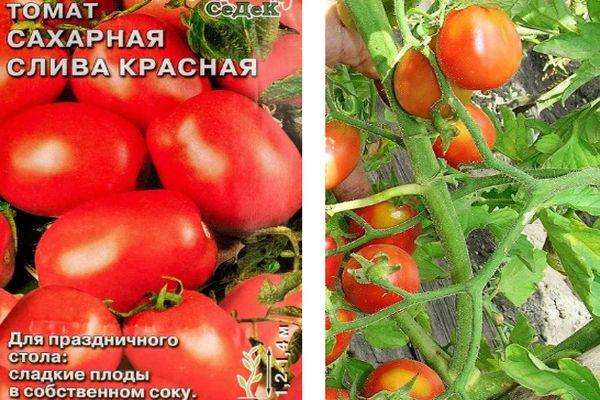
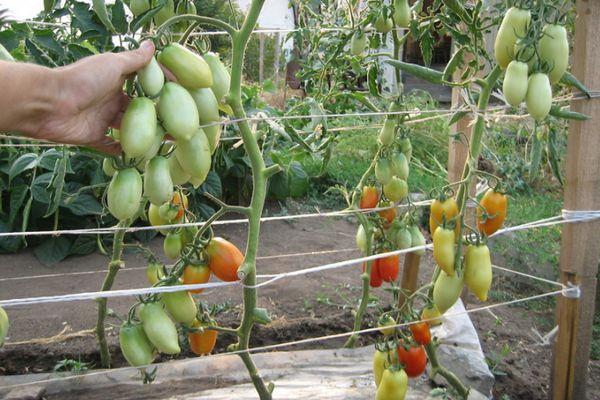
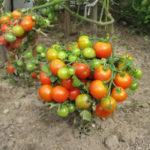
The fruits are elongated, oval, and perfectly shaped, growing in clusters. Each bunch produces 5-7 berries. They measure up to 5 cm in length and 3-3.5 cm in diameter. They average 20-25 g. The tomatoes are sweet with a slight tartness. The flesh is dense and uniform, free of white specks. The skin is deep red, firm, thin, and resistant to cracking. Under favorable conditions, the yield per bush reaches 1200-1300 g. Farmers can harvest up to 10 kg of beautiful and delicious tomatoes per square meter.
The ripening period is 105-110 days, with fruiting lasting until mid-autumn. The "Yellow Sugar Plum" variety of this tomato is distinguished by its earlier first harvest. Tomatoes can be harvested as early as 84-90 days after germination. As they ripen, the tomatoes turn yellow.
Both varieties of tomatoes have a wide range of uses. Early berries are in high demand at markets when fresh vegetable options are limited. Tomatoes are served whole, in salads, and sliced. The fruits are well-suited for canning in regular jars and small-mouth containers. The harvest is used for juice, lecho, pasta, and sauce.
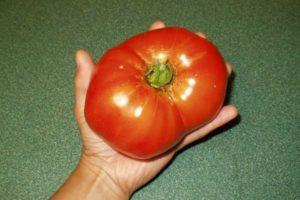
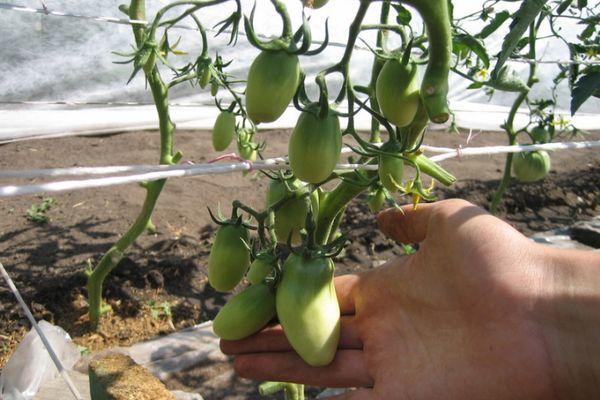
The fruits are transportable and can be stored for up to three months. To do this, they are stored in a dark, cool, and well-ventilated cellar. In these conditions, they retain their marketable appearance until New Year's and serve as a true centerpiece for the table.
Advantages and disadvantages of the variety
Tomatoes are grown in private households, on small farms and large agricultural firms.
Farmers note the following advantages of Sugar Plum tomatoes:
- A refined taste that almost everyone loves. The fruits are rich in nutrients, minerals, and vitamins.
- Attractive appearance. The small, neat fruits look beautiful and appetizing.
- The ability to create an original assortment of red, yellow and raspberry berries.
- Versatile in terms of culinary use, tomatoes are eaten fresh, processed, and canned.
- Good shelf life of ripe tomatoes. This property is used for long-term storage and transportation of tomatoes to areas with high demand.
- Early and uniform ripening. With proper planting and care, the first tomatoes will appear abundantly and densely on the bushes as early as early June.
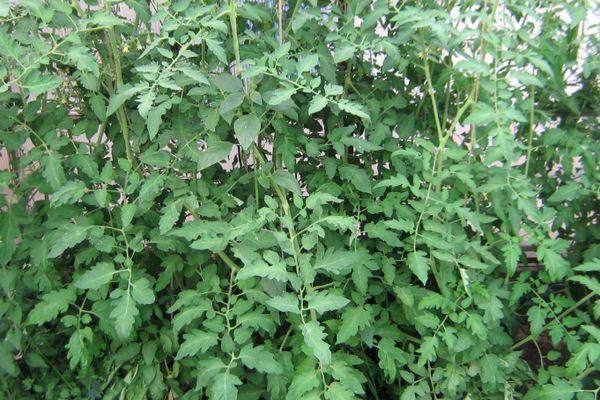
The variety does have its drawbacks, the main one being its low immunity to infectious and fungal diseases. Growing tomatoes requires staking the stems and regularly removing side shoots. Tomatoes are sensitive to moisture and soil acidity. Watering and fertilizing should be done sparingly.
Growing and care
Seeds are planted in the second ten days of March. After disinfection, they are planted in the soil to a depth of 1-1.2 cm. For small quantities of seeds, peat pellets can be used. For large quantities, it's best to use pots filled with fertile soil with expanded clay drainage. Cover the containers with plastic wrap and place them in a warm room.
Newly emerged seedlings require warmth and ample light. It's best to place the pots on a windowsill. If natural light is insufficient, supplement with fluorescent lamps. Maintain a constant temperature of 22 to 23°C. After the first two leaves appear, the seedlings are pricked out. A week before transplanting into the garden, harden off the plants by gradually lowering the air temperature and increasing the time spent outdoors. Transplanting occurs when the stems have 5-7 leaves.

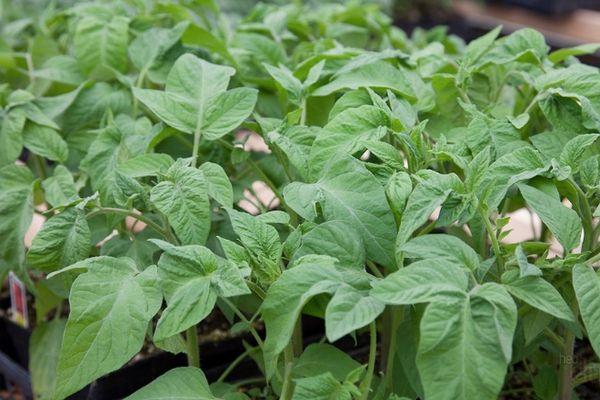
Preparing the beds involves adding drainage, ash, charcoal, calcined sand, and fertilizer to the soil. It is recommended to sprinkle an insecticide solution around the holes to protect the plant roots from pests. Eight to nine plants are planted per square meter of bed. They are immediately secured to stakes or tied to a trellis. This process is repeated as the stems grow.
Depending on the weather and temperature, water the bushes 2-4 times a week. In extreme heat, water daily. Watering should be done with well water that has been allowed to settle for a day, after sunset.
Fertilizer should be applied monthly. During stem and crown formation, it's advisable to use ammonium nitrate and magnesium sulfate. After ovary formation, a solution of mullein or bird droppings should be added to the soil. Plant care includes weeding, mulching, pest control, and periodic spraying with disinfectant solutions.
To protect bushes from fungal diseases, you must follow these rules:
- do not plant seedlings too densely;
- provide sufficient lighting;
- do not allow the soil to become oversaturated with fertilizers;
- Provide moderate watering and good ventilation.
It is important to remember that if signs of disease are noticed on one plant, it should be replanted so as not to expose the remaining bushes to infection.
Related posts:
 Description of the best varieties of black tomatoes for open ground and greenhouses
 The best eggplant varieties for growing in a polycarbonate greenhouse: planting and care
 What varieties of tomatoes are best to plant in a polycarbonate greenhouse?
 The best grape varieties for growing in the Urals, planting and care rules in summer
 80 Best Eggplant Varieties for Different Regions with Descriptions and Characteristics
 Description of the best tomato varieties for open ground in the central zone
 What are standard tomatoes, description of varieties and cultivation
 The best tomato varieties for growing in the Leningrad region for greenhouses and open ground
Many people grow this particular tomato variety; it's well adapted to our climate and grows beautifully even in open ground. For fertilization, simply use "BioGrow".
Many people grow this particular variety of tomato; it is well adapted to our climate.