
The hybrid tomato "Golden Mother-in-Law" has been included in the Russian State Register since 2008 and has already found a following among vegetable growers. This popular variety can be found in any region of the country, producing equally well in southern Russia, Siberia, and the Urals. Its fruits are distinguished by their beautiful color and valuable nutritional properties.
General description of the plant
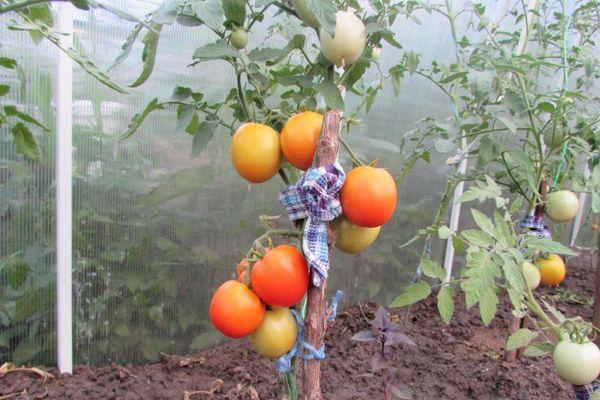
Zolotaya Teshcha (Golden Mother-in-Law) tomatoes are determinate and self-top after 5-6 clusters have formed. The bushes are vigorous, reaching a height of about 0.8 m even in open ground. They need to be tied to a support or trellis and trained. This variety can be grown in open ground and greenhouses throughout Russia.
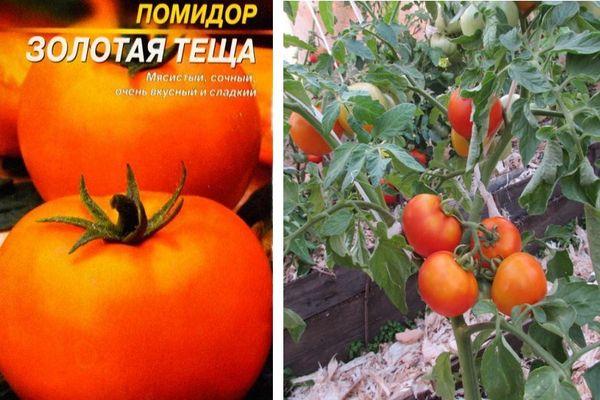
To ensure a good harvest, Zolotaya Teshcha F1 tomatoes are recommended to be grown in 2-3 stems. To achieve this, shoots appearing after the first and second flower clusters are left behind. The remaining shoots are removed as they grow. A properly trained bush yields 6 kg of marketable produce.
A hallmark of modern tomato varieties is their high disease resistance. This trait is also characteristic of the Zolotaya Teshcha hybrid. It is resistant to fusarium and macrosporiosis, and by the time late blight pathogens appear, it has almost completely finished fruiting.
 To prevent late blight in cold summers with constant rain, you can remove some of the lower leaves, allowing the plantings to be better ventilated so that the yield of the bushes does not decrease due to losses.
Fruits of the Golden Mother-in-Law
The Zolotaya Teshcha F1 variety is an early-ripening hybrid. The first fruiting begins 85-90 days after germination. Mass harvesting begins two weeks after the first ripe tomatoes appear.
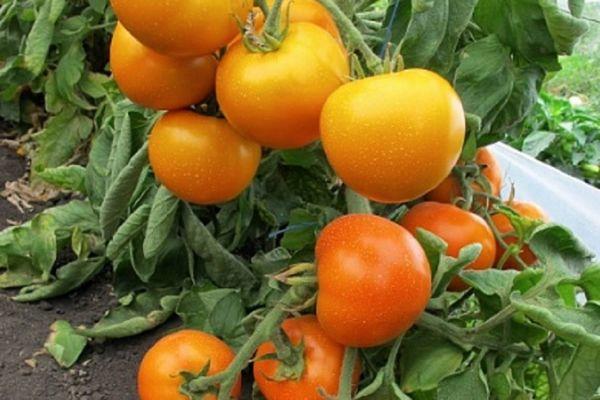
The State Register description notes complex, sometimes double, clusters. Each cluster produces 6-7 rounded, slightly ribbed ovaries. All fruits on the cluster ripen and mature almost simultaneously. The average weight of a single berry is 200-220 g.

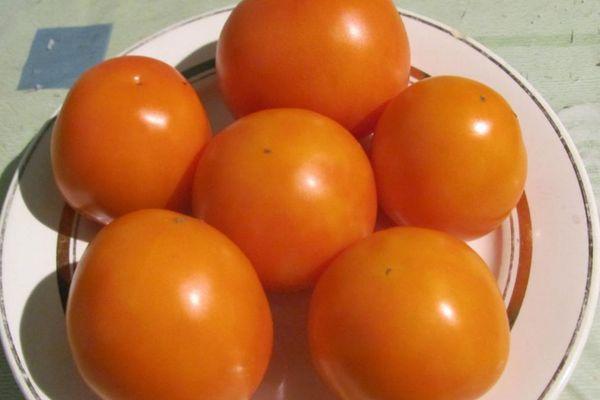
The skin is thin but strong. Tomatoes are not prone to cracking in excess moisture. This allows for the complete preservation of the harvest and the harvesting of tomatoes of at least average quality.
Unripe tomatoes in the milky stage ripen well at room temperature. To speed up the process, add a few ripe tomatoes to the box with the unripe ones.
The fruit color at biological maturity is orange-gold, glossy, and very decorative. Unripe tomatoes are pale green. There is no spot near the stalk.
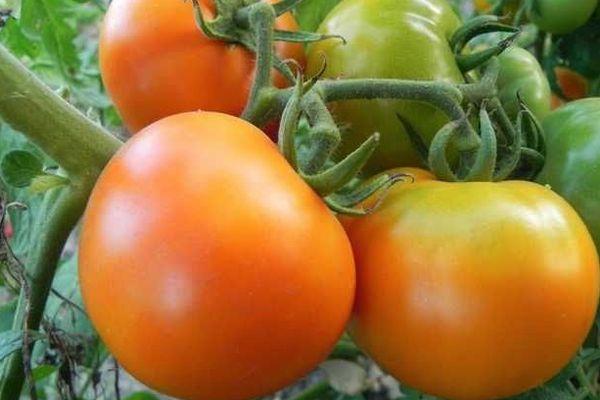
The flesh is firm, meaty, and juicy. Seed chambers may be empty, as the hybrid produces seeds poorly. The tomatoes have excellent shelf life, yield, and transportability, which is especially valuable for early varieties grown for commercial use.
The taste of Zolotaya Teshcha berries is highly rated. Gardeners' descriptions and characteristics of the variety indicate that the tomato may become more tart in colder seasons. Tomatoes grown in a sunny, well-heated area are sweet, with a slightly tart undertone. The aroma is classic and not overly strong.
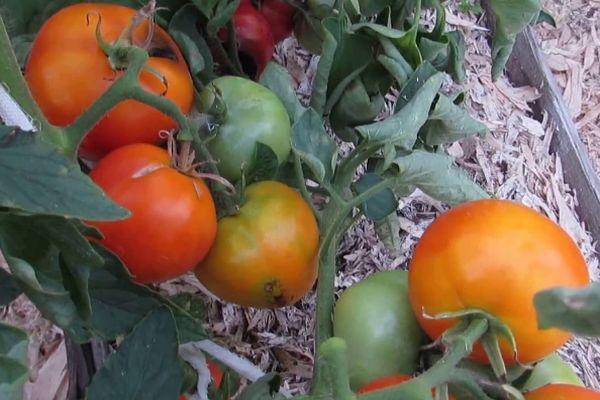
Orange tomatoes are distinguished by their high beta-carotene content. They are especially beneficial for children and are recommended for dietary nutrition. Zolotaya Teshcha tomatoes have reduced allergenicity (compared to red tomatoes) and contain high amounts of lycopene and protein.
This variety is best eaten fresh. The bright orange flesh adds a touch of color to any salad or platter. These tomatoes can be used as sandwich and hamburger slices, or as a garnish for appetizers.
Small berries are ideal for whole-fruit canning. Their firm flesh retains its texture well when pickled or marinated, and their strong skin resists cracking during cooking. These tomatoes make delicious, uniquely colored juice or sauce.
How to grow a good harvest
To obtain high-quality seedlings, seeds should be sown 50-60 days before the expected planting date. The soil for growing them is prepared from equal parts garden soil, sand, and humus, adding 2 tablespoons of ground chalk or dolomite flour for every 10 kg of soil. The soil is disinfected by baking it in the oven or soaking it in a hot solution of potassium permanganate.
Sow the seeds in well-watered soil, spreading them out over the surface. Cover the seeds with a thin layer (0.5 cm) of dry soil or sand. Cover the seed trays with plastic wrap and germinate in a warm place (+25°C). Under these conditions, high-quality seeds germinate uniformly within 4-5 days. Then remove the plastic wrap.

When 2-3 true leaves appear on the bushes, the tomatoes should be transplanted into 10x10 cm pots or into individual pots. Further care consists of timely watering. The soil in the container should not dry out. Water as soon as the top 0.5-1 cm of soil dries out.
Plant outdoors after the spring frosts end, in late May or June. Greenhouses can be planted 2-3 weeks earlier. Plant 4-6 bushes per square meter.
Gardeners' reviews indicate that two feedings are sufficient for tomatoes. The first is done 10-14 days after planting, and the second when the first flowering cluster has formed. Complex mineral mixtures for tomatoes (Agricola, Kristallon) are used for feeding.
Related posts:
 Description of the Goldfish tomato with decorative fruits and features of agricultural technology
 What varieties of tomatoes are best to plant in a polycarbonate greenhouse?
 Description of the best varieties of black tomatoes for open ground and greenhouses
 Characteristics and description of the Golden Bullet tomato, tips and reviews about the variety
 Description of the Golden Drop tomato and growing guidelines for the indeterminate variety
 Description and characteristics of the best tomato varieties for outdoor cultivation in the Urals
 Description of yellow tomatoes Golden Brush and growing rules for the variety
 Characteristics of the tall tomato Golden Canary and cultivation techniques