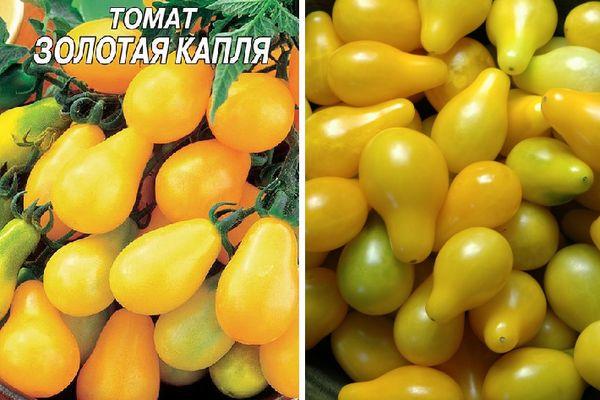
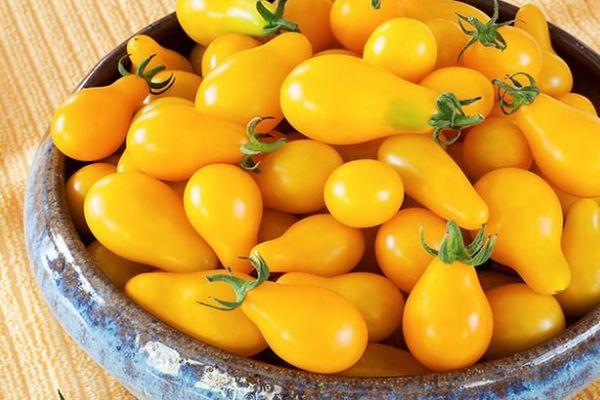
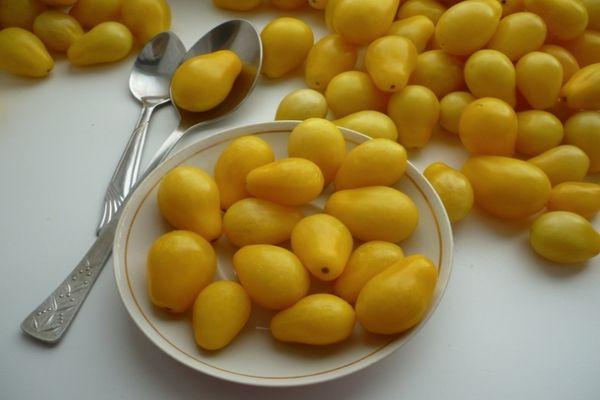
The Golden Drop tomato gets its name from its bright yellow, pear-shaped fruit. The Golden Drop variety was bred in Russia to suit our climate and growing conditions. Therefore, it is suitable for planting in any region of the country. It can be grown in plastic and glass greenhouses, and in warmer climates, in open ground. The variety description and photos suggest why the Golden Drop tomato is so beloved by gardeners and farmers.
What is the Golden Drop tomato?
Characteristics of the variety:
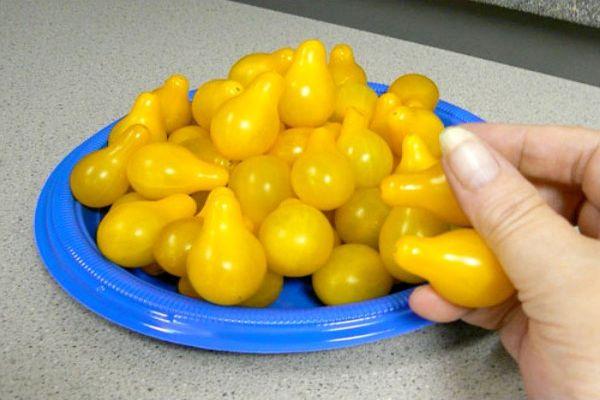
- These are small, teardrop-shaped tomatoes with a sunny color. They are very tasty (they are pickled and added to salads).
- This type of tomato is an indeterminate plant.
- They can reach 190 cm in height. This variety has a very powerful root system, and the stems are strong and branched.
- The plant has a moderate number of leaves, all of which are dark green.
- The fruits form in large clusters, each bearing 10-12 ripening tomatoes. The yield is quite good: up to 5 kg of tomatoes can be harvested from 1 m².
- Only yellowed fruits are plucked from the branches. Each tomato weighs approximately 25-40 g.
- Even in the photo you can see the smooth and dense skin of the tomatoes, which never cracks.
Features of cultivation
When additional shoots (side shoots) appear, they must be removed to ensure that all the strength and nutrients go to the fruit, not the leaves. Since the plant is very tall, it must be tied and supported as it grows. Like other tomato varieties, water only the root system, avoiding the leaves and stems, as moisture can cause them to darken and rot.
If you've decided to plant Zolotaya Kaplya tomatoes, you'll need to sow the seeds in the second half of March. It's recommended to treat them with a growth stimulant before planting. Small containers are used for sowing the seeds. They should be planted at a shallow depth, lightly misting the soil with water and covering the container with plastic wrap.

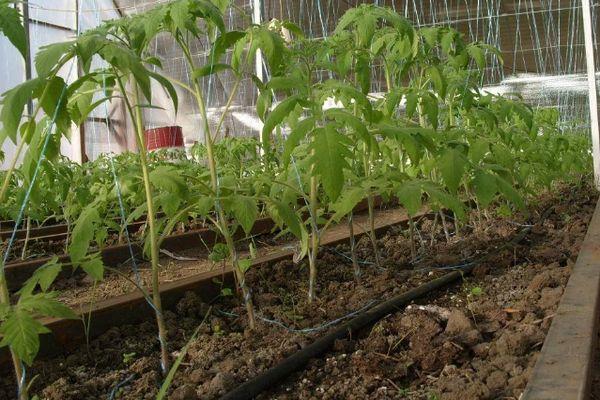
Until the sprouts appear, the container should be kept in a warm place, and then the seedlings are moved to a bright spot. Once the plants have strengthened a bit, they are transplanted to their permanent location.
When grown outdoors, tomatoes require fertilizing every two weeks using a mineral fertilizer or mullein. Ripening occurs two months after planting.
Although this plant variety is highly resistant to various diseases, care should be taken to prevent mold and mildew from developing. It is necessary to monitor the air humidity, which should be low.
To achieve this, the room where the tomatoes are planted should be frequently ventilated. To protect the plants from rot and disease, spray them with phytosporin or a weak solution of potassium permanganate as a preventative measure.
If you accidentally spot insect pests in the soil, use insecticides (chemicals), onion peel decoction, or celandine. Ammonia is suitable for killing slugs, and soapy water is good for aphids.
The Beefseller Pink F1 (M-12) tomato grows up to 2 m in height. These tomatoes are easily recognizable by one characteristic: their slightly elongated top (a small "nose" can be seen in the photo). The fruits grow quite large. Each tomato weighs between 250 and 400 g.
The harvest can be completed 3-3.5 months after germination. The fruits have a very pleasant sweet and sour taste.
The plant is grown and cared for in the same way as other varieties. The only important characteristic is that it should be formed into a single stem, requiring the removal of all side shoots.
Forum members' reviews of modern tomato varieties are mostly positive. When choosing and purchasing seeds, they recommend paying attention to the packaging; the photos accurately reflect the actual seeds.
Related posts:
 The best grape varieties for growing in the Urals, planting and care rules in summer
 Description of the best varieties of black tomatoes for open ground and greenhouses
 80 Best Eggplant Varieties for Different Regions with Descriptions and Characteristics
 What varieties of tomatoes are best to plant in a polycarbonate greenhouse?
 Description of the best tomato varieties for pickling and canning
 Description and characteristics of the best indeterminate tomato varieties for greenhouses
 Description of blight-resistant tomato varieties for open ground and greenhouses
 A review of the best tomato seed varieties for open ground in the Rostov region