
- The purposes and uses of blackberry pruning
- Shoot normalization
- Trimming and pinching
- Removing the growth
- Crown formation
- What you will need
- Timing and specifics of the procedure
- In the spring
- In summer
- In the fall
- Correct formation of different types of blackberries
- For a remontant look
- For creeping varieties
- For upright varieties
- Pruning thornless blackberries
- How to care for the plant after
- Methods of garter
- Fan-shaped
- Ropeway
- Wave
- Possible errors when pruning
Blackberries have quickly gained the respect of gardeners and homesteaders, captivating them with their taste, productivity, nutritional value, and berry size. This is no surprise to anyone who has ever seen a mature, fruit-bearing bush. But to achieve a high yield, simply planting them requires more than just proper training. Gardeners need to know why, when, with what, and how to prune garden blackberries.
The purposes and uses of blackberry pruning
Blackberries, except for everbearing varieties left for a second fruiting, produce fruit on two-year-old, overwintered shoots. Once the fruit has been produced, it only drains the blackberry bush, preventing the young stems from developing effectively, and generally thickening the plant.
All of this can lead to disease outbreaks, reduced fruit size, and overall yield. Therefore, gardeners prune old stems and root suckers. This procedure will also help limit shoot growth and properly shape the bush, depending on the variety's characteristics.
Shoot normalization
This procedure involves removing unnecessary stems after fruiting, as they only hinder the plant's further development. Thinning is also performed: all excess shoots are trimmed, leaving 6-10, depending on the blackberry variety and vigor.
This is done to ensure that the bush is not overloaded with the harvest, as this will affect the size of the fruit and its quality.
For example, the thorny, creeping variety Karaka Black leaves behind significantly fewer shoots than the thornless Loch Tay. This affects the future harvest and the ease of picking.
Trimming and pinching
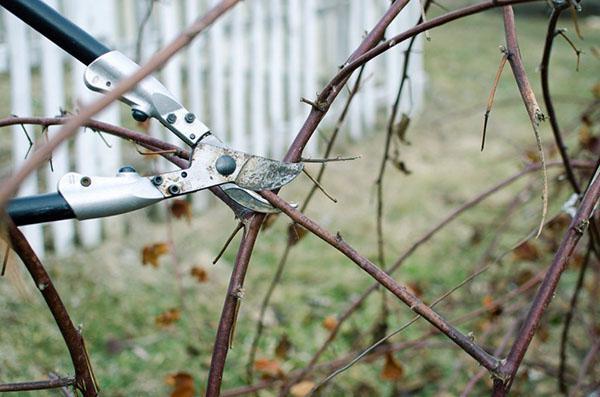
Gardeners call shortening blackberry shoots "pinching." This agricultural practice is used to increase yield by increasing the number of fruiting branches (laterals). Pinching is especially important for upright, thornless varieties (Apache, Navajo) and everbearing varieties (Prime Arc Freedom, Prime Arc Traveler).
This is done in the spring, by pruning old overwintered shoots to a height of 80-120 centimeters. In double pruning, the lateral shoots growing on them are shortened to a length of 40-50 centimeters. Young shoots are pruned in the summer.
Removing the growth
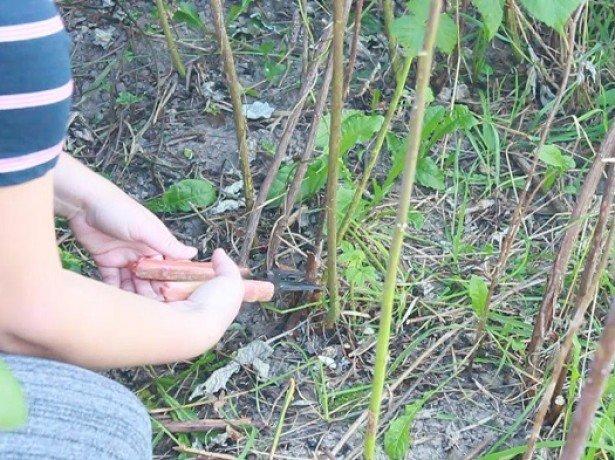
Many blackberry varieties actively produce root suckers, especially when the roots are damaged. These young suckers grow quite quickly, leading to denser growth. Furthermore, they drain the main blackberry bush's energy. Therefore, it's important to carefully loosen the soil around the trunk, being careful not to damage the roots. If the suckers regrow, simply cut them off completely with pruning shears.
Crown formation
The nuances of blackberry pruning depend primarily on the species. Crown shaping must take into account the characteristics of each variety:
- dewberries (creeping varieties): Loch Tay, Asterina;
- bramble (upright varieties): Navajo, Apache;
- intermediate forms: Triple Crown, Osage, Kiowa;
- remontant varieties (they belong to the upright blackberry family): Black Magic, Prime Ark, Prime Ark Freedom, Prime Ark Traveler.
What you will need
Pruning blackberries requires sharp pruning shears. Flat pruning shears and even simple kitchen shears are suitable for shaping the crown and shortening thin branches, while bypass pruning shears (spring, ratchet, and anvil) are used for trimming thick stems.

Timing and specifics of the procedure
It's important to adhere to the correct pruning timing for blackberries. They have a high growth rate, so it's important to begin shaping them before the stems become too overgrown.
In the spring
During this period, a general inspection of the bush is carried out, identifying shoots that have frozen, dried out, or are diseased after winter. Once the threat of severe frost has passed, all of these are removed by cutting them down to the ground. Healthy, firm stems of a green or brown color are left. After new leaves appear on the stems, old ones should be trimmed off, as they harbor pathogens.
In summer
In summer, all excess shoots should be regularly pruned, leaving 6-10 per bush, depending on the variety and growth rate, as well as root suckers that drain the plant's energy. In July, stems are also shaped and trimmed to length. In August, all fruiting shoots are cut back to the ground to prevent them from draining the blackberry plant's energy. Summer pruning, either single or double, of young shoots is performed to increase yields for the following season.
In the fall
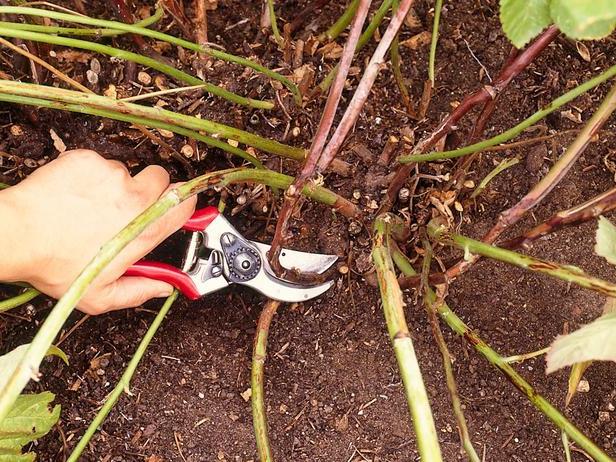
In the fall, spent shoots are pruned from mid-season and late-season varieties, and a sanitary cleaning is performed in preparation for winter. After harvesting, fruiting blackberries should be prepared for shelter, trimming any overly long shoots to ensure easier and better wintering.
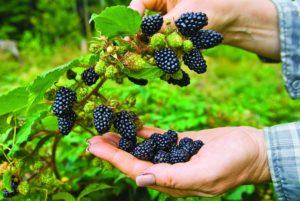
On remontant varieties (Prime Arc, Prime Arc Freedom, Black Magic), stems that have borne fruit are cut down to zero if the goal is not to obtain a harvest from them in the new season.
Correct formation of different types of blackberries
Different types of blackberries (dewberry, cloudberry, and intermediate forms) have their own nuances in pruning and crown shaping that the gardener needs to take into account.
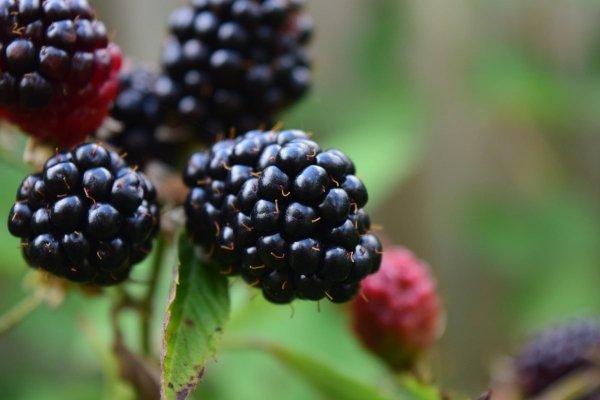
For a remontant look
Everbearing varieties yield less than regular blackberries. To increase yield, single or double pruning is used. For example, as with the Black Magic and Prime Ark Freedom varieties.
With single pruning, young, powerful shoots are shortened at a height of 0.8-1.2 meters.
Once the shoots are doubled, the lateral branches growing on them are pruned when they reach a length of 50-60 centimeters. If the goal is not to produce a second harvest on overwintered shoots, they are pruned back to the ground in late fall or early spring, for example, like everbearing raspberry varieties.
For creeping varieties
Pruning trailing blackberry varieties (such as Loch Tay) involves reducing the number of shoots (leaving 8-10), shortening them when they reach a length of about 3 meters, and regularly cleaning them. Trailing thorny varieties (such as Black Butter and Karaka Black) are pruned as little as possible to prevent the growth of spiny side shoots.
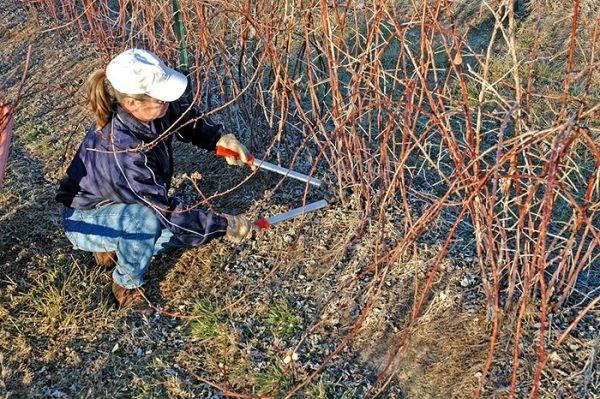
For upright varieties
Six to eight of the strongest shoots are left for fruiting, with the rest regularly pruned to the ground. Thornless blackberries retain a slightly larger number of shoots than thornless varieties. Upright varieties typically don't have their shoots pruned, but rather receive sanitary pruning, such as 'Navajo' and 'Apache'.
Pruning thornless blackberries
Thornless blackberries are much easier to prune than thornless varieties. Moreover, on thornless varieties, shoots are pruned lengthwise, which encourages vigorous side growth. On thorny varieties, especially trailing ones, this type of pruning can make harvesting difficult.
How to care for the plant after
After pruning the shoots, the blackberry bush requires more careful care, consisting of the following steps:
- inspection of cut shoots and tying them to the trellis wire or supports;
- When pruning thick shoots after the sap has begun to flow, it is advisable to cover their ends with garden pitch;
- spraying with a stress-relieving stimulant, such as Megafol;
- shallow loosening of the root zone;
- abundant and regular watering of blackberries;

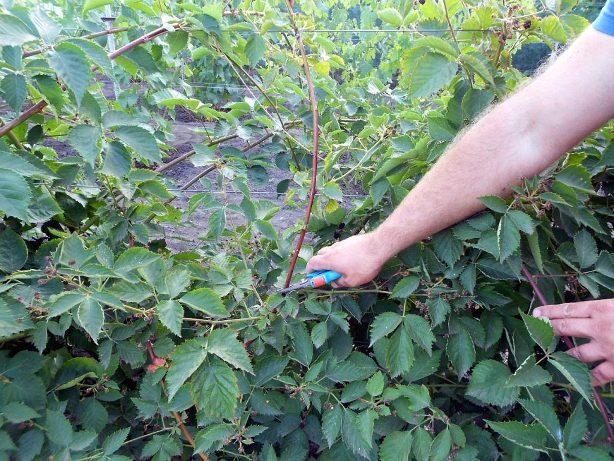
Methods of garter
To prevent fungal diseases and to facilitate bush maintenance and harvesting, blackberries are tied to supports or trellises. This can be done in a variety of ways.
Fan-shaped
This is the most effective method of staking blackberries, especially for young bushes and upright varieties (blackberry), such as Apache and Navajo. The technique is simple: the shoots are tied alternately to the trellis wire in a fan-shaped pattern on either side of the bush. This method prevents overcrowding, improves ventilation and sun exposure, and makes harvesting the berries easier.
Ropeway
With this method, fruiting shoots are tied horizontally to the trellis wire, and young shoots are placed vertically in the center of the bush.
Wave
Fruiting blackberry branches are arranged in a wave-like pattern on the lower wires of the trellis, and young shoots are tied to the upper wire of the trellis above them. This type of tying is primarily used for trailing varieties (dewberry), such as Loch Tay and intermediate forms (Triple Crown).
Possible errors when pruning
Although pruning blackberries seems like such a simple task, it can present certain challenges for novice gardeners. Common mistakes include:
- untimely pruning (carrying it out too early or, conversely, too late);
- cutting out young shoots and those preparing to bear fruit (as a result, the bush will be dominated by old, fruit-bearing shoots, and there will be practically no harvest);
- irregular pruning (it is not performed annually, but once every 2-3 years);
- leaving weak or diseased shoots (as a result of this mistake, healthy shoots do not receive enough nutrition);
- Incorrect shoot thinning (leaving a large number of shoots, as a result the bush becomes overloaded with berries, and their size and quality significantly decreases).
Related posts:
 Description and characteristics of the Natchez blackberry variety, planting and care
 How to care for blackberries in open ground, growing and planting
 Characteristics and description of the Thornfree blackberry variety, cultivation and care
 Description and characteristics of the 40 best blackberry varieties, yield indicators
 A simple recipe for making blackberry jam for the winter
 Description of thornless blackberry varieties and their cultivation, planting and care
 Timing and methods for propagating blackberries at home, planting rules
 Description and characteristics of the Karaka Black blackberry variety, planting and care