
- Is it possible to grow dates at home?
- The best varieties for indoor growing
- Curved
- Robelena
- Forest date palm
- Palmate
- Canary
- What you will need
- Pot
- Soil and drainage
- Where can I get planting material?
- How to prepare date kernels for planting?
- Landing
- When to plant a seed
- Seed depth and placement patterns
- Germination conditions: temperature, light, humidity
- How long does it take for a sprout to emerge?
- What to do if the seed does not germinate
- How to care for a plant
- Watering
- Fertilization
- Transfer
- Trimming
- Protecting from pests
- We treat diseases
- Date palm flowering: timing and favorable conditions
- Will a plant grown from a seed bear fruit?
- Reproduction of culture
In the wild, trees reaching 30 meters in height are found in North Africa, Western Asia, and the Canary Islands. Long before the Common Era, the date palm was cultivated, and its fruits served as a staple food for the inhabitants of the Arabian Peninsula and ancient Egypt. Today, dried and cured date palm fruits are sold year-round in markets and supermarkets across Europe.
Is it possible to grow dates at home?
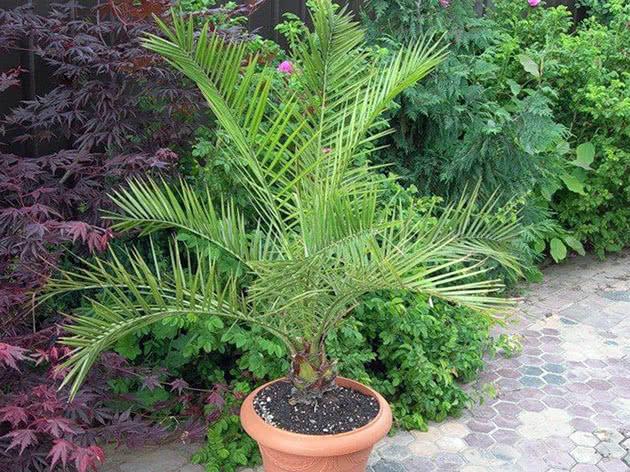
Palms, distinguished by their thick trunks and interesting leaves, are used to decorate the interiors of offices, medical facilities, shopping centers, and entertainment centers, and are planted in greenhouses. The date palm thrives indoors, but instead of reaching 20 meters as in the wild, it only reaches 2 meters, fitting into a standard apartment. Growing a palm is not easy, but with care, it will enhance even the most modest interior and create a cozy atmosphere.
The best varieties for indoor growing
There are about 17 species of date palm, but only a few of them are suitable for landscaping apartments and private houses.
Curved
This palm, which produces lateral trunks, appears like a shrub. In the wild, it is found in the African subtropics and grows up to 8 meters tall; indoors, the tree is much shorter. The curved, feather-like leaves droop downwards from the top of the palm, reaching up to 6 meters in length and one meter in width. They consist of numerous, hairy, bright green leaflets. The petiole bears sharp, thin spines. The branching inflorescences of the curved palm, formed in the axils, reach almost 1 meter in length.
Robelena
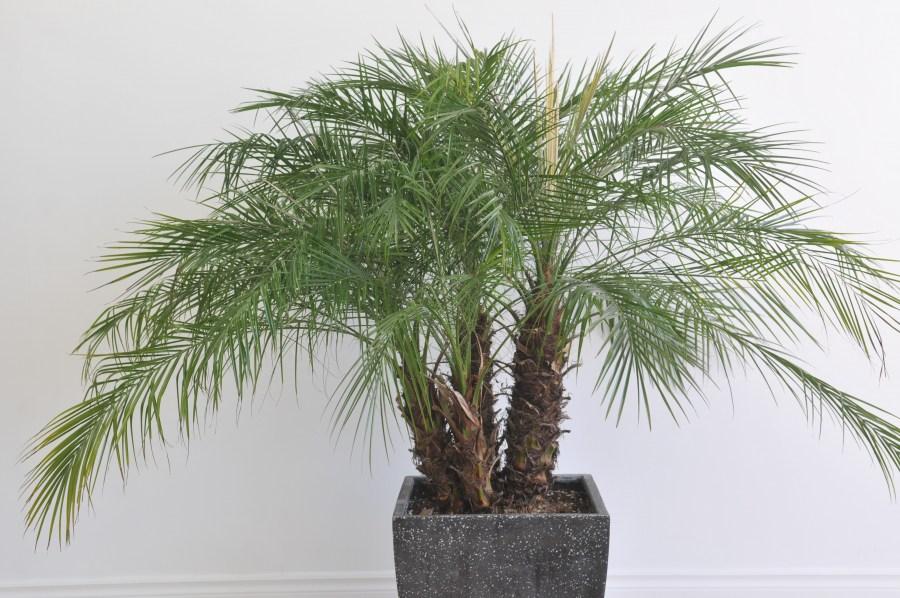
A low-growing date palm grows in the humid tropics of Southeast Asia and thrives indoors. The tree can have one or more trunks, and the elongated, curved leaves of the robelena are composed of numerous narrow leaves 15–20 cm long.
Forest date palm
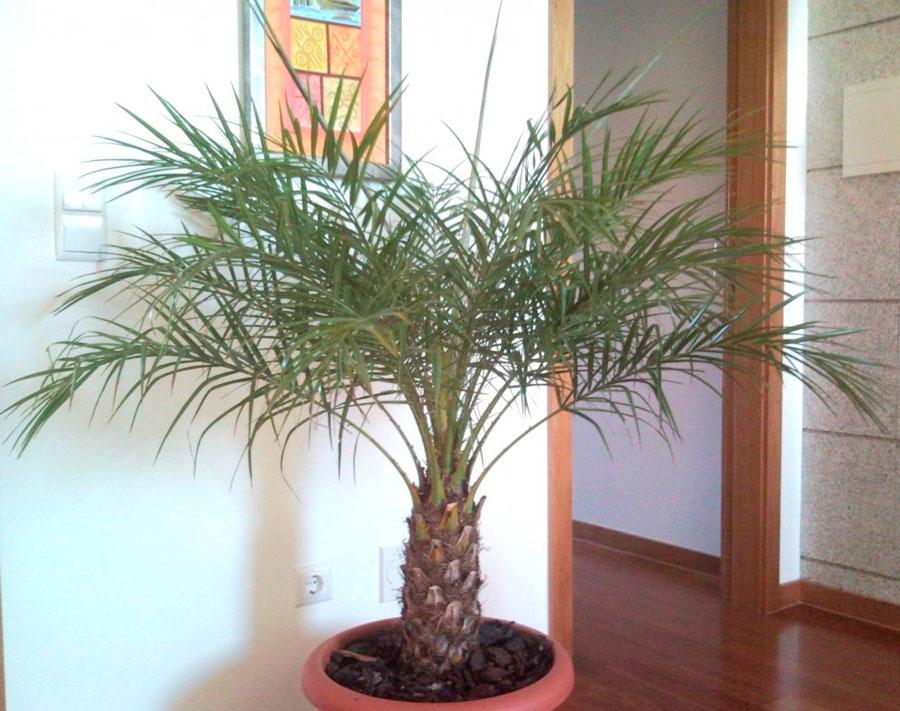
In the valleys and lower reaches of rivers in the arid regions of India, a tall tree with a single, straight trunk grows. Up to two hundred arching, glaucous leaves extend downward from its crown. Spines protrude along the edges of the long petioles, and brown fibers are visible at the base.
Palmate
The date palm, whose trunk grows up to 30 meters long and whose curling leaves reach up to 6 meters, is cultivated in Africa, Kuwait, Saudi Arabia, and Iran. The palm's inflorescence bends downward under the weight of its large, oblong fruits.
Canary
On the rocks and cliffs of islands located in the Atlantic Ocean off the coast of Morocco, grows a tall date tree with a thick trunk and a dense crown formed by numerous long leaves. In their axils are male and female inflorescences.
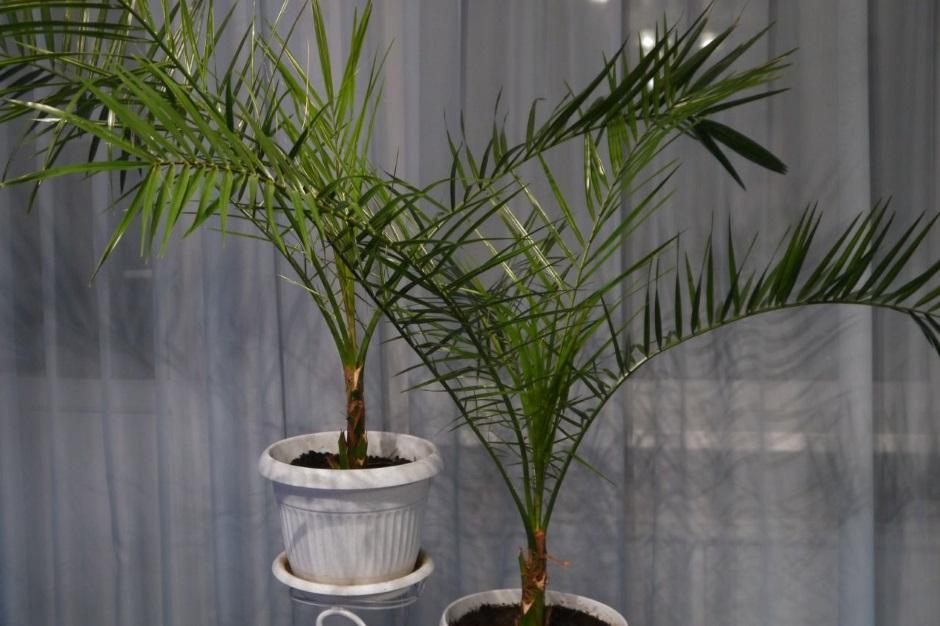 The Canary palm is planted in houses and winter gardens; this date palm reproduces only by seeds.
What you will need
Nowadays, many gardeners grow ornamental trees in their apartments; they add a decorative touch to the room, but don't produce fruit. Planting requires special soil and seed.
It will take more than one year for the palm tree to develop a dense crown, although the sprout appears in 4–6 weeks.
Pot
You don't need a large tub to plant the seed; a plastic container is enough, or even better, place each date palm seed in a separate pot 6–8 cm high.

Soil and drainage
You can buy the substrate at a flower shop or make your own by combining 1 part each of humus, garden soil, and peat, 2 parts coarse sand, and a handful of ash. It's recommended to disinfect the prepared soil:
- Place in the oven for half an hour.
- Heat in the microwave for a few minutes.
- Scald with boiling water.
- Water with a solution of potassium permanganate.
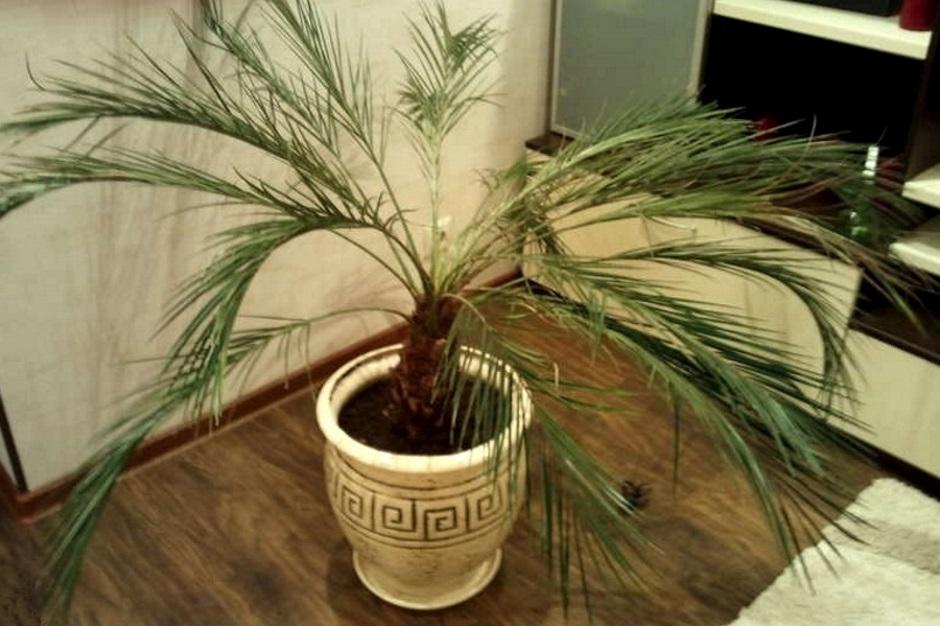
Place small stones or expanded clay on the bottom of the pot. This drainage layer will prevent water from stagnating.
Where can I get planting material?
From dried dates bought at the store or fresh ones purchased while on holiday in Tunisia, Egypt, or Tenerife, select the largest pits. They should be free of mold, cracks, or insect marks.
Fruits dried at high temperatures do not sprout.
How to prepare date kernels for planting?
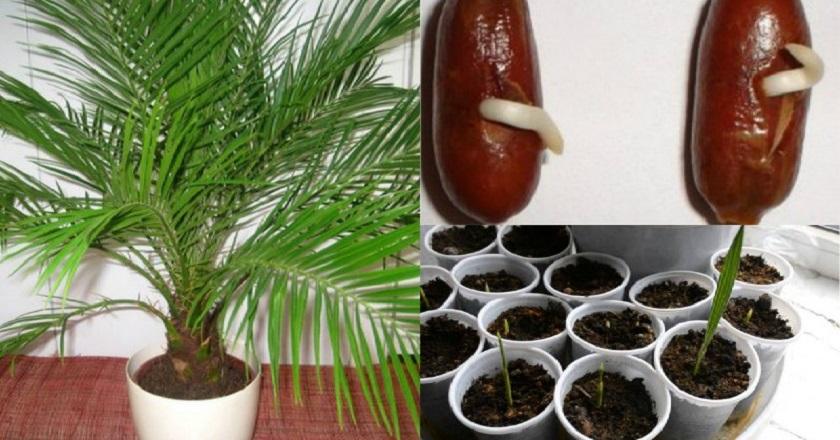
The selected seeds are cleaned of any remaining pulp, rinsed under the tap, and dried. Before planting, the hard palm kernels are rubbed with sandpaper, scalded, or nicked. To speed up germination, the seeds are wrapped in wet gauze, soaked for 24 hours in warm water, changing the water several times, and then infused with a potassium humate solution.
Landing
The date palm seeds should swell, and then they are placed in separate pots with a drainage layer, filled with substrate.
When to plant a seed
In order for the seed to sprout and the tree to begin to develop and delight with its decorative appearance, it is necessary to choose the right period in which to plant the seeds.
Seed depth and placement patterns
Prepared and sprouted seeds are planted vertically in loose, nutritious soil and covered with a 10 mm layer of moist substrate. Alternatively, the seeds can be planted horizontally, covered with soil, and watered with warm water. Cover the pot with plastic wrap and leave it in a room with a temperature of at least 25°C.
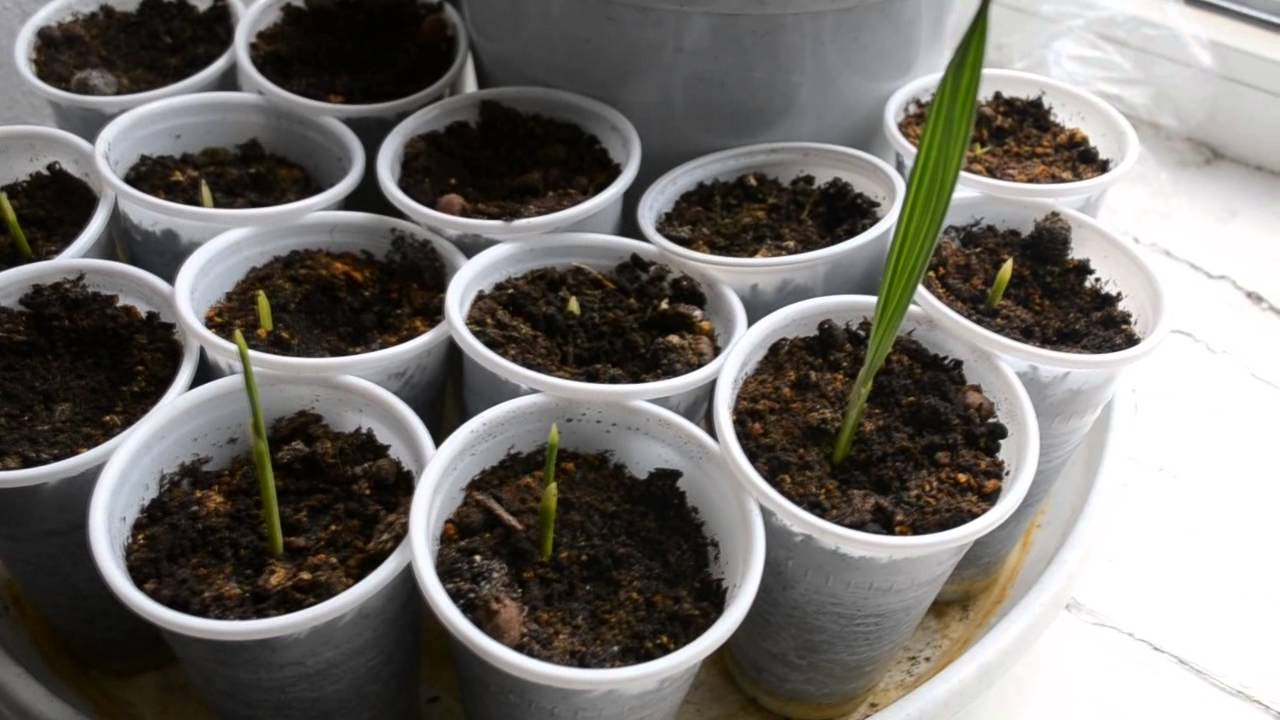
Germination conditions: temperature, light, humidity
The container is aired twice a day to prevent rot. It's important to ensure the substrate doesn't dry out; the seeds are unlikely to germinate if there's insufficient moisture. When several seeds are planted in a pot, when two leaves appear, they are transplanted individually into separate containers.
For the growth and development of a palm tree from a seed, optimal conditions must be created:
- The pot is placed away from heating devices on a window located on the western or eastern side.
- The seedlings are watered with settled water.
- The room temperature is maintained at 20°C and is not allowed to drop below 16.
- In hot weather, wipe the plant with a wet sponge or spray it with a spray bottle.
Seedlings need to be protected from drafts. To ensure even light falls on the leaves, the pot is rotated twice a month. In summer, the palm is watered three times a week, and once a week in winter.
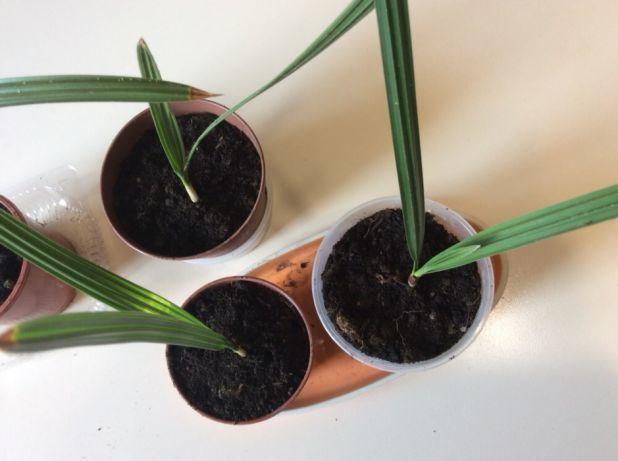
With the onset of warm weather, the pot with the plant is taken out into the garden or yard, and in the summer it is left outdoors, but in a place protected from the sun.
How long does it take for a sprout to emerge?
For a Canary Island or Bentham palm to delight you with a beautiful, dense crown, you need to be patient, create optimal conditions for the seedling, and care for it. Seedlings sometimes appear in as little as three weeks, but more often, it takes two months.
Seedlings 15 cm high are placed in separate shallow pots filled with the same substrate in which the seeds were planted.
What to do if the seed does not germinate
Seedlings take a long time to appear if the room is cool, humidity is below 50%, there's no ventilation, or the potting soil dries out or rots. If all conditions are met and the pit hasn't sprouted after three months, the dates were most likely heat-treated. Buy new dates and make sure they've been air-dried.
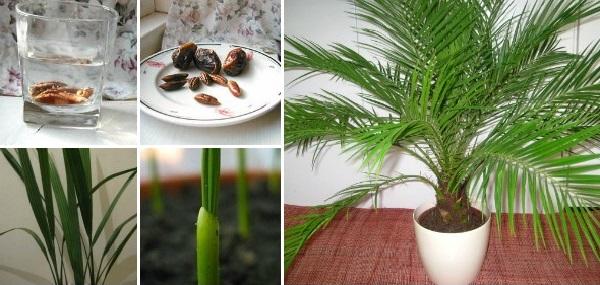 The seeds should be collected immediately after eating the fruit, plant a few pieces, soak them in water and process thempotassium mate.
How to care for a plant
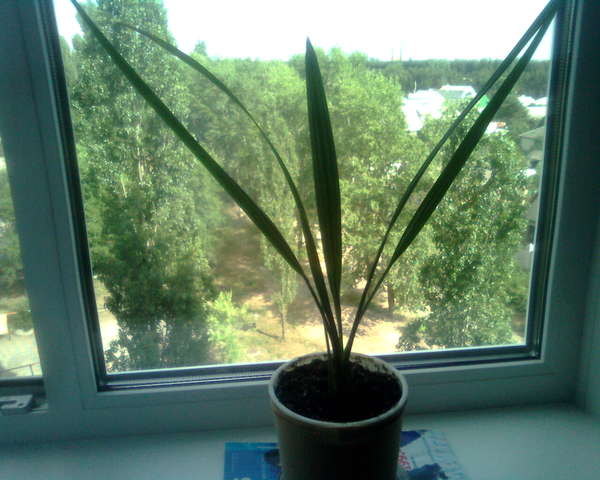
The date palm loves the sun; even a young tree needs to be protected from direct sunlight only at midday, when the heat is intense. After the seedlings emerge, the film is removed, and the plant pot is placed in a south-facing window. During winter, a grow light is added; the palm requires at least 12 hours of light. Proper care is essential for this tropical tree to maintain its decorative appearance.
Watering
Water for irrigation and spraying the plant should be settled or filtered. It should be soft and free of impurities. In spring and throughout the summer, both seedlings and mature date palms need to be watered frequently. In winter, reduce the frequency of watering, and do so only after the soil in the pot has dried out.

Wash the leaves every 7 to 10 days to prevent dust accumulation. Experienced gardeners recommend keeping the palm pot in a tray filled with wet expanded clay. This cultivation technique helps maintain optimal humidity.
Fertilization
Date palms are fed every ten days from April until the end of summer, and every 30 days in winter. This tropical plant requires minerals and organic matter. Fertilize the tree along with watering, using Agricola or specialized palm fertilizers.
Transfer
Date palms prefer to grow in one spot, but the pot should be changed every four or five years, as it becomes too small for this tropical plant. To avoid damaging the roots, the palm should be repotted by transshipment, without disturbing the soil ball. Fill a slightly larger, deep container with expanded clay, add soil, and carefully move the palm. It is recommended to refresh the substrate annually, removing the top layer and adding fresh soil. The palm must be repotted correctly, otherwise it will die rather than grow.
Trimming
Broken and dried date palm leaves should be removed regularly, but this must be done very carefully and gently to avoid damaging the trunk. It is not recommended to prune more leaves than have grown over the year. The palm's top should not be trimmed, as this will prevent the tree from developing and will cause it to die.
Protecting from pests
Date palms attract scale insects and spider mites, but these pests usually appear when the plant is poorly cared for. If small spots or a whitish coating are found on the palm leaves, mix 15 grams of laundry soap with a liter of water. Once the solution dissolves, wipe all parts of the tree with the mixture. If the pests persist, spray the palm with insecticides. If gray plaques and fine webbing appear, treat the date palm with an infusion of garlic cloves or a decoction of onion peels; if this is ineffective, use Actellic.
To prevent the drying of leaves that occurs during a mealybug infestation, the palm tree is sprayed with insecticides such as "Aktara" and "Calypso".
We treat diseases
Not only insects pose a danger to tropical plants, but if not properly cared for, the date palm will not acquire a decorative appearance and may die:
- If the tips of the leaves are drying out, the palm is likely lacking moisture. The tree needs regular watering, and the soil and indoor air should be kept from drying out.
- With a nitrogen deficiency, light spots form, and the leaves darken due to a lack of potassium.
- When yellow stripes appear, the plant needs to be fed with fertilizers containing magnesium.
- Tropical palm trees develop chlorosis when there is a lack of manganese and iron in the soil.
If the leaf tips turn brown, reduce watering. Date palms don't thrive in cold weather. The room temperature shouldn't drop below 17°C.
When a young tree is infected with a fungal infection, pink or root rot develops, and the plant also suffers from leaf spot. To combat these diseases, fungicides such as Ridomil and Mancozeb are used; home remedies are ineffective.
Date palm flowering: timing and favorable conditions
A tropical palm grows slowly indoors; it's planted for interior decoration, not for fruit harvesting. Indoors and in greenhouses, the tree rarely blooms, and this usually occurs 10 years after planting, not 12 months. With proper care and optimal conditions, the date palm will develop panicles in the leaf axils, each bearing both a cream-colored male flower and a white female flower.
Date palms, native to North Africa or Asia, begin to bear fruit at 10 years of age, and then flower. The palms are pollinated by the wind, and the female flower develops into a fruit. In young trees, the trunks don't have time to reach a significant height, and the clusters of dates touch the ground.
Will a plant grown from a seed bear fruit?
After planting the seed, the palm will sprout in 2 or 3 months. It will grow slowly, producing only 3 leaves per year. This tropical tree won't delight you with its fruit in an office or home, but it will decorate even the most modest space. Both male and female flowers are needed for pollination. In the wild, the date palm produces fruit when the trunk reaches 10 meters in height.
Reproduction of culture
To decorate the interior of an apartment or house, palm trees are propagated from seeds. To do this, purchase the palm fruit, remove the seeds from the pulp, wash them, soak them, and plant them in a pot filled with nutritious soil, covered with plastic. To encourage seedlings to sprout, water the seeds with soft water and keep them warm but ventilated regularly.
Some date palm species can be propagated by cuttings. These are pruned from plants with strong roots, taking care not to damage the trunk, and carefully planted in the same soil prepared for seeds. The cuttings are covered with plastic wrap, which is removed after a few days.
The tropical palm tree reacts negatively to even the slightest care error. If there's a lack of moisture, the leaves turn yellow and dry out, and if overwatered, they turn black. At low temperatures, the date palm stops growing. However, with optimal conditions and proper care, the palm tree will impress with its beauty.
Related posts:
 Description of the Canary date palm variety, growing from seeds at home
 Description and propagation of Chinese dates, planting and tree care
 Description of the tomato Finik Red F1 and other varieties in this series
 Description and rules for eating royal dates, benefits and harms
 The benefits and harms of dates for men and women, contraindications
 The best eggplant varieties for growing in a polycarbonate greenhouse: planting and care
 Is it possible to grow an apricot tree from a seed in your garden? How to plant and care for it?
 Methods for planting and propagating cherries at home