
Today, there are many types of fungicides available for home gardening. Let's explore the capabilities of the "Champion" fungicide, its instructions for use, its mode of action and purpose, its advantages and disadvantages, application rates and consumption, its toxicity, its compatibility with other pesticides, and proper storage instructions.
Composition, existing forms of release and purpose
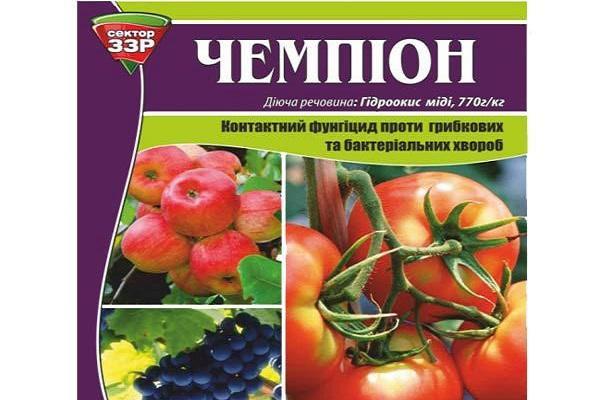
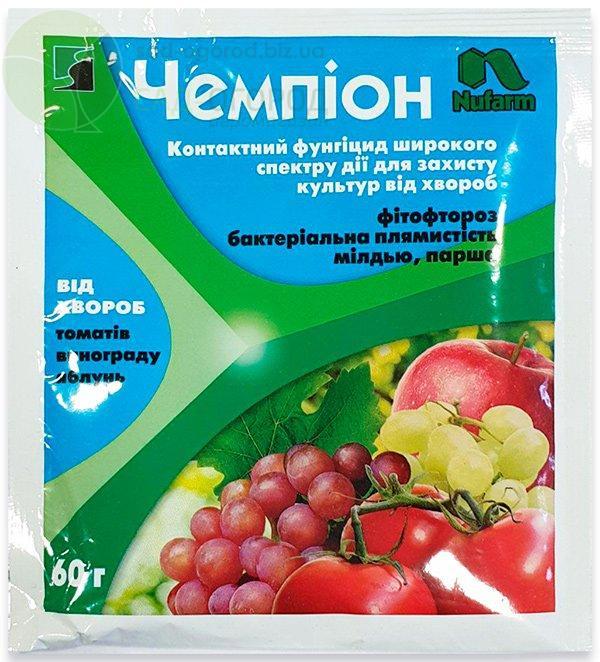
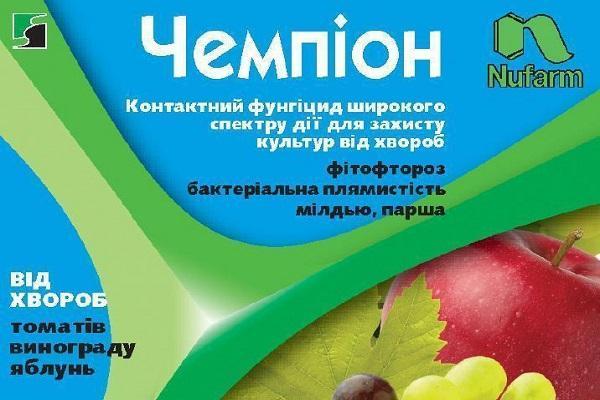
Champion is available as a wettable powder containing copper hydroxide at a concentration of 770 g per kg. It is available in small 20, 30, and 40 g sachets, convenient for home use, and in 10 kg containers for industrial use.
How does the product work?
"Champion" is a contact fungicide used to treat tomato, apple, and grape crops against pathogens. It forms a protective layer on the foliage surface, preventing pathogens from penetrating into plant tissue.
The product has bactericidal and antifungal properties. Copper hydroxide, when applied to bacteria and fungi, inhibits cell division and spore germination, killing the pathogens or preventing them from reproducing. It is most effective when used prophylactically.
Pros and cons
Calculation of consumption
Tomatoes are sprayed against late blight, early blight, and bacterial spot. The application rate is 20 g per 100 m², with a consumption rate of 5 liters. The waiting period is two weeks. Grapes are sprayed against mildew at a rate of 30 g per 100 m², with a consumption rate of 10 liters. Apple trees are treated against canker, moniliosis, scab, fire blight, and clasterosporium with a solution at a rate of 40 g, with a consumption rate of 10 liters per 100 m². The waiting period for apple and grape trees is one month.
Preparation of the working mixture
Preparation: Fill the sprayer with one-third of the water, add the powder as directed, and stir until completely dissolved. Then, add water to the sprayer to reach the required volume and stir again.
Instructions for use
When preparing the fungicide, use water with a pH of 5-11. If the water has a different pH, the effect of the product will be slower, as copper oxide will form slowly. It is not recommended to apply the fungicide at temperatures above 25°C, when the fruit is excessively wet, or when the air humidity is low.
The interval between subsequent treatments with "Champion" should be at least 1-1.5 weeks. The duration of this interval depends on the disease's progression and the prevailing weather conditions.

Safety rules for processing
The fungicide "Champion" is classified as a hazard class 3 product. It poses a low health risk, so it can be handled in light protective clothing. However, it is essential to wear a respirator, goggles, and long rubber gloves. Do not remove these protective equipment while spraying. After use, wash your face and hands with soap and water. If the product comes into contact with any part of the body, eyes, or mouth, rinse it off. In case of poisoning, take activated charcoal, drink plenty of water, and induce vomiting.
How toxic is it?
The product is low-toxic to humans and beneficial insects, plants, and soil when used in recommended doses. It is not recommended for use near bodies of water.
Possible compatibility
The fungicide "Champion" is compatible with pesticides, except for organophosphates and acidic pesticides, in a tank mix. If precise compatibility information is not provided in the instructions, conduct a small compatibility test before mixing the pesticides. Mix a small amount of both products and check for a reaction. If there is no violent reaction, mixing the products is acceptable. If incompatibility occurs, consider choosing a different product.
How to store properly and expiration date
"Champion" can be stored for 3 years from the date of production. Store in a dry, dark, and cool place. After the expiration date, the product should not be used. It should be discarded and replaced with a fresh batch. After dilution, the solution should be stored for only 1 day; after that, it loses its effectiveness. The old solution should be discarded in an area not used for growing plants.
Analogues
Based on its active ingredient, copper hydroxide, "Champion" can be replaced by the following products: "Coside 2000," "Coside Super," "Kupidon Gold," "Kupidon," "Mercury," and "Meteor." For private use, "Oxychom" is used.
The fungicide and antibacterial product "Champion" is used to treat vineyards, apple orchards, and tomato beds against pathogens that can cause disease. It is used as a preventative treatment; it is not used for post-infection treatment. "Champion" acts quickly, is non-toxic to plants and soil, and is not washed away by rain. It increases plant resistance to frost. It does not penetrate plant tissue, acting only on the surface. However, a certain period of time must be allowed after treatment before harvesting.
Related posts:
 Description and characteristics of the Champion apple tree variety, cultivation technology
 Description of the Em Champion tomato, growing it yourself, and pest control
 Description and subtleties of growing the Champion of the North apricot variety
 The best eggplant varieties for growing in a polycarbonate greenhouse: planting and care
 Description of the Champion Vesto tomato, characteristics and advantages of the variety
 Causes and treatment of eggplant pests and diseases, how to combat them at home
 Methods for planting and propagating cherries at home
 The health benefits and contraindications of black currants