
- Is the Colorado potato beetle dangerous to potatoes during and after flowering?
- The importance of potato flowering for tuber maturation
- Is it possible to poison the Colorado potato beetle during flowering?
- Is it necessary to treat potatoes against beetles after flowering?
- Treatment of crops against pests
- Chemicals
- Folk remedies
- Biopreparations
- Protecting potato tubers before planting
Gardeners are wondering whether it's possible to spray potatoes against the Colorado potato beetle during bud formation and active flowering. What methods are most effective, and what is the risk to tuber development? Following simple recommendations and potato care guidelines will help protect the plant and ensure a healthy harvest.
Is the Colorado potato beetle dangerous to potatoes during and after flowering?
The Colorado potato beetle is the most dangerous pest for potatoes. It feeds on the tops of the plants, causing the upper portion to die. As a result, the tubers fail to develop. The insect lays larvae, which are extremely voracious and quickly consume the leaves and young shoots. The Colorado potato beetle also damages the inflorescences.
The most dangerous period for pest infestations is flowering. Because the beetle destroys the tops of the crop, which leads to reduced plant development, tubers fail to form properly. Large infestations of the Colorado potato beetle during flowering lead to the failure of the tubers to set.
Important: A female Colorado potato beetle can lay up to 500 eggs, which hatch into larvae within 24 hours.
The importance of potato flowering for tuber maturation
Flowering plays a crucial role in ensuring a plant's full growing season. The above-ground portion of the plant is responsible for metabolism and oxygenation of the tubers. During the formation and development of tubers, buds appear on the mature plant. Flowers have a positive effect on the roots, but do not affect their development or quantity.
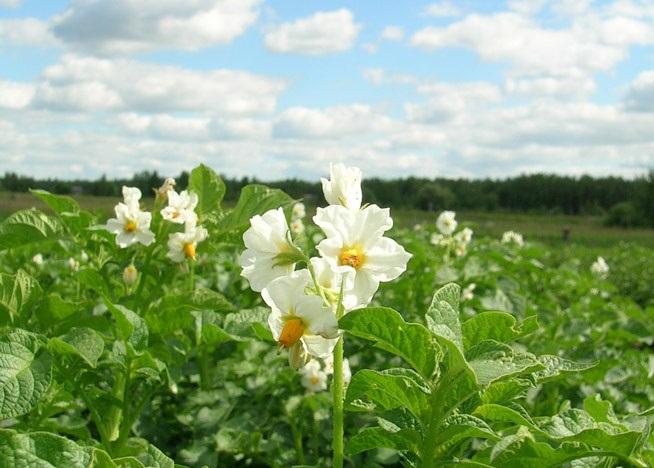
The appearance of buds on potatoes signals the need for additional watering and nutrient additions. Many gardeners remove the buds to ensure a harvest, but this is incorrect, as mechanical stress on the plant weakens it and results in a low yield.
Is it possible to poison the Colorado potato beetle during flowering?
Flower color is crucial for the plant's development. If beetles damage the inflorescences, the plant will devote all its energy to forming new buds, which will negatively impact the tubers. Spraying the plant during flowering is not recommended. If beetles are present, manual removal of the pests is necessary. Toxic components can harm the flowers and the plant as a whole.
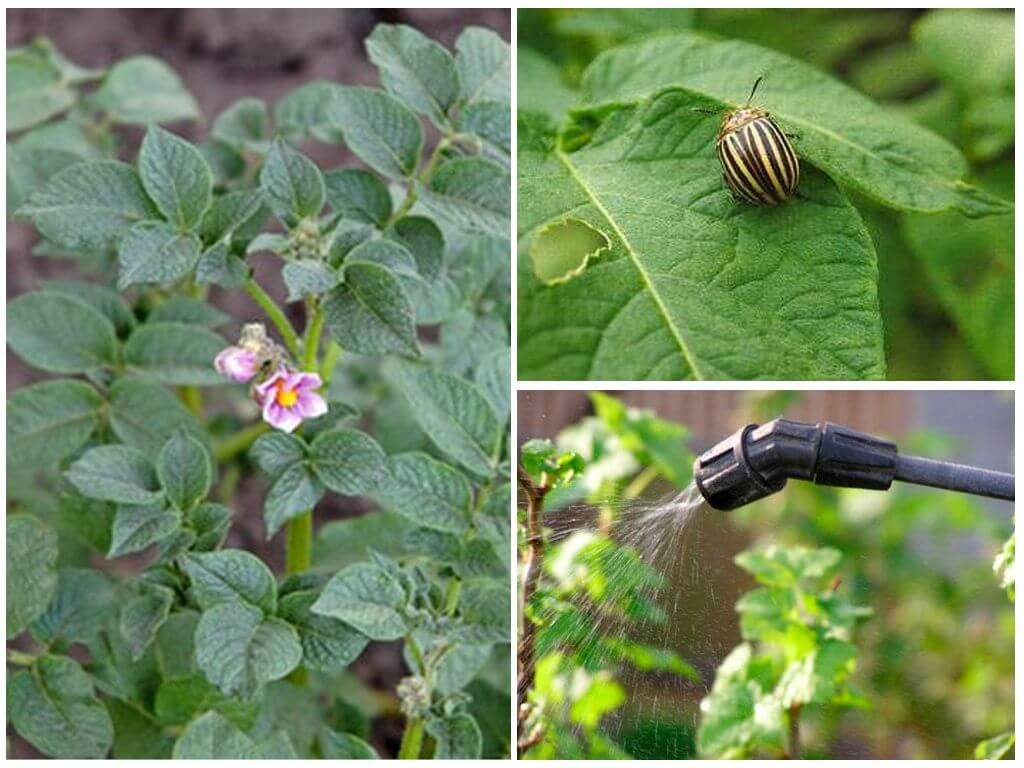
However, in some cases the pest attacks potatoes in large quantities, in which case chemicals cannot be avoided.
Spraying potatoes against beetles allows you to save the harvest, since the potato blooms for a long period, during which the pest can completely destroy the plant.
Important: When handling potatoes during flowering, avoid contact with the inflorescences, carefully covering them with your hand.
Is it necessary to treat potatoes against beetles after flowering?
Potatoes often bloom unevenly, so constant care is necessary. Eliminating the Colorado potato beetle with a single spray is very difficult, as many females reside in the soil. Therefore, the pest often reappears after a while. Repeated spraying can protect the potato tops from damage and prolong the period of beneficial nutrients in the tubers.
Treatment of crops against pests
Potatoes can be treated against Colorado potato beetles using various types of products. It's important to note that the pest tends to become resistant to poison, so it's recommended to periodically replace the chemical with a new one to which the beetle has no immunity.
Chemicals
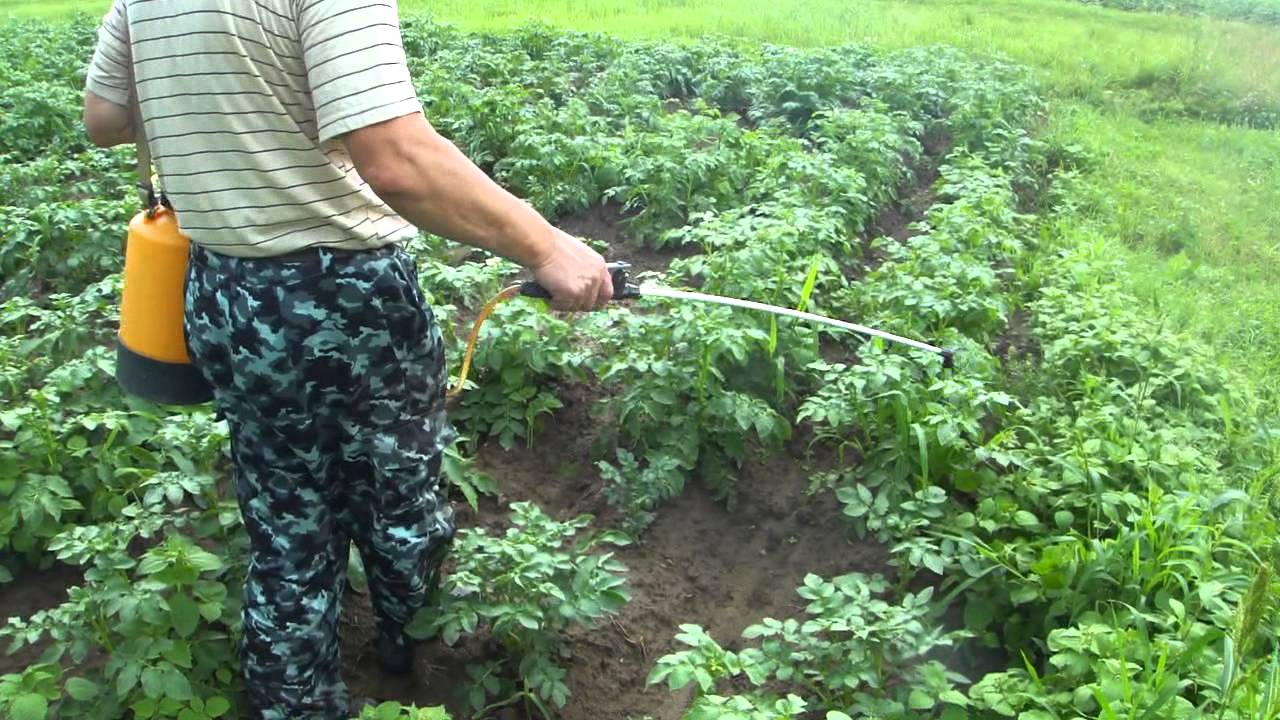
These products contain toxic components that affect the vital organs of the Colorado potato beetle, leading to its death. Spraying with these products quickly eliminates the pest and its larvae.
Among the most popular means against the Colorado potato beetle, it is necessary to highlight:
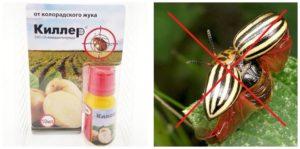
- "Killer" is effective against not only adult beetles but also their larvae. The product is non-washable and remains on potato tops for a long time, reducing the likelihood of beetle re-infestation.
- "Gulliver" is a liquid concentrate. To make a solution, mix one ampoule of the product with 10 liters of water. It eliminates Colorado potato beetles the first time.
- "Napoval" is considered safe for plants and is used as a spray solution. To achieve the desired result, it is recommended to add liquid soap to the solution.
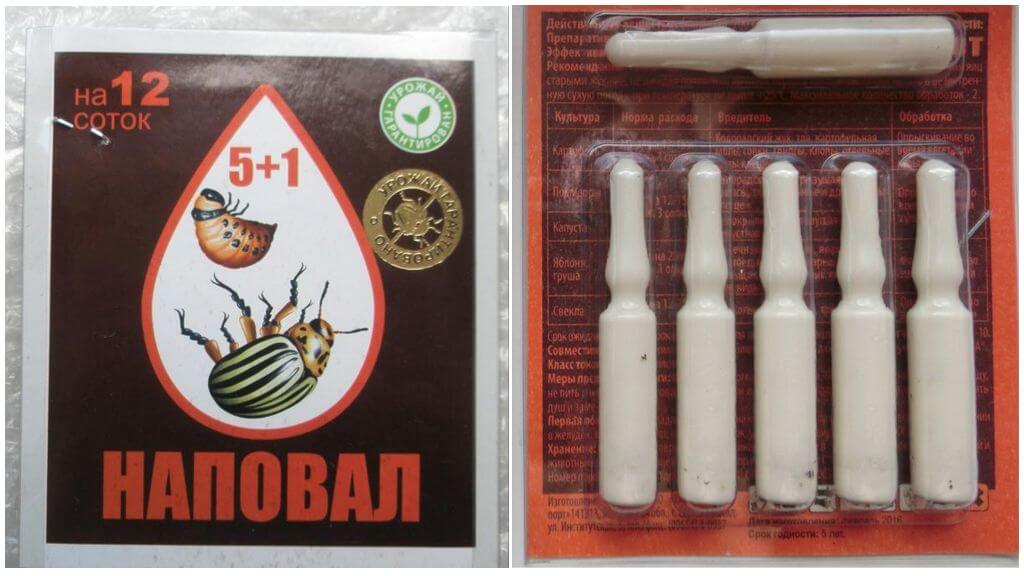
Spraying with chemicals should be done on cloudy days or after sunset. Otherwise, there is a risk of plant burns.
Folk remedies
Using traditional methods to eliminate the pest does not harm the potato plant. However, a drawback of this control method is the need for multiple treatments.
The most common methods include:
- Ash dusting. This method is effective when using birch ash. The procedure is performed early in the morning.
- Using pine needles. Using pine needles as mulch can reduce the presence of Colorado potato beetles. Place the needles in a thick layer between rows.
- Garlic water. Peel 5 heads of garlic and press them through a press. Pour a liter of water over them and let them steep for 24 hours. Strain the mixture and mix it with a bucket of clean water. Spray the beds every 10 days.
- Onion peels. Colorado potato beetles can be killed with an onion infusion. To do this, add a kilogram of peels to a liter of water and bring to a boil. Let the infusion sit for 24 hours. Strain the resulting mixture and mix it with a bucket of water. Spray the crop with this infusion.
- Tomato tops. You can spray your beds with a solution made from tomato tops. Chop 1 kg of tomato tops and pour 2 liters of boiling water over them. Let it steep for 4 hours. Mix the resulting mixture with 5 liters of water and add two tablespoons of liquid soap. Spray the beds every 3 days.
- Urea. Used not only to kill pests but also as a fertilizer, dilute 100 grams in 10 liters of water and spray the beds. You can also use bait. Cut the potatoes into wedges and soak them in a urea solution (100 grams per liter of water). Place the wedges between the beds.
- Wormwood. The plant has a distinctive odor and bitter taste. Mix one kilogram of crushed wormwood with 200 grams of ash. Pour 10 liters of water over the mixture and let it steep for four hours. Spray the potatoes after sunset.
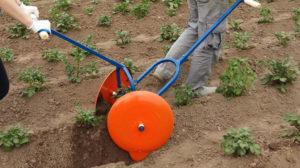
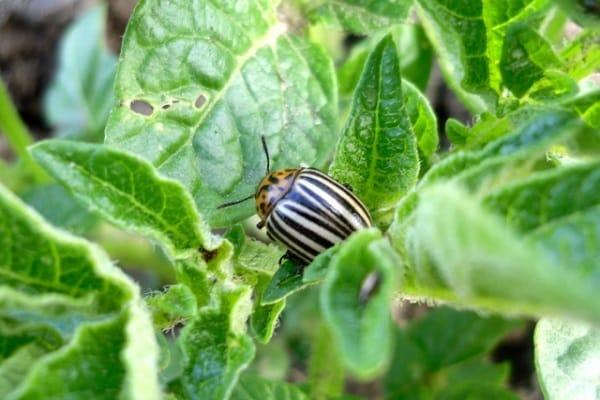
Using traditional methods, treatment can be carried out even during the flowering period; many plants can act as additional fertilizer. To achieve results, it's important to begin treating your garden beds from the first signs of infestation.
Plants such as marigolds and calendula can also be used to combat beetles. These plants have a strong scent that repels pests.
Biopreparations
Potatoes can be treated with biological pesticides during flowering. The advantage of these products is that they do not contain harmful components that affect plant development. Treatment with biological components has a negative impact on the larvae, as they lack a protective shell. Adults are difficult to eliminate using this method.
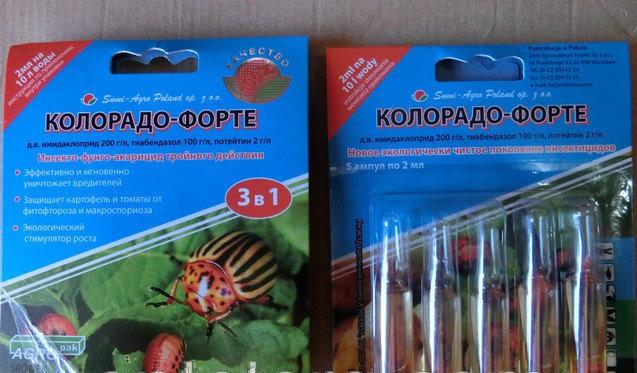
Biological drugs include:
- "Colorado Forte" contains a growth activator, so spraying improves growth and combats pests. Treatment can be repeated every 10 days.
- "Bitoxibacillin" is produced in powder form. The substance is diluted with water at a ratio of one packet of powder per 10 liters of water. Spraying is carried out several times per season.
- "Agravertin" quickly eliminates larvae and prevents their reappearance. Does not affect the plant. Recommended for use during hot weather.
To achieve the desired result, plants must be treated at the first sign of insect infestation. Biological treatments may be ineffective if the pest infestation is large.
Important: All prepared solutions must be used within a few hours. After prolonged storage, the solution becomes ineffective.
Protecting potato tubers before planting
When planting potatoes, it's important to treat the tubers specifically to protect them from soil-borne pests, including the Colorado potato beetle. The following products can be used:
- "Prestige" – treating tubers with a substance prevents various diseases. To use, mix 100 grams of the substance with 4 liters of water and spray the tubers before planting them outdoors.
- "Cruiser" is a product designed to combat the Colorado potato beetle and other pests. To use, mix 100 ml of the product with 5 liters of water and spray it on the planting material.
- Copper sulfate is a substance that does not contain harmful compounds and can be used to treat potatoes. To prepare the solution, mix 1 teaspoon of boric acid, copper sulfate, manganese, and 10 liters of water.

Treating planting material before planting reduces the number of pests, but such methods cannot completely eliminate the Colorado potato beetle.
The Colorado potato beetle can cause significant damage to crops. Timely removal of the pest will help save the plant. The flowering period is crucial for potatoes, so at this stage of crop development, it is recommended not to use toxic substances, instead using traditional methods and hand-picking the beetle and its larvae.
Related posts:
 Description of the Colorado potato beetle, 20 chemical and folk remedies for control
 Pre-plant potato treatments for Colorado potato beetle
 Instructions for using the poison "Executioner" against the Colorado potato beetle
 How to dilute Fitoverm for Colorado potato beetles and instructions for use
 Instructions for use of "Sonnet" against the Colorado potato beetle and its composition
 Description and treatment of potato pests, control measures
 Instructions for use of Zubr against the Colorado potato beetle
 Instructions for using the Apache remedy against Colorado potato beetles, how to dilute