
- Description and distinctive features of the Adretta variety
- The main advantages and disadvantages of potatoes
- Growing Adretta potatoes
- Seed material
- Choosing a location
- Preparing for landing
- The landing process
- Further care of the variety
- Hilling, loosening
- Watering and fertilizing
- Diseases and pests
- Late blight
- Macrosporiosis
- Common scab
- Aphid
- Colorado beetle
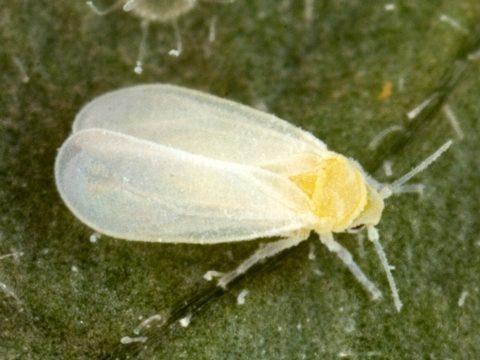
- Greenhouse whitefly
- Harvesting and storage of crops
- Reviews from experienced gardeners
One of gardeners' favorites, the Adretta potato variety has remained popular for nearly 40 years thanks to its excellent flavor and resistance to various diseases. It is listed in the State Register of Potatoes of Russia and is recommended for cultivation in all regions except the northern ones. Its care is not particularly specific compared to other varieties.
Description and distinctive features of the Adretta variety
Among the characteristics of the Adretta potato we highlight the following:
- mid-early table variety;
- reaches maturity in 65-80 days from the moment of emergence;
- yield – 400-450 centners per hectare;
- marketability – 85-88%;
- shelf life – 90-95%;
- starch – 15-18%;
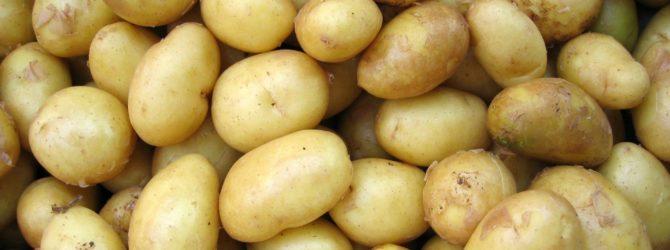
- the flesh is light yellow;
- tuber color - yellow;
- tuber weight – 120-150 grams;
- resistant to major potato diseases.
Adretta receives a taste rating of 4.5-5. Any dish made with this potato is delicious and healthy. Its low starch content makes it dietary. Cooked tubers are a beautiful yellow color and retain their shape.
Adretta grows tall, upright, and does not spread. The leaves are large and light green. It blooms profusely with lush clusters of white flowers.
Important! To maintain potato yield and high commercial quality, seed should be replaced every 3-4 years.
The main advantages and disadvantages of potatoes
The Adretta variety has the following advantages:
- High-yielding.
- Transports well.
- Keeps well.
- Does not become sweet when frozen.
- Resistant to tuber cancer and late blight.
The disadvantages of the Adretta potato include susceptibility to diseases such as late blight of bushes, scab and macrosporiosis.
Growing Adretta potatoes
The Adretta potato variety requires no different care than other varieties. The key is to select healthy tubers for planting, find a suitable growing location, and plant them correctly.
Seed material
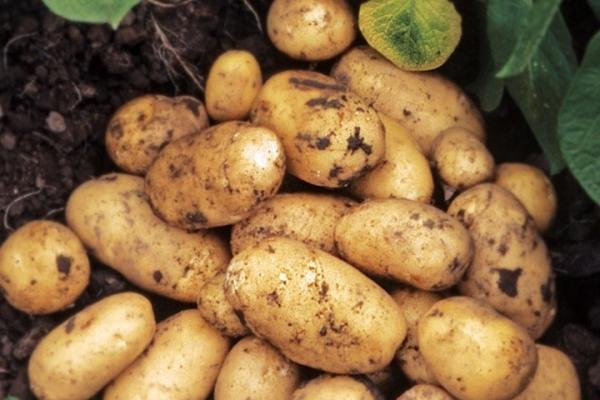
For planting, select the highest-yielding bushes. At least 50% of the potatoes should be large (100-120 grams each). Choose tubers 6-8 millimeters in diameter, with clean, smooth skin, and no signs of disease or damage.
Choosing a location
Open, sunny areas with light, fertile soil are ideal. The Adretta variety does not tolerate either dry soil or excessive moisture. Lowlands that become flooded during rainy seasons are not a good choice for Adretta potatoes.
Preparing for landing
About two weeks before planting, remove the seeds from the cellar and place them in a warm, bright place. This is necessary to allow the sprouts to emerge and the tubers to warm up. Any diseased seeds are discarded and checked for damage from rodents or insects.
If necessary, disinfect the potatoes by placing them in a solution of Maxim, Fitosporin, or 0.02% copper sulfate. Leave them for about an hour, then dry.
The landing process
Furrows are cut or holes are dug in the plot. Their depth is 10-15 centimeters. The distance between rows is 50-60 centimeters, and between plants – 35-40.
Add ash or a tablespoon of urea to the hole, mix with soil, lay out the potatoes, and cover with soil.
Remember to practice crop rotation in your plot. Legumes, cabbage, or corn are good predecessors to potatoes.
Further care of the variety
Basic plant care includes watering, fertilizing, loosening, and hilling.
Hilling, loosening
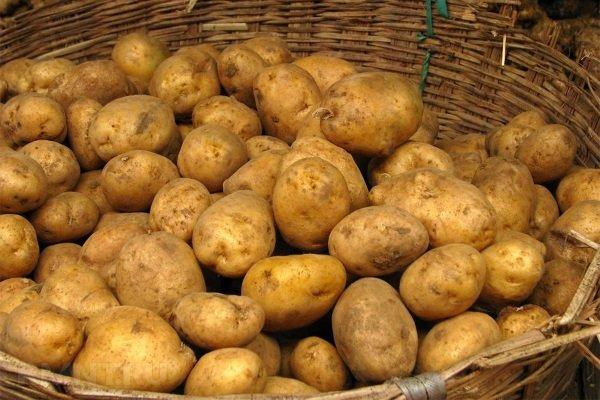
Loose soil is essential for oxygenating the roots, improving their structure and eliminating weeds. Loosening the soil is considered dry watering. Adretta potatoes are first hilled after the new shoots emerge, protecting them from frost. This subsequently promotes the formation of stolons, on which the tubers develop. Hilling is performed at least three times per season.
Watering and fertilizing
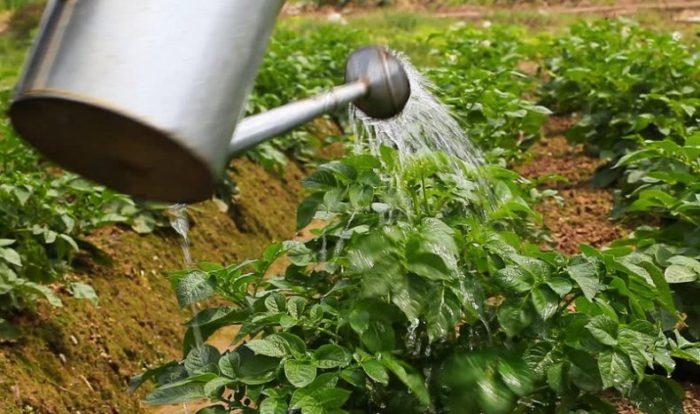
The Adretta potato is a drought-resistant crop, but if rainfall is lacking, especially during germination and flowering, it needs watering. This should be done in furrows to ensure even distribution and absorption by the roots.
If watering is combined with fertilizing, the concentration of the solution is made weaker.
To form bushes, use infusions of manure (1:10) or chicken manure (1:20). Subsequently, phosphorus, potassium, and microelements are necessary. Mineral fertilizers include superphosphate, potassium and phosphorus nitrate, and complex compounds.
Diseases and pests
The Adretta potato has a number of positive qualities, including resistance to many diseases. Let's look at how this variety responds to viruses and pests.
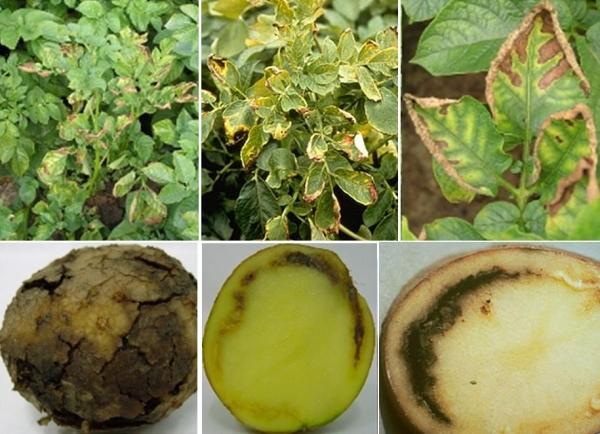
Late blight
The disease attacks Adretta potatoes in cold, damp weather. Dark spots appear on the plants, followed by damage and drying of the entire top. Copper-containing products are used for control. Copper sulfate solution (1 teaspoon per 0.5 liters of water), Bordeaux mixture, and HOM and Skorobey products have been effective.
Try to use biological pest control. Spraying the lower leaves and soil around the potato plant with solutions of Zircon and Fitosporin is helpful.
Macrosporiosis
Dry spot. Characterized by yellow spots on the leaves, which then darken and dry out. A fluffy growth forms underneath, containing macrosporiosis spores. The disease damages the entire plant. Infected tops initiate the disease in the tubers. These potatoes store poorly and lose their germination capacity. A single tuber can infect an entire storage facility. Measures to protect potatoes from macrosporiosis:
- compliance with crop rotation;
- careful selection of seed material;
- seed treatment before planting;
- For prevention, it is worth adding nitrogen, phosphorus, potassium, and foliar feeding with elements of copper, boron, and manganese to the soil;
- at least a week before harvesting, you will have to mow and burn the tops;
- It is important to disinfect potato storage areas.
Rye crops are effective as a green manure. Their roots inhibit macrosporiosis fungi.
Common scab
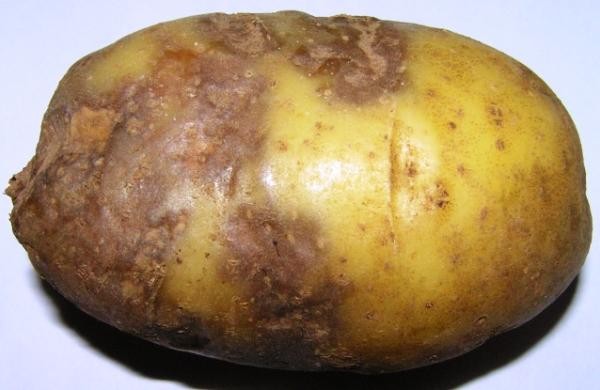
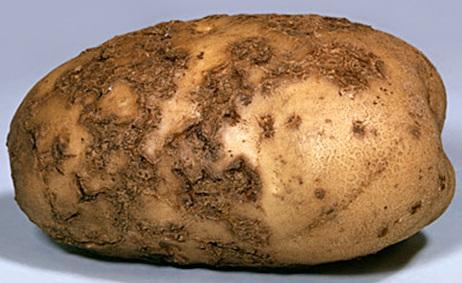
Scab damages potato tubers. Small ulcers initially appear, then become continuous. The cause is a soil-dwelling fungus. Dry, alkaline soil is a favorable environment for this fungus.
Crop rotation is essential for scab prevention. It's helpful to plant legumes as green manure, as they promote the formation of bacteria in the soil that inhibit scab fungi.
The presence of copper, manganese, and boron in the soil also contributes to this. For every 100 square meters of land, apply:
- copper sulfate – 40 grams;
- manganese sulfate - 20 grams;
- boric acid – 24 grams.
Excessive liming is a clear cause of scab on potatoes.
Aphid
Potato aphids produce sugary substances on leaves, which ants love. They then spread the insect's larvae. Removing ants reduces the number of aphids in the garden. They can be destroyed by washing them off the leaves with a hose. Spraying with an infusion of garlic, marigold, and pepper can also help. Chemical pesticides such as Force, Grom-2, Regent, and Fitoverm can also be used.
Colorado beetle
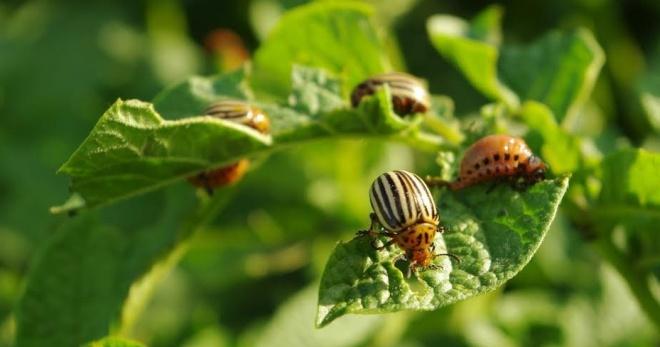
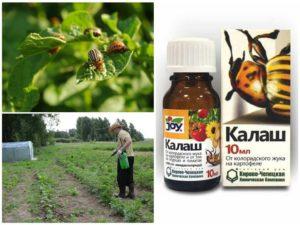
It's not very dangerous for the Adretta potato variety, as it grows and flowers before the pest's mass flight. In a small area, beetles and their larvae can be collected by hand. For larger areas, chemical pesticides such as Colorado, Komandor, Iskra, Marshal, and Aktara are used. Three treatments are recommended.
Greenhouse whitefly
This insect destroys plants, sucking out sap and consuming green parts. It transmits many viruses, including sooty mold. It thrives in the hot, humid climate of greenhouses. In small areas, it can be washed off with a hose. Traps, consisting of brightly colored plates coated with glue, are hung in greenhouses.
Whiteflies are controlled by ladybugs and lacewings. There is a biological product based on the fungus verticillin. Its spores kill the insect at all stages of its life.
Chemical pesticides are also used: Aktara, Actellic, and Inta-vir. These products, absorbed by plant parts, have a long-lasting effect on the pest. Due to their toxicity, their use should be discontinued 20-30 days before potato harvest. Biological pesticides such as Boverin, Fitoverm, and Agrovertin are the most preferred. After treatment, the effect lasts for 5-7 days. For reliability, repeat treatment every 2-3 weeks.
Harvesting and storage of crops
Harvesting is carried out on dry days. When harvesting by hand, the potatoes are dug up with a pitchfork to prevent damage to the tubers. They are laid out in the shade to air and dry. The portion of the crop intended for sowing is placed separately, kept in the light, and inspected several times before storage.
A cool, dry cellar is suitable for storage. Storage temperatures range from +2 to +5°C. Wooden crates are convenient for storing potatoes. This makes it easier to monitor the tubers' condition and identify any potential diseases. Ensure proper ventilation in the cellar.
Reviews from experienced gardeners
Many gardeners grow Adretta potatoes, and reviews of this crop are increasingly positive.
Shakhnova Rina Ivanovna, 57 years old, city of Novokuznetsk.
"My parents started growing Adretta potatoes. They're the most delicious potato for me. They're always yellow and don't darken after boiling. It's an easy-to-grow, high-yielding variety. There's a common misconception that the original Adretta no longer exists here. I'd like to renew my own seed stock, but I'm afraid of losing the original seeds."
Bystrov Ivan Tikhonovich, 60 years old, Penza.
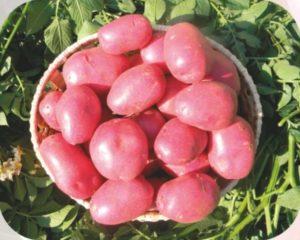
"I've been planting the Adretta potato variety for a long time and with great success. It's delicious, crisp, and has a beautiful yellow color. I didn't use any special farming techniques. I don't think this variety can't be replaced. There are many new varieties—delicious and productive. I really like Darenka and the pink Rosara."
Related posts:
 Description of the best potato varieties of domestic and foreign selection
 Description and characteristics of the Rodrigo potato variety, cultivation and care
 Description and characteristics of the Krasavchik potato variety, planting and care
 Description and characteristics of the Gulliver potato variety, planting and care
 Why potatoes aren't growing well in the garden, and what to do to ensure a bountiful harvest
 Description and treatment of potato diseases, methods of control using folk and chemical means
 Description and characteristics of the Zhukovsky potato variety, planting and care
 Description and characteristics of the Bellarosa potato variety, planting and care