
The Claudine F1 cucumber was developed by Dutch breeders by crossing other cucumber varieties. Since 2008, the Claudine variety has been included in the State Register of Seeds of the Russian Federation.
This variety is self-pollinating, making it suitable for greenhouse cultivation—it doesn't require insects for pollination. These cucumbers are also suitable for both greenhouse and open-air cultivation.
Reviews from gardeners indicate that Claudine cucumbers have a good taste and can produce a rich harvest.
What is a Claudine cucumber?
The variety's description and characteristics make it suitable for growing in any conditions—both greenhouses and open ground. Claudine cucumbers are best grown in fertile, pre-prepared soil. This early-ripening variety allows the first harvest to be collected within 40 days of planting.

The fruit can be described as an elongated ellipse of a rich, dark green color. The cucumber's surface is covered with numerous small tubercles. Small spines are also noted, evenly distributed throughout the fruit of the Claudine variety.
The skin of the fruit is quite thin, with several light stripes running lengthwise. Each fruit can weigh up to 100 g and reach a length of 10 cm. All gardeners who grow the Claudine variety agree on one thing: these cucumbers have an excellent flavor, free from bitterness. They have a pleasant crunch and are very juicy. They are best eaten fresh.
Experts advise against pickling or marinating Claudine F1 cucumbers. This method causes them to become soft and limp, and they also lose their flavor.

The plant is medium-sized, with numerous shoots. Numerous medium-sized leaves form on the bush. The plant produces ovaries in clusters, with up to seven gherkins at each node. Claudine produces fruit over a long period of time. Up to 10 kg of fruit can be harvested from 1 m².
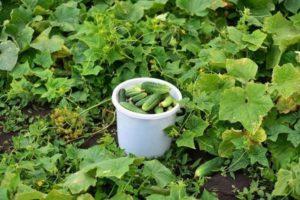
Let's consider the variety's positive and negative qualities. The Claudine variety is characterized by high resistance to high temperatures and a number of common diseases. The plants are also immune to powdery mildew and cucumber mosaic virus.
Among the positive qualities, the following can be highlighted:
- long fruiting period;
- rapid fruiting;
- resistance to external factors;
- do not require special care;
- can be stored fresh for a long time without losing their taste and aesthetic qualities.
The disadvantage is that overripe fruits do not barrel.

How are cucumbers grown?
Let's look at the specifics of growing this variety. The seeds of this cucumber variety are sown when the nighttime temperature reaches at least +10ºC. The seeds are planted at a depth of no more than 2 cm; the planting pattern is 50x30 cm.
Early crops must be covered with film, which will protect the plant from frost.
A bountiful harvest will be obtained from fertile and loose soils, which should be pre-treated with mineral fertilizers. It is not recommended to plant seeds in wet soil.
The variety should not be transplanted from one place to another, so it is better to plant the seedlings in peat pots, in which the root system will not be damaged, and the plant will easily acclimatize to its permanent growing location.

It is not recommended to prepare seeds in advance, that is, before the season, since only sterile bushes are grown from such seedlings.
Let's look at how to care for the plant. To get a bountiful harvest of Claudine cucumbers, you need to follow a few care guidelines. Although this variety doesn't require much attention, basic care tips are worth following.
Plant care rules:
- It is necessary to water the plant regularly and abundantly: about 3 liters of water should be used per 1 m² of cucumbers;
- the soil should be loosened periodically;
- It is necessary to regularly add nitrogen fertilizers to the soil;
- regularly weed the soil and remove weeds from it;
- the crop must be harvested each time it ripens;
- It is necessary to treat the plant from time to time in order to protect it from pests.


In addition, to obtain a large harvest, other measures must be taken. If necessary, thin out the plants after the seedlings emerge, as this will allow you to get rid of the weakest shoots. When the plant begins to bear fruit, you need to increase the amount of water for irrigation.
If the bushes aren't growing quickly enough, apply nitrogen fertilizer, urea, ammonium nitrate, or potassium nitrate. Experts also recommend using Ammophoska fertilizer, at a rate of 8 kg per bucket of water.
If you follow all the necessary growing practices for the Claudine cucumber variety, you'll enjoy an excellent harvest. The fragrant and delicious fruits will last a long time, both for eating on their own and in salads.
Related posts:
 Description of the best, most productive and new varieties of cucumbers for 2025
 Description of the best varieties of Chinese cucumbers, planting, growing and care
 35 Best Powdery Mildew-Resistant Cucumber Varieties with Descriptions
 TOP 30 best varieties of cold-resistant cucumbers with descriptions and characteristics
 TOP 10 recipes for quickly preparing lightly salted crispy cucumbers using cold and hot methods in a saucepan
 TOP 30 best determinate cucumber varieties with descriptions
 Description of the best varieties of pickling and barrel cucumbers for greenhouses and open ground
 How to prepare pickled cucumbers in adjika for the winter without sterilization and Caucasian style: recipes