
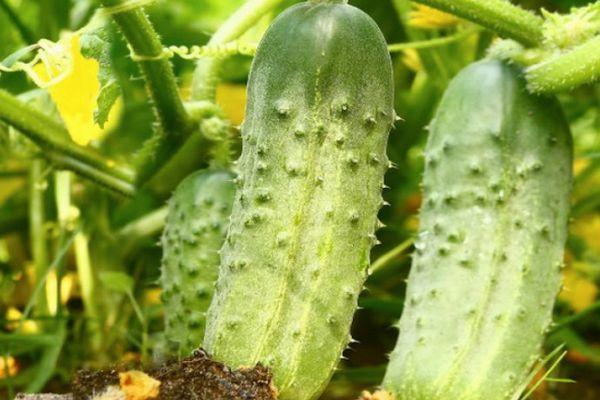
Cucumbers, the envy of everyone, belong to a group of hybrids that grow both in greenhouses and open ground. The plant can be grown indoors, as it thrives in low light conditions. The fruits are suitable for canning and pickling, and they are eaten fresh or sliced into salads.
Characteristics and description of the variety
The characteristics and description of the variety are as follows:
- The hybrid pollinates itself, so it takes 40-45 days from planting the seedlings to receiving cucumber products.
- The bush grows up to 1.0 m tall. It develops numerous shoots, producing numerous nodes. These can produce 3 to 6 ovaries.
- The length of the fruit ranges from 98.5 to 12.5 cm. The flesh is crisp and juicy.
- The weight of the fruits reaches 0.1 kg.
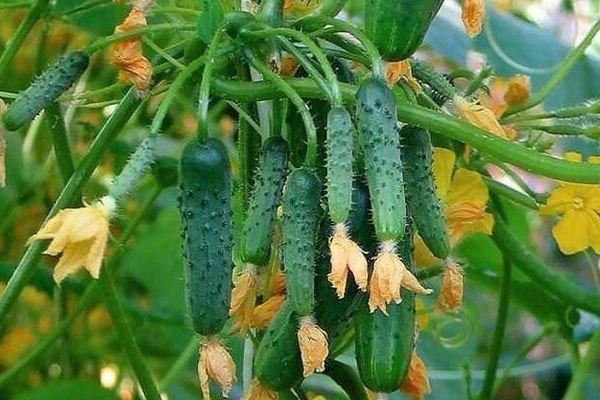
Gardeners' reviews indicate that the yield of the "To Envy Everyone F1" cucumbers reaches 10-40 kg per 1 m² of garden bed per season. Moreover, the harvest volume is virtually independent of weather conditions. This "variability" in yield is due to the hybrid varieties developed by breeders.
If a gardener follows all agricultural practices, they can harvest 3-4 kg of fruit per square meter in a single harvest. The hybrid is highly resistant to cucumber mosaic virus, powdery mildew, root rot, and olive leaf spot. The plant should be protected from late blight.
In a cold cellar, the hybrid's fruits can be stored for up to 45 days. The harvest can be transported over considerable distances, as the cucumber's dense structure protects it from mechanical damage.

The hybrid can be planted throughout Russia. In the southern regions of the country, seeds are sown directly into the ground, while in the central regions, plastic greenhouses and hotbeds are best. In Siberia and the northern regions, seedlings are planted in well-heated greenhouse complexes or hotbeds.

How to plant a hybrid yourself
Cucumbers of this variety are planted both by direct sowing and by using seedlings. To obtain seedlings, the seeds are planted in a homemade mixture of peat, sand, and soil in the last ten days of March or early April. The seeds are sown to a depth of no more than 20 mm. They germinate well at a temperature of +25°C. The soil should be warmed to +14…+15°C.
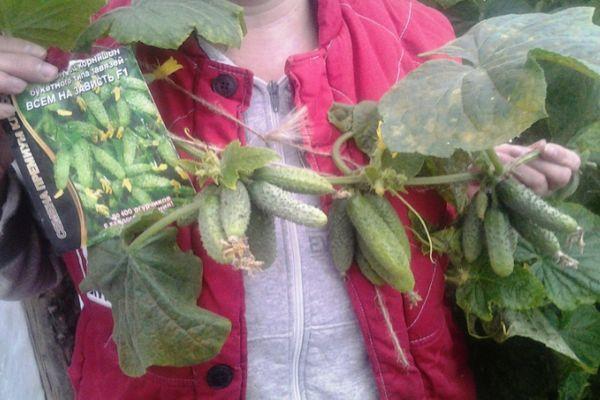
It's recommended to plant seedlings in a permanent location only if there are no sudden changes in nighttime air temperature. Cover the seedlings with plastic wrap or any other warm material. This will protect the young plants from frost and sunburn.
The seedlings are planted in a 0.15 x 0.6 m format. This arrangement ensures that the bush does not interfere with its neighbor, does not shade it, and allows free air circulation between the plants.
Many gardeners are interested in how to shape their bushes. To do this, remove the four lower ovaries, allowing all the remaining shoots to grow upwards rather than outwards. In some cases, staking the hybrid's branches is recommended. Failure to do this can cause the bush to break off when producing a large number of fruits.
Caring for plants before harvest
If you properly implement all agricultural practices and follow the advice of plant breeders, you can get the largest possible harvest. To achieve this, you need to water the growing stems promptly, loosen the soil under the bushes, and control weeds and garden pests.
Be sure to water the seedlings three times a week with warm, sun-settled water. It's best to do this after sunset. Removing the four lower nodes on the stems will produce larger fruits. There's no limit to the number of ovaries at each node, but there should be only one leaf.
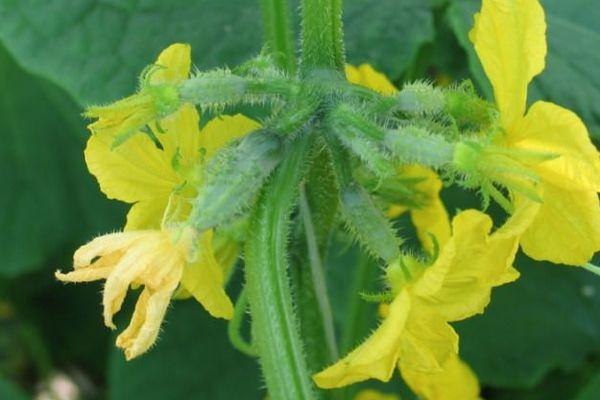
After the first fruits have formed, plants are fed with nitrogen fertilizers or nitrogen-containing organic matter. Complex mixtures are recommended for use during fruit formation.
To prevent various diseases, it is recommended to treat plant leaves with medicinal preparations that destroy fungi and bacteria.
If some specimens of the hybrid become infected with any disease, they are destroyed to prevent the spread of the infection.
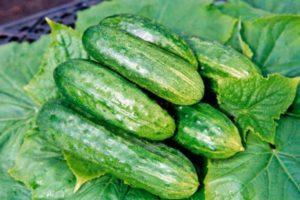
Loosening the soil in the beds is done twice a week. This procedure helps the roots receive oxygen, which promotes rapid growth. Weeding the beds is done every 14 days. This helps combat late blight and kills parasites that colonize the plant's root system.
If signs of a garden pest infestation appear, spray the leaves and stems with pesticides. If none are present, copper sulfate or a soap solution is recommended. Wood ash, added to the soil, helps kill pests. It repels slugs and kills the larvae of various insects that parasitize plant roots.
Related posts:
 The best eggplant varieties for growing in a polycarbonate greenhouse: planting and care
 80 Best Eggplant Varieties for Different Regions with Descriptions and Characteristics
 Description of the best varieties of black tomatoes for open ground and greenhouses
 Methods for planting and propagating cherries at home
 The health benefits and harms of cherries, rules of consumption, and their effects on the body
 The best grape varieties for growing in the Urals, planting and care rules in summer
 The health benefits and contraindications of black currants
 Descriptions of the 20 best cherry varieties for the Moscow region, their planting and care