In a good harvest year, when tomatoes, eggplants, plums, and apples are inexpensive, many women who haven't previously canned buy them to make jam or preserve assorted vegetables. Some recipes call for sterilizing jars, but not all novice home cooks understand how and why to do this. Empty containers are typically sterilized, which doesn't guarantee the vegetable snacks won't spoil.
Why do they sterilize?
To extend the shelf life of preserves containing liquid and protect them from mold, boiling fat or oil is poured into jars and sealed with parchment paper, which prevents germs and fungi from entering. Salads, caviar, and vegetable preserves, which are acid-free, like pickled tomatoes, are attacked by bacteria that are killed by high temperatures, which is why the jars and the snack are sterilized together. After heat treatment, the containers must be hermetically sealed.
What you need to consider
Getting ready to prepare zucchini caviar for the winter Whether you're making eggplant, adjika, or sauce, you need to not only wash, sort, and chop the vegetables, but also choose glass containers that are free of cracks and chips, as well as tin lids that are airtight.
Jars and their contents can be disinfected:
- in a container with boiling water;
- in the oven;
- in a microwave oven.
Each sterilization method has its own rules that must not be ignored. Containers containing salads and caviar swell when contaminated with debris, so the vegetables are washed and soaked.
Do not fill the jar with boiling mass, as the glass may crack.
When disinfecting containers, avoid adding vinegar or hot peppers to snacks. If empty containers aren't sterilized, they must be washed with baking soda or mustard.

To improve the disinfection process, a couple of spoons of salt are added to the water in which the container is placed, killing the microorganisms that cause fermentation.
How to sterilize filled jars
Regardless of the chosen method for disinfecting vegetable preserves, it's essential to adhere to the heat treatment time. Reducing the sterilization time will prevent microorganisms from entering full jars of salad or caviar.
In the microwave
A microwave oven is convenient for disinfecting small containers of adjika or caviar. Place the containers on the rack without lids, which should be disinfected separately by placing them in boiling water. Turn on the microwave at maximum power. Do not fill the jars to the brim with the product, as the contents may spill and contaminate the microwave's interior. Boil the vegetable mixture for 10 to 15 minutes.
In the oven
When preserving caviar with zucchini or eggplant, the containers containing the finished product must be sterilized. Place the hot jars on a rack in a gas or electric oven preheated to 100°C, gradually increasing the temperature to 120°C. Sterilize one-liter containers of caviar for 15 minutes.
In boiling water
Both disinfection methods are effective, extending the shelf life of preserves by killing pathogenic fungi and bacteria. However, women, out of habit, place jars of preserves in a large saucepan or basin filled with warm water just below the top of the glass container. The bottom is lined with a thick cloth, and the stove is turned on.
The method is convenient because it can sterilize not only small containers, but also 2- and 3-liter jars.
To raise the temperature of boiling water to 110°C, which is necessary for disinfecting some preserves, salt is added to the container. Tomatoes and cucumbers are sterilized in a pot of water if they are going to be stored in the kitchen or pantry rather than in the basement.
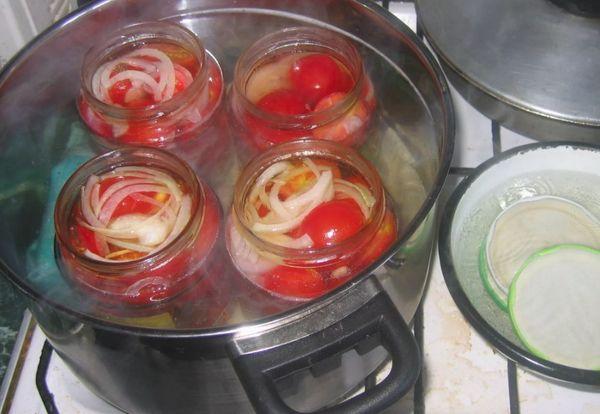
Boil 0.5 liter jars for 10 minutes, 3 liter jars for half an hour.
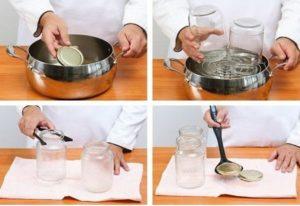
Pasteurization
Heating appetizers and salads to 100°C not only kills microorganisms but also evaporates the beneficial components of fresh vegetables. To preserve vitamins and rich color through pasteurization:
- A tank or deep pan is filled with water.
- A lid with holes is placed on the bottom of the container.
- Place jars with the preparation on top, leaving 20 or 30 mm between each.
When boiling, the vegetable mixture only reaches a temperature of 98°C. After a quarter of an hour, the container with the preserves is removed from the tank and sealed hermetically.
Is it possible to sterilize already sealed jars?
Containers of salads prepared for the winter, which will be stored under tin lids, are first placed in the microwave, oven, or a pan of boiling water to sterilize, and only then sealed hermetically.
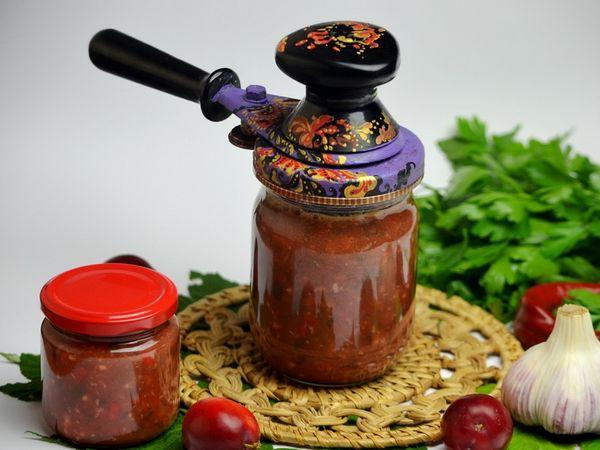
Jars of vegetable caviar can be sealed with glass lids, a seal and clamp can be installed on the neck, and then a suitable method can be chosen to disinfect the contents from microbes.
How long does the procedure take?
Preparing the jars, cleaning, and chopping vegetables for canning can take up to an hour. Whether in the oven or in a pot of water, jars of caviar or adjika take approximately the same amount of time to sterilize after boiling. The sterilization process takes approximately the following volumes:
- 0.5 l – 10 minutes;
- 1 l - 15-20;
- 3 liters - half an hour.
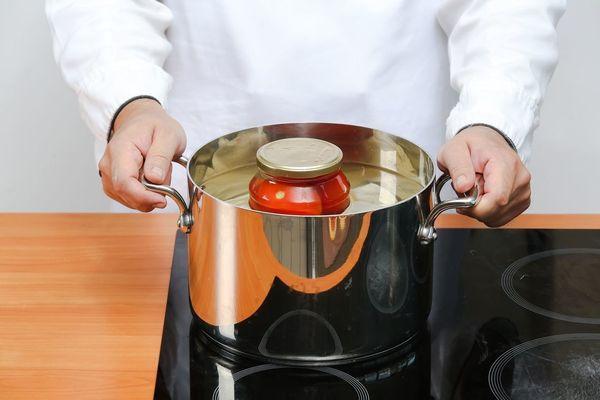
Tomatoes are not heated for long periods of time, as their delicate skins will burst quickly. Hot jars containing the vegetable mixture are removed with tongs and sealed immediately.
How to wrap and store preparations
To keep eggplant or squash caviar from spoiling for longer, seal the container hermetically, insulate it with a towel, blanket, or blanket, and leave it upside down for 24 hours. To ensure that prepared salads last through the winter or even a year, the jars with preserves are placed in a basement or cellar.
Related posts:
 How to sterilize jam jars in the microwave: methods and rules
 How to properly sterilize jars at home and for how long, the best methods
 Is it possible to sterilize empty jars in the microwave? How to do it correctly and for how many minutes?
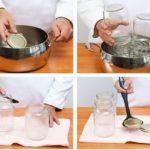 How long does it take to sterilize jars with steam? Home cooking instructions.
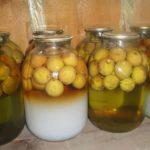 How to properly preserve compotes for the winter, methods for sterilizing jars, and the main problems
 15 simple recipes for pickling tomatoes in jars for the winter
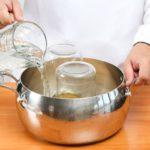 How and how long should you sterilize jars in a pot of water at home?
 TOP 10 step-by-step recipes for preparing zucchini like pineapples for the winter, with and without sterilization