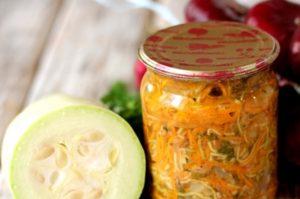
Many housewives try to stock up on as many canned fruits and vegetables as possible for the winter to ensure they get the necessary vitamins every day during the cold season. But to ensure canned goods last a long time, it's important to store them in sterile, clean jars. Every housewife should know how long to steam sterilize jars of different sizes to prevent spoilage.
Features of steam sterilization
Sterilization is an important stage of food preservation. If you ignore this procedure, your delicious and healthy preserves will be irreparably spoiled. Either the jars containing the contents will explode, or the canned product will become unfit for consumption and may even cause food poisoning.
Some housewives believe that thoroughly washing jars is sufficient. But this is not true. Even after washing, the surface of jars and lids remains teeming with microbes, continuously releasing waste products harmful to humans.
One such product is botulinum toxin, which causes the life-threatening disease botulism. Therefore, home sterilization procedures should not be ignored.
Heat treatment of cooking utensils can be carried out with or without the use of steam. The latter involves the use of an oven or electric oven. Steam treatment involves:
- holding over the released steam;
- using a container with water;
- also microwave oven;
- multicookers;
- steamers.
Preparatory work
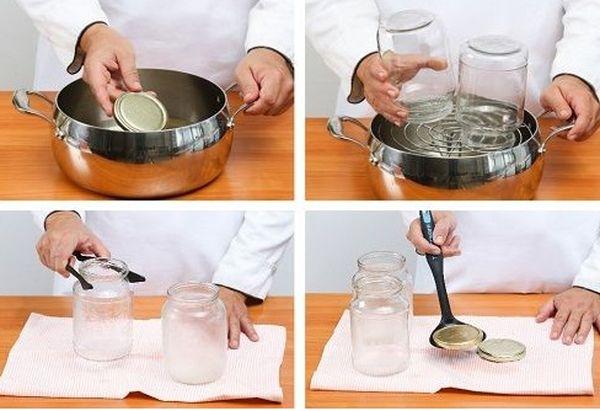
To carry out the procedure you need to take:
- a capacious container with water;
- a metal cover with holes for inserting cans;
- clean cotton kitchen towels;
- jars and lids.
You can choose any vessel for boiling. It can be a saucepan of a certain size or a tank. The main thing is that it can accommodate the required number of jars.
Take a look Also
Not all home cooks have sterilization pads. In this situation, a flat, wide colander can be used. However, pads are the best option. They allow you to heat jars effectively, and most of the steam settles on the glass walls rather than escaping, resulting in a slight increase in humidity in the kitchen. Therefore, it's advisable to buy pads; they're inexpensive.
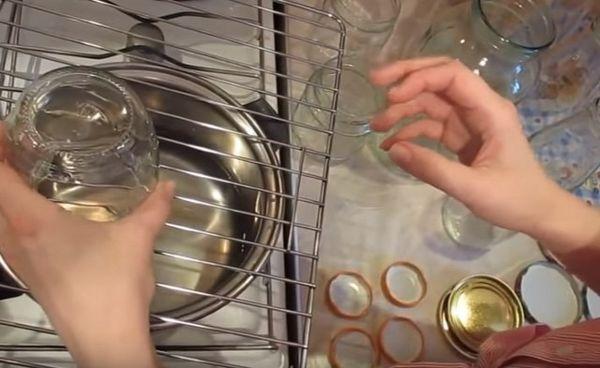
The towels are washed and ironed on both sides using the highest temperature setting. One towel is used for removing the jars from the lids, and the other is used for placing them upside down on the table.
Prepared jars should be inspected for cracks, chips, and stubborn dirt. Any defective jars should not be used for canning. Suitable jars should be thoroughly washed with hot water, preferably with baking soda. Then rinse thoroughly. Do not use gel or powder dishwashing detergents.
Lids are usually tin, single-use. Reusable threaded ones are also acceptable, but they should be free of defects and dents.
Required temperature
The required temperature level is determined by the sterilization method:
- in the oven – 150 °C;
- in a microwave oven – power up to 1000 W;
- Above the container with the released steam is water boiling at a temperature of 100 °C.
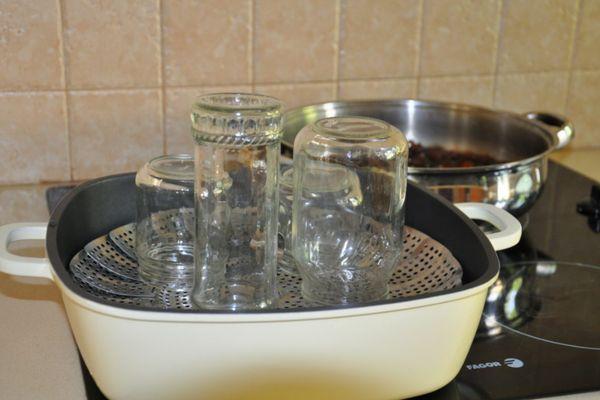
What can be done to prevent banks from bursting?
The jar may burst during the sterilization process due to:
- the presence of unnoticed cracks on the glass surface or chips on the rim;
- high temperature difference between the dishes and the steam.
To prevent sterilization from rupturing, it's important to perform it correctly: avoid using defective or unheated containers. Jars should be warm.
How long does it take to steam jars?
Sterilization is carried out according to the following algorithm:
- Fill a large container with water. The volume of water is determined by the number of jars you're sterilizing. If you're using three-liter containers or several smaller ones, it's best to fill the container halfway with water.
- A cover is placed on the dish.
- Turn on high heat to make the water boil faster.
- Place the jars on a simmering rack. Reduce the heat so that the water doesn't boil, but continues to simmer at a moderate rate.

As soon as the water begins to boil, start counting down the sterilization time. The sterilization duration is determined by the volume of the jars and the method of heat application. Steaming small jars takes less time than three-liter jars.
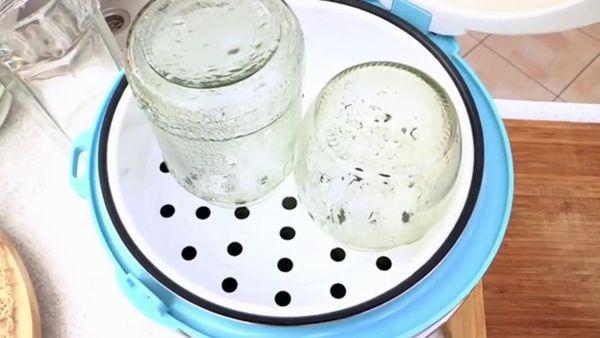
Half-liter
0.5 liter containers are processed for the following number of minutes:
- in a steamer – 10;
- in the microwave – 2;
- over a pan of boiling water – 15.
1-liter
1 liter jars should be kept:
- in a steamer (or multicooker) – 15 minutes;
- in a microwave oven – 3;
- over boiling water – 20.
Three-liter
How long can you process a 3 liter container:
- in a steamer – 40 minutes;
- in the microwave – 5;
- over boiling water – 30.
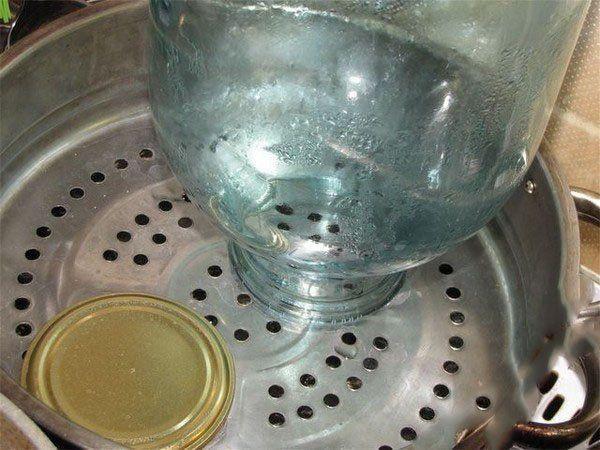
Features of sterilizing jars in a steamer
To sterilize the dishes, fill the steamer with water. Place the containers on the lid, rim down. Sterilization times are listed above.
You can tell when the steaming process is finished visually: large drops of water will start to run down the glass sides of the jars.
Is it possible to sterilize jars with preserves in this way?
Yes, but it requires a special procedure. To sterilize the containers with the ingredients inside, use a large saucepan. Place a thin towel on the bottom.
Then proceed as follows:
- the rolls are placed on the towel;
- heat the water to a temperature corresponding to the temperature of the jars (cold water may cause the glass to crack);
- water is poured into the pan to the level of the jar shoulders;
- cover the pan with a lid, but not tightly;
- turn on the heat and bring the water to a boil.
Boil the jars for the amount of time indicated for the size of the jar: 0.5-liter jars – 10 minutes, 1-liter jars – 15, 2-liter jars – 20, 3-liter jars – 30. The appearance of numerous large drops of water on the glass surface indicates that sterilization is complete.
Related posts:
 How to properly sterilize jars at home and for how long, the best methods
 How to sterilize jam jars in the microwave: methods and rules
 Is it possible to sterilize empty jars in the microwave? How to do it correctly and for how many minutes?
 How to properly preserve compotes for the winter, methods for sterilizing jars, and the main problems
 How and how long should you sterilize jars in a pot of water at home?
 How to properly sterilize jars with preserves, the best methods and duration
 The most delicious recipes for pickled cucumbers and zucchini in one jar for the winter
 Why do jars of cucumbers explode? What to do? How to save and reseal them? Is it safe to eat?