
- Pickled and salted watermelons: their health benefits and harms
- Peculiarities of watermelon pickling
- At the bank
- In a saucepan
- In a barrel
- In a bucket
- Choosing the right watermelon
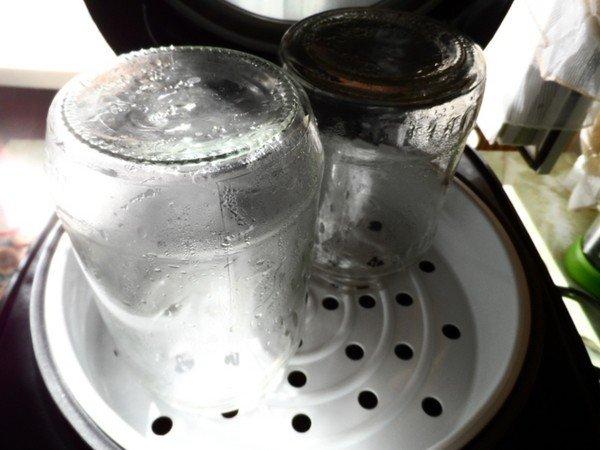
- We prepare and sterilize containers
- Basic recipes for preparing berries
- The classic method of pickling watermelons for the winter in jars
- Pickled with mustard
- With sauerkraut
- Whole pickled watermelons in a barrel
- Fermentation in ceramic barrels
- Pickled in a barrel with spices
- Pickled in watermelon juice
- Recipe with honey
- With garlic
- With cloves
- With grapes
- Without sterilization
- Marinated watermelon pieces
- A quick pickling recipe
- Storage rules
Russian cuisine is renowned for its diversity, offering a multitude of pickles, marinades, and homemade preserves. Whole, firm watermelons, salted, are exceptionally delicious: they can be prepared sweet and sour, with garlic, whole or in wedges. The choice of specific recipe determines whether the dish will be enjoyed by the host and guests.
Pickled and salted watermelons: their health benefits and harms
A large garden berry, watermelon is healthy when eaten fresh. It's a great option for an impromptu dessert and a way to cool down in the summer heat. Watermelon is loved by both adults and children. It quenches thirst perfectly and has a beneficial effect on metabolism and the genitourinary system.
Watermelon contains a lot of liquid:
- water – 92%;
- sugar – 8%.
Watermelons contain vitamins A, B, PP, C, and E, as well as trace elements such as potassium, magnesium, and iron. They are recommended for anemia and for pregnant and lactating women. The benefits of watermelons include antioxidant activity, a beneficial effect on the heart and circulatory system, and the ability to normalize blood pressure. Plaques that build up on the walls of blood vessels will decrease in size after eating this sweet berry, and bone tissue will be strengthened by the calcium dissolved in the juice. The seeds are beneficial for athletes, as they contribute to muscle growth. Overall, nutritionists recommend eating watermelon for weight loss and the removal of accumulated toxins from the body.
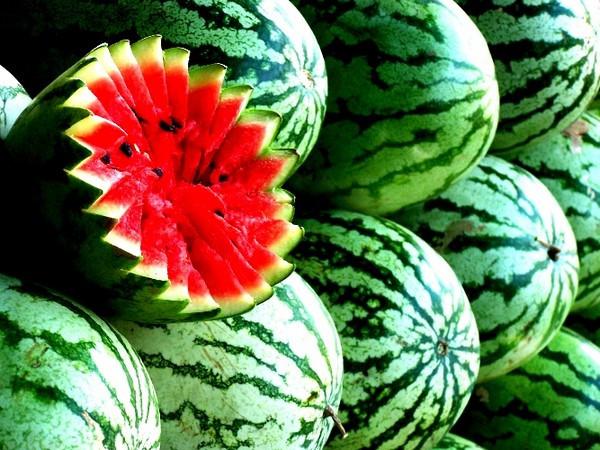
Many beneficial properties are concentrated not only in the pulp, but also in the rind, juice, and seeds, so it makes sense to use them in pickling, marinating, or freezing. Pickling watermelon is easy: just slice it or immerse it whole in the solution, wait the required time, and the product is ready.
But overindulging in this delicacy, especially for those with kidney disease, diabetes, or genitourinary complications, can lead to serious consequences. The polysaccharides and high fluid content of fresh watermelon are harmful for these patients, and when combined with salt, they are doubly dangerous. Edema and an allergic reaction may occur.
You should be careful when eating early ripening watermelons in the early period – before the end of July and the beginning of August: there is a high risk of poisoning from products rich in nitrates, which are not at all healthy because of this.
Better yet, wait until the end of summer and then enjoy the taste of ripe, sweet melons.
Peculiarities of watermelon pickling
Thanks to its high liquid content, watermelon pickles easily and quickly. The amount of water for the brine is adjusted experimentally, depending on the specific watermelon being brine. Preparation takes 2-3 days, and within that time, delicious, crispy, sweet-and-sour watermelon slices are ready.
The fruits shouldn't be overly soft or have peeling flesh—these are unsuitable for canning. Firm, unripe watermelons are best: they'll keep for a long time and won't fall apart during pickling. Cracked, rotten, or bruised watermelons should be discarded immediately.
Never use an aluminum pan—enameled or glassware is recommended. Adding mustard or garlic will enhance the flavor, making it more piquant and rich.
At the bank
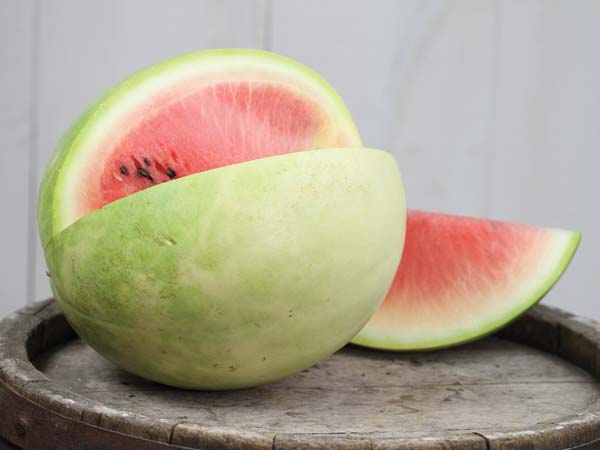
For pickling in glass containers, choose medium-sized, medium-ripe berries. It's important to remember that the brine solution should completely cover the flesh, so it's best to cut the watermelon into wedges. The size of the jar also plays a role: 1-liter jars or smaller aren't suitable—they won't hold much. The optimal size is 3-liter jars.
You'll need a clean, undamaged glass jar, table salt, and the watermelon itself. Calculating the correct amount isn't easy—experimentation is recommended. Wash the watermelon, remove any dirt or damaged areas from the rind, and dry it with a towel. Then cut it into segments large enough to fit into the mouth of the jar (approximately 7-8 centimeters). You can choose to pickle just the pulp or the whole watermelon, including the rind—it's up to you.
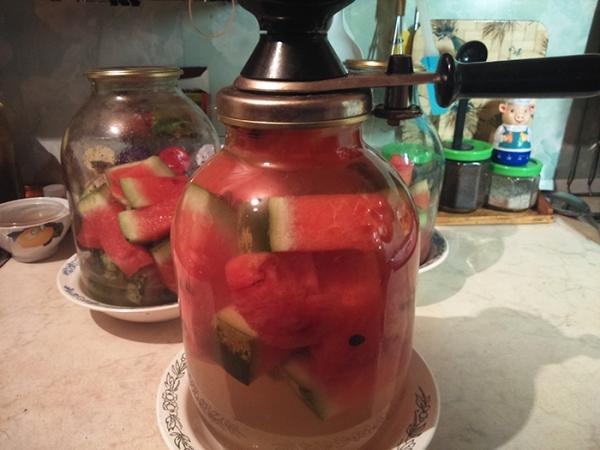
The peeled core will be salted faster, and the slice with the seeds and skin will be more satisfying to crunch on. Next, prepare a solution: 2 tablespoons of rock salt per 1 liter of water.
Place the slices in a jar, pour brine over them until they're completely covered, and leave at room temperature. After 2-3 days, the separately salted flesh will be completely ready; the watermelon with the rinds on will soak in the brine more slowly (over about a month).
In a saucepan
A great way to treat yourself to a delicious treat is to pickle watermelon in a saucepan. The material of the container is limited: no aluminum; glass, stainless steel, or enamel are best. A wide, flat saucepan with a lid will hold a sufficient amount of the finished product.
A medium-sized watermelon is thoroughly washed under running water and sliced. Leaving the peel on ensures virtually zero waste. You'll just have to trim off the top and bottom, and the rest is recycled. Place the watermelon in a saucepan and then pour brine over it.
To prepare it you will need:
- Water – 1-1.5 liters (determined experimentally).
- Salt – 100 grams.
- Granulated sugar – 80 grams.
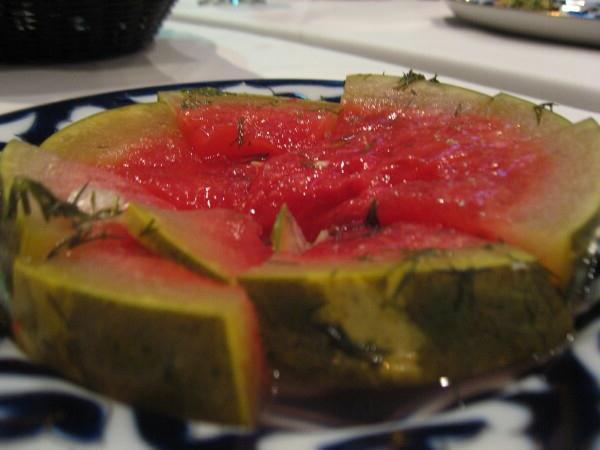
The composition should cover the contents completely; sometimes, to improve the taste, currant leaves are used.
Tip: The ingredients dissolve better in hot water, then immediately pour the brine over the watermelon. Cover the pot with a lid and store in a cool, dark place. You can brine the whole berry instead of cutting it into slices, but this takes a lot longer. After 30-35 days, you can begin tasting the crisp, sweet and sour slices. The finished product should be stored in a cool place for no more than 2 weeks.
In a barrel
An old Russian recipe: fermenting in a wooden barrel (preferably oak) ensures the snack is salted quickly and thoroughly, preventing it from absorbing foreign odors or acquiring unpleasant flavors. This method also allows you to salt the whole watermelon—no need to cut it or peel it. Thin-skinned berries—special southern varieties—are best. Sugary berries that ripen too quickly and too quickly are also unsuitable: pink-fleshed watermelons are best.
The salting process begins with preparing the container: it is thoroughly washed and cleaned without the use of chemicals. Plain water is used for this, and finally, the barrel is scalded with boiling water.
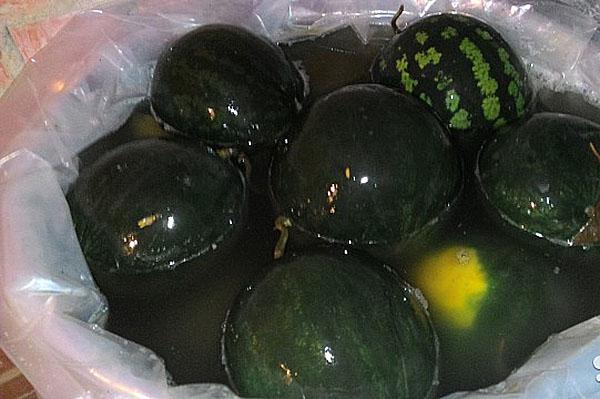
To help the brine penetrate the core of the fruit, you can poke small holes in it (using a bamboo skewer or knitting needle). The watermelons selected for preservation are placed in a barrel. The salt and water content are adjusted arbitrarily, at a rate of 600 to 800 grams per 10 liters. Knowing the capacity of the container and this ratio, preparing the brine is easy.
The solution should completely cover the contents; a special weight (press) can be used to press down on the watermelons. The minimum pickling period is 21 days. Readiness is checked by tasting the product: it should be rich, slightly tart and sweet, and the skin should soften to the consistency of a fresh cucumber.
In a bucket
Another option is a cross between pickling in a jar and a barrel. To successfully complete the process, you'll need a bucket—a clean plastic or enamel one, like those found in every home. Wash and dry a medium-sized, moderately ripe watermelon with a not-too-thick rind. If pickling whole, no more than one will fit in the bucket, but cutting it into slices or layers will allow the berry to fit more tightly.
Place the prepared, cut fruits in a pre-washed container and then pour in a cold brine (approximately 600 grams of salt per 10 liters of water). For a piquant flavor, you can add a bay leaf, currant leaf, or 4-5 black peppercorns—whatever you prefer.
When pickling, two conditions must be met: the solution must cover the entire contents, and the berries must be pricked in several places. The product is ready in 3-4 weeks.
Choosing the right watermelon
The success of an event depends largely on the choice of watermelon. It shouldn't be:
- overripe;
- broken or rotten;
- incised, cracked;
- thick-skinned;
- from sugar varieties.
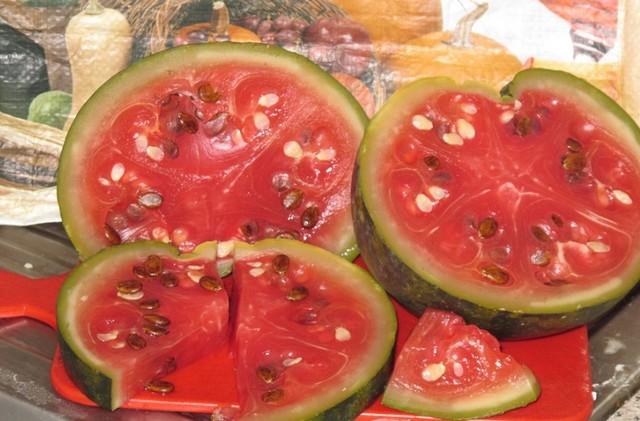
Sweetness isn't a crucial factor for pickling. It's much more important that the fruit be firm, elastic, and have a moderately thick rind. Size influences the pickling method and container: small watermelons are easier to preserve in buckets and tubs, while larger ones will definitely need to be cut into wedges. Slightly greenish, but not too green, watermelons are best when ripe. After 20-30 days of brine curing, they will develop a unique sweet-tart flavor.
We prepare and sterilize containers
To prepare a delicious, healthy snack, you need the right containers. These include glass jars of appropriate capacity (preferably 1-2 or 3-liter), wide-bottomed saucepans (enameled, thermoglass, or stainless steel), plastic buckets, and barrels. The latter option is considered a classic: this is how vegetables and fruits were pickled and fermented in the old days.
Never use chemical detergents or cleaning agents when cleaning the containers; only use running water. Finally, rinse the containers with boiling water. The containers are ready for pickling.
Basic recipes for preparing berries
There are several classic methods for pickling watermelon—in jars, saucepans, and wooden barrels, with or without additional ingredients. All of them are simple, which is their main advantage. To enjoy the taste of salted berries, whole or sliced, after 3-4 weeks, you'll need two main ingredients: water and regular table salt. This is how our ancestors prepared them, and these same methods are still used today.
The classic method of pickling watermelons for the winter in jars
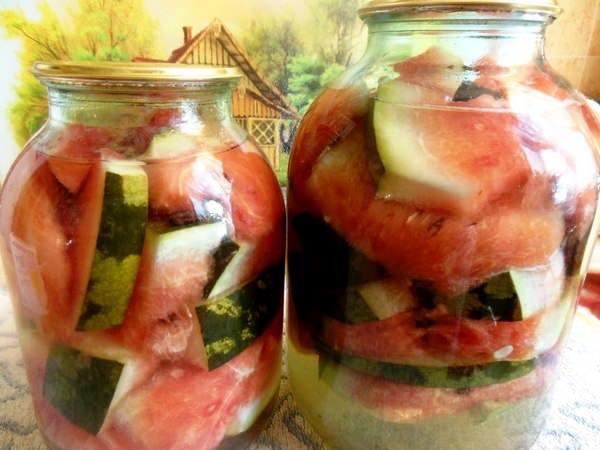
Pickling ripe watermelons in glass jars is a convenient option for urban settings: no need to find a bucket or tub, or adhere to special container preparation requirements. To obtain juicy, firm, tart-salty, and slightly sweet slices, you'll need:
- salt – 1 tablespoon;
- granulated sugar – 2 tablespoons;
- vinegar essence 70% – 1 teaspoon (per 3 liter glass jar);
- clean water – 1 liter.
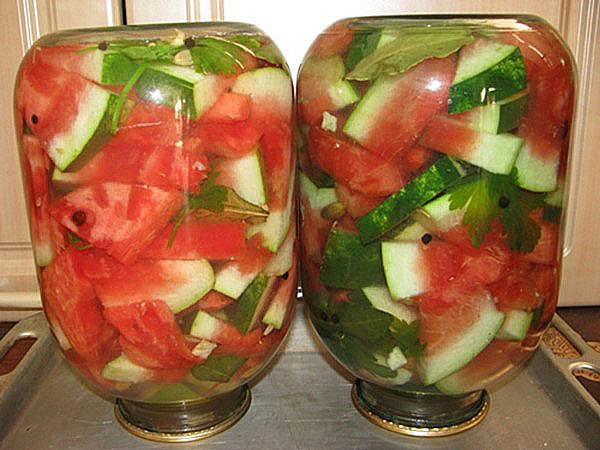
Wash the watermelons thoroughly, clean off any dirt with a sponge or brush, and dry. They are cut using a special method: first, slices are cut across the entire width, then each layer is successively divided into 2, 4, and 6 pieces to form neat triangles. Then, they are placed in jars (pre-sterilized), water is heated in a clean saucepan, and the watermelons are poured in. The pulp needs to absorb moisture, so it is left there for a while (half an hour).
The cooled liquid is poured back into the saucepan; it will be used to make the brine. Place the pan over low heat, add salt and sugar one after the other, and stir until completely dissolved. Pour the vinegar directly into the jars, and fill them with the boiling brine. Seal the jars with tin lids, turn them upside down, wrap them tightly, and leave them like that for several hours. The preserves can be stored in a cool, dark place. The snack is ready to eat at any time.
Pickled with mustard
This recipe is a twist on the classic recipe, adding a new ingredient. Everything is done as usual, except this time you'll need mustard powder. Clean, sliced watermelon is layered in a bucket or saucepan, sprinkled with a mixture of sugar, salt, and mustard. You'll need about 1 tablespoon of each ingredient (per medium-sized berry).
You don't need to add any water at all; the layers, pressed down with a weight (a stone wrapped in a clean cloth, a jar of water, or a weight), will release juice, which will saturate the filling and salt them. After 5 days, the product is ready. Before eating, rinse the watermelon with water, remove the salt, and serve. The taste is sweet and sour, with a hint of tang.
With sauerkraut
You can also pickle watermelon this way – with white cabbage, alternating layers in a tub or bucket. This is one option; you can also shred the cabbage as for regular pickling, and place medium-sized watermelons uncut. Try both ways: the taste of the finished product will not disappoint.
Whole pickled watermelons in a barrel
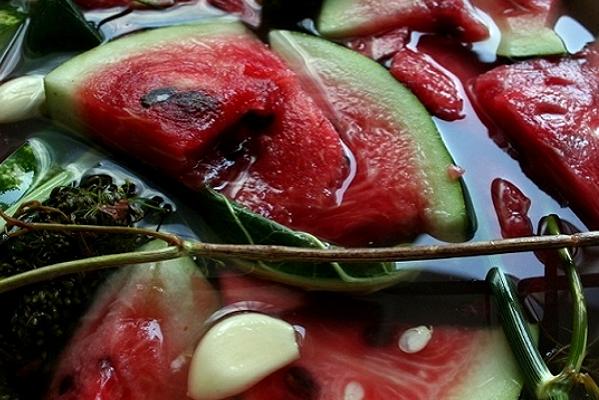
You'll need a sturdy, thoroughly cleaned wooden barrel with no rotten boards. Before pickling, rinse it with boiling water, then place washed, medium-ripe watermelons without cracks or cuts in it. Fill with water and add table salt at a rate of 600 grams per 10 liters.
You can apply some weight on top. The fermented watermelon is cut into slices, peeled, and served as a unique vodka appetizer—whatever your preference.
Fermentation in ceramic barrels
This method is not fundamentally different from cooking in a wooden container. Ceramic is renowned for its inertness to food and does not transfer or absorb odors. Therefore, it is ideal for fermenting cabbage, apples, and watermelons. It's important to remember that, despite all its beneficial properties, this material is fragile and susceptible to impacts and excessive loads.
Pickled in a barrel with spices
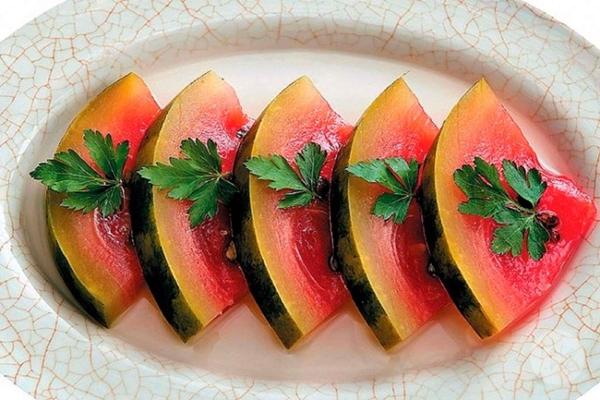
Another variation on the classic recipe. Spices (cloves, nutmeg, peppercorns, bay leaf) can be combined in any way you like: let your imagination run wild, remembering to taste the finished product for spiciness. Sliced and peeled berries will pickle faster, while peeled ones will be firm and crisp, like cucumbers.
Pickled in watermelon juice
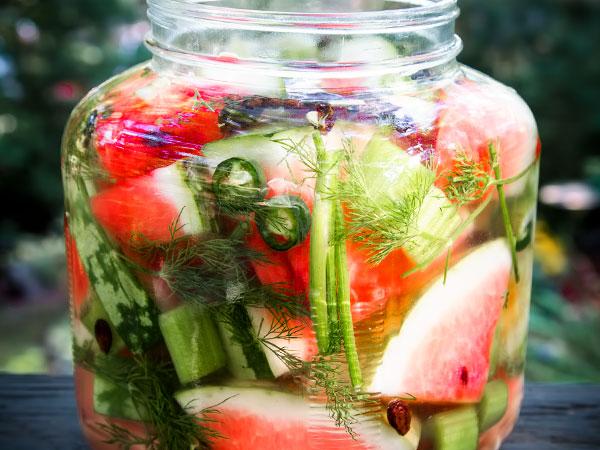
A lazy method: remove the outermost layer of the watermelon's rind (the green part), leaving the white layer. Cut the peeled berry into segments and place it in a jar. Sprinkle with coarse salt, using as much as you like. Cover with a plastic lid and leave in a warm place for about 24 hours.
Gradually, the watermelon will release juice and absorb the salt. You can shake the jar periodically to ensure even fermentation. The finished dish can be stored in the refrigerator.
Recipe with honey
To implement this idea, you'll need honey—natural, uncandied. Clean, sterilized jars are filled with watermelon slices. The contents are then steeped in boiling water for 8-10 minutes. The drained liquid is used to prepare the marinade: 5 tablespoons of sugar, 250 milliliters of honey, 5 tablespoons of salt, and 300 milliliters of vinegar (9%). This mixture is used for 7-8 liters of water and approximately 8 kilograms of watermelon.
The marinade ingredients are added to the jars one by one, then topped up with the liquid brought to a boil again. The jars are sealed with a tin lid, turned upside down, and wrapped in a blanket.
The finished product is stored in the refrigerator, pantry or cellar.
With garlic
For each 3-liter jar of pickled berries, you can add 2-3 cloves of garlic: this will add a slight tang to the watermelon, making it even more delicious. This appetizer goes well with meat dishes, roasts, and stewed potatoes.
With cloves
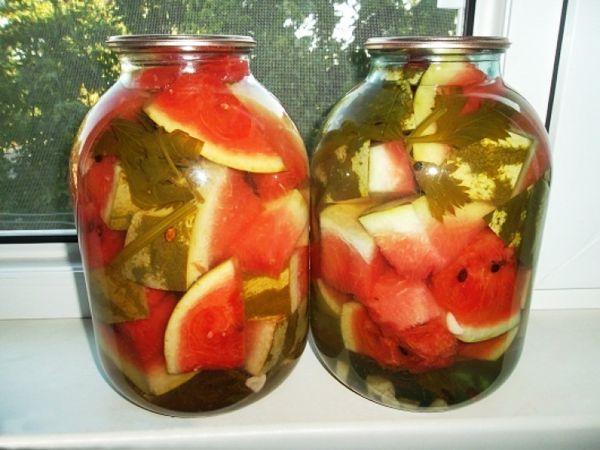
Adding cloves to salted watermelons will add a slight tartness. Just be careful not to overdo it, otherwise the finished product will acquire a bitterness that will be impossible to remove. This method allows you to pickle the berries in jars, barrels, pots, or buckets.
With grapes
A delicious, sweet and sour salty snack, for the preparation of which you will need:
- Medium ripe watermelon – 2 kilograms.
- Grapes – 0.5 kilograms.
- Allspice – 5 peas.
- Cherry leaves – 10-15 pieces.
- Whole cardamom – 3 pieces.
- Peppermint sprigs – 3 pieces.
- Salt – 1 tablespoon.
- Sugar – 2 tablespoons.
- Vinegar – 1 tablespoon.
- Water – 1.5 liters.
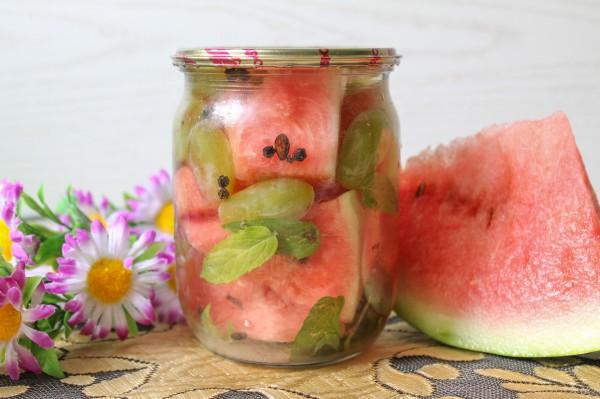
Pre-washed and sterilized jars are filled with sliced watermelon. Mint and cherries are placed at the very bottom beforehand. Grapes are placed randomly between the layers of watermelon. Boiling water is poured over this mixture and left to steep for 20 minutes. The cooled liquid is carefully poured into a saucepan, reheated, and sugar, salt, vinegar, pepper, and cardamom are added. The resulting marinade is then used to fill the jars with the watermelon and sealed.
Without sterilization
A quick way to make a salty snack. Prepare the salt, sugar, and watermelon in advance. Wash the berries and cut them into small pieces, large enough to fit in 1-2 liter jars. Then, place them in the jars, sprinkling them with a dry salt and sugar mixture. Cover with a plastic lid and leave in a warm place for 72 hours. Store in the refrigerator and enjoy with meat, poultry, and vegetables.
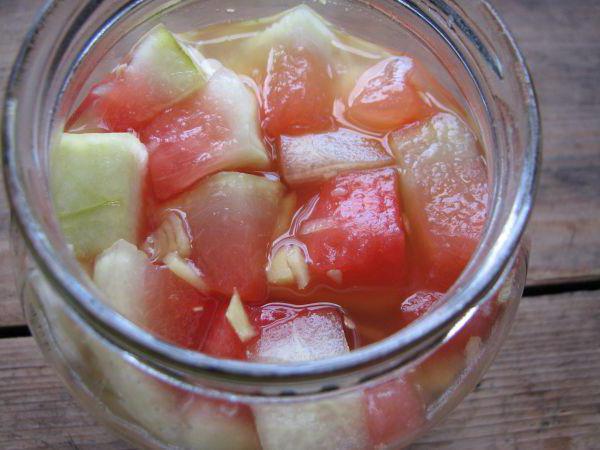
Marinated watermelon pieces
One of the simple step-by-step recipes. You will need:
- granulated sugar – 2 tablespoons;
- rock salt – 1 tablespoon;
- vinegar 9% – 1 tablespoon;
- watermelon – 2 kilograms;
- clean cold water – 1.3 liters.
The proportions given are for a 3-liter jar. Place ripe berry pieces in clean, steamed jars and pour boiling water over them to the top. Let sit for 20 minutes. Then, pour the water into a saucepan for the marinade. Dissolve the salt and sugar in it and bring to a boil. First, add vinegar, then the marinade. Store the sealed product in the refrigerator or cellar.
A quick pickling recipe
An extremely simple yet effective method. The secret is to peel the watermelon down to the pink flesh, cut it into small cubes, and place it in a saucepan or jar. Fill the jar with a brine made from cold water and table salt (2 tablespoons per liter) until it completely covers all the pieces. After 2-3 days, the snack is ready.
Storage rules
Unsterilized, salted foods in jars with plastic lids or in open containers are stored in the refrigerator. Properly prepared canned foods can be stored in a pantry, cellar, or basement.
Related posts:
 The health benefits and harms of watermelon for the human body, how to consume it correctly
 Description and characteristics of the Sugar Baby watermelon variety, cultivation
 Is it possible to freeze watermelon in the freezer for the winter and how to do it correctly?
 Description and characteristics of the Producer watermelon variety, cultivation features
 15 simple recipes for pickling tomatoes in jars for the winter
 Step-by-step recipes for pickled and canned watermelons in jars for the winter without sterilization
 Simple step-by-step recipes for how to properly pickle saffron milk caps in jars for the winter
 Is it possible to grow a square watermelon at home?