
- How far apart can tomatoes be planted?
- In the greenhouse
- In open ground
- How tomato variety influences planting pattern selection
- Indeterminate
- Determinant
- Low-growing, standard
- Calculating the density of tomato plantings
- Why is it dangerous to thicken garden beds?
- Planting pattern for a vegetable garden
- In rows
- Parallel
- Chess order
- Square nest method
- Planting tomatoes in a greenhouse
- The classic way
- Combined landing
- We select the method according to the different sizes of greenhouse premises
- 3 x 4
- 3 x 6
- 3 x 8
Tomatoes need to be planted so that each plant receives good light and allows for free air circulation. The yield of the crop depends on the seeding pattern. With optimal spacing, they germinate faster and better, and the seedlings grow into healthy transplants. Strong plants thrive, but to ensure fruit set and ripen in the garden or greenhouse, gardeners need to know how far apart to plant tomatoes. The placement of tomatoes in their permanent location affects yield as much as the seeding pattern.
How far apart can tomatoes be planted?
To prevent plant diseases, avoid allowing bushes to touch each other, and be aware of the characteristics of each variety. Tall hybrids require more space than miniature tomatoes.
In the greenhouse
Indeterminate tomatoes in closed ground are planted so that the distance between plants is at least 65 cm, and the distance between beds is up to 80 cm.
If you're leaving 2 or 3 stems on low-growing tomatoes, space each plant about half a meter apart. When training to a single stem, the distance between rows should be 40 to 50 cm, and between plants, about 30 cm.
Seedlings from pots are placed vertically into holes, overgrown tomatoes are placed at an angle into a deeper hole.

In open ground
Tomatoes are planted in the garden or field at the end of May, when the nighttime temperature is at least 12°C. When planting in rows, the paths should be about half a meter to 80 cm wide. When planting in parallel, leave 25 to 70 cm between plants, depending on the growth of the tomatoes.
The seedlings can be placed in a checkerboard pattern, which allows access to all bushes.
How tomato variety influences planting pattern selection
Breeders are developing both short and tall tomatoes. The spacing between plants with an unlimited growing point cannot be the same as when planting standard or dwarf tomatoes.
Take a look Also


Indeterminate
Tomato varieties with strong roots can grow up to 3 meters tall during the growing season. Indeterminate hybrids should not be planted too close together; only two plants per square meter should be planted. Bushes should be tied to supports, side shoots removed, and stems pinched.
Determinant
Tomatoes up to 1.5 meters tall have developed roots, but only grow to a certain point. Varieties that don't require shaping are planted three or four times per square meter.
Low-growing, standard
These compact tomatoes grow to less than 0.5 m in height. They have strong, thick stems and densely foliated branches that don't need to be tied to supports or pinched. Up to 7 standard tomatoes can be grown per square meter.
Calculating the density of tomato plantings
Indeterminate varieties are convenient to grow in a greenhouse because they save space. A single stem is left on each bush, and it produces 8–10 clusters. Fruit sets throughout the growing season. The spacing between seedlings should be 50–75 cm, and between rows, up to a meter.
Standard tomatoes Grown to produce early fruits, compact bushes are planted every 0.3 m.
Why is it dangerous to thicken garden beds?
The productivity of both dwarf and indeterminate tomato varieties depends largely on the spacing between tomato plants. If seedlings are planted close together:
- Tomatoes are not getting enough light.
- Stronger plants take away microelements and moisture from weaker bushes.
- Fungi and bacteria become active, causing various diseases.
When beds become too dense, tomato development slows. Fewer ovaries are set, and the fruits take longer to ripen.

Planting pattern for a vegetable garden
In open ground, holes for standard tomatoes are dug to a depth of 20 cm, and for indeterminate hybrids, to a depth of 0.3 meters. The optimal planting pattern in the garden is chosen based on the crop variety.
In rows
In the garden, it's most convenient to plant tomatoes in two strips, each two plants wide. This method reduces the risk of fungal infections and makes shaping and spraying easier. The row spacing for indeterminate tomatoes is 70 cm, with the distance between plants 50 cm. For standard varieties, the corresponding distances are 50 cm and 30 cm, and for medium-sized varieties, 60 cm and 45 cm.
Parallel
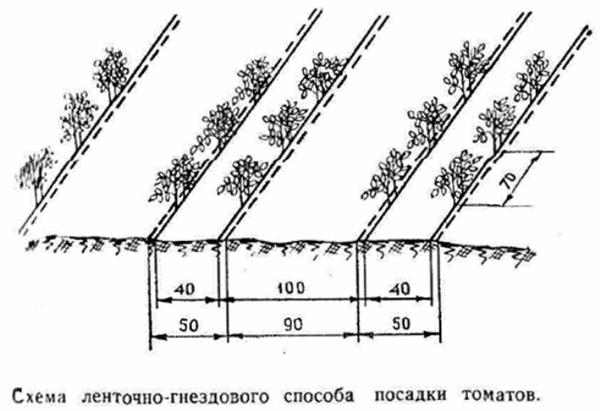
Farms use the ribbon-nest method because it makes tomato care and harvesting easier. Two parallel rows are created, leaving a path one meter wide.

The distance between indeterminate plants should be at least 60 cm, while a 0.4 m interval between standard tomatoes is sufficient. Behind the wide path, two rows are formed again.
Chess order
For compact bushes and medium-sized tomatoes, leave two or three stems instead of just one. The depth of the hole dug depends on the variety and the number of shoots formed. In a checkerboard pattern:
- Tall tomatoes are planted 70 cm apart.
- Medium-sized tomatoes with 3 stems are planted at a distance of 0.5 m.
- Between bushes with 1 shoot, leave a gap of 30 centimeters.
First, create two rows up to 50 cm wide, but begin planting in one row, gradually moving to the other. Mark out the rows before planting the tomatoes.
Square nest method
In areas used by farmers for production purposes, a planting pattern is used in which three tomato plants are placed per hole. The holes are dug in squares, 60 cm apart, along parallel lines marked at 0.8 m intervals. Once the tomatoes have established themselves, the weakest tomato plant is pulled out, and the strongest one is secured to a support.

Planting tomatoes in a greenhouse
In temperate climates, where summers are short and cool and spring frosts linger, vegetables are grown in polycarbonate greenhouses rather than in open beds. When planting in such structures, proper agricultural practices, crop rotation, and soil renewal are essential; otherwise, tomatoes are susceptible to disease, and if they survive, they don't produce a decent harvest.
The classic way
Early standard varieties and tall, single-stemmed hybrids are easiest to plant in rows, maintaining a certain distance between them and the bushes. The classic method isn't suitable for all tomatoes, and the following applies:
- Plants take up a lot of space.
- Caring for tomatoes is difficult.
- It is inconvenient to pick the fruits.
If the bushes are formed from multiple stems, it's better to use a different planting pattern—a staggered or nested pattern. In this case, it's important to choose the optimal distance between the holes, taking into account the tomato variety.

Combined landing
Experts recommend planning the placement of vegetable crops in advance. A combined layout is considered the optimal solution for growing tomatoes in a greenhouse. This allows for planting both low-growing standard varieties and indeterminate hybrids at least 2 meters tall. The former are placed at the edges, the latter in the center.
For compact bushes, the classic row planting method is suitable. Fruit on low-growing tomatoes ripens earlier than late-growing varieties.
We select the method according to the different sizes of greenhouse premises
In regions where tomatoes don't thrive in open gardens, many gardeners build their own greenhouses or buy ready-made polycarbonate greenhouses. To maximize the number of tomatoes, they are planted in two or three rows.

3 x 4
Not everyone knows how to space rows and tomato plants. In a greenhouse only 4 meters long, it's not a good idea to plant spreading tomatoes. A three-row layout with two plants per hole produces good growth and yields:
- 130–132 dwarf or standard tomatoes;
- 24 medium-sized tomatoes;
- 20 indeterminate hybrids.
In a greenhouse of this size, varieties with stems taller than 2.5 m should not be planted. The width of the bed should be between one meter and 120 cm.
3 x 6
Even with a large space, plants should be planted according to a plan. In a 6-meter-long greenhouse, two 100-cm-wide beds are laid out near the walls. The plants are staggered in rows of 30.
When planting in three rows, leave 0.4 m between the rows, the outer ones of which are along the walls. The beds are located 30 cm above the ground level.
Early and dwarf varieties (180 pcs.) are placed in a checkerboard pattern every 40 centimeters, indeterminate hybrids - every 75.

3 x 8
In a medium-sized greenhouse, tomatoes are planted in 3 rows, which allows:
- use space rationally;
- care for each bush without any problems;
- create optimal conditions for tomatoes to develop.
For the middle bed, a row planting pattern is suitable, while for the outer beds, a ribbon-nest planting method is used.
To ensure that tomatoes grow well in a greenhouse, the air temperature should not exceed 24°C, and humidity and ventilation must be monitored.
Related posts:
 Description of the best varieties of black tomatoes for open ground and greenhouses
 15 simple recipes for pickling tomatoes in jars for the winter
 16 Best Quick Pickled Tomato Recipes for the Winter
 What varieties of tomatoes are best to plant in a polycarbonate greenhouse?
 How to grow cherry tomatoes on a balcony: suitable varieties and planting and care guidelines
 How to make marinated tomatoes in jars for the winter using a Bulgarian recipe
 TOP 17 recipes for pickled sweet tomatoes for the winter
 The 14 Best Tomato and Aspirin Recipes for a 3-liter Jar for the Winter