
Many vegetable growers are faced with the question of how to plant tomatoes without watering them during the growing season and still achieve a high yield. To cultivate tomatoes with limited water, methods are used that take into account the plant's biological characteristics.
The influence of moisture on tomato development
Gardeners and summer residents, often busy with other responsibilities, can't always control their tomato watering schedule. This crop is sensitive to moisture deficits.

Growing tomatoes without irrigation requires a number of conditions that stimulate the plant to obtain water. Even with infrequent watering, if the topsoil is moist, the root system will develop poorly.
This is because the roots don't need to find a water source on their own; there's plenty of water available to grow green mass. As a result, root system development is delayed until fruit set and harvest ripens.
By applying water at the roots, the crop is artificially induced to become dependent. Tomatoes grown without irrigation begin to seek out the desired moisture deeper down, resulting in the development of a large and strong root system.
Subsequently, the planted tomato bush obtains its own water and is not dependent on further irrigation. The plant begins to grow confidently, provides itself with everything it needs for growth, and produces more fruit.
Horizontal planting of crops
Growing tomatoes without watering requires proper seedling planting and certain steps. When planting tomatoes in a greenhouse or open ground, trim half the leaves. Starting at the bottom, trim them down to about halfway up the seedling.
This procedure is carried out in advance, 7-14 days before transplanting the seedlings to their permanent location. This will allow the plant time to recover from the shock. It is recommended to dig a trench in the garden bed that can accommodate several plants.
The furrow should be the width of a shovel and 18-20 cm deep. You can also dig an oblong hole for individual bushes. Add 5-8 liters of prepared compost per plant into the prepared holes.


If rotted organic fertilizer is unavailable, you can use lawn clippings or last year's leaves. Adding mineral fertilizer to the holes is not necessary.
The micronutrients contained in soil and compost are sufficient to nourish plants. Depending on soil type, mineral components can be added according to the manufacturer's recommendations.
Before planting the seedlings, apply a fertilizer consisting of wood ash and potassium permanganate. Mix the mixture thoroughly inside the trench and water the seedlings at a rate of 5 liters per plant. After the moisture has been absorbed, place the seedlings horizontally, spaced apart.

To help the plant adapt more easily, it's recommended to repot the plant with its root ball. Otherwise, you'll need to help the root system connect with the soil. To do this, take a small amount of soil and dilute it with a small amount of water until it reaches the consistency of thick sour cream.
The roots are dipped into this solution and then dusted with soil. The seedling is then placed in the hole and covered with a 5-cm layer of soil. Tomatoes don't like their leaves to touch the ground, so the stem is tied to a support. The support is positioned at a right angle to the plant.
Tomatoes should be planted facing north. After planting, water each bush with 5 liters of warm water. At this point, all necessary steps can be considered completed.

After planting, it's noticeable that the plant doesn't wither in the sun in the open ground. When the moisture in the hole completely evaporates, the leaves begin to wilt and lose their color. At this stage, it's important to exercise patience and avoid overwatering the seedlings.
During this period, tomatoes seek survival, their root system deepening in search of water. After seven days of struggling for survival, stem growth resumes, and the bushes begin to gain foliage. Within two to three weeks, the tomatoes will strengthen and begin to develop into tomato thickets.
Vertical arrangement of plants
This planting method is suitable for seedlings whose roots have grown downwards and have not branched outward. The optimal method for growing such seedlings is planting them in plastic bags.
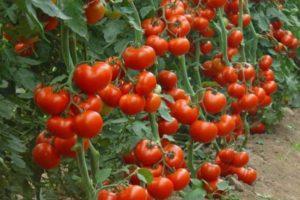
Before growing seedlings this way, you'll need to prepare the material. To do this, cut the plastic film into sheets the size of a standard sheet of paper. Sprinkle 1-2 tablespoons of soil onto the unfolded sheet, place the seedling, and cover with the same amount of soil.
The leaf is folded under at the bottom and rolled into a tube. The result is long containers that are placed vertically in the containers.

For growing seedlings, you can use tall cups, but the use of so-called "diapers" made of polyethylene requires a minimal amount of soil.
Unlike regular cups, tomato roots reach the bottom as they grow. Afterward, you can unfold the bottom of the bag and add more soil, then roll the plastic wrap back into the cup, but without the bottom.
Before planting, unfold the plastic film and plant the plant along with the soil. This method prevents damage to the root system. In this case, to grow tomatoes without watering, prepare holes at least 25 cm deep.

Place some well-rotted compost at the bottom and add 5 liters of water. This amount of liquid will thoroughly saturate the soil and will subsequently prompt the roots to seek water on their own.
In this case, the seedlings are positioned strictly vertically to prevent damage or bending of the central root. If it is accidentally broken, it will continue to grow in the surface soil layer.
After planting, water each seedling with 5 liters of water. Further care recommendations include encouraging the plant to seek water on its own. The main principle is not to wet the top layer of soil.
Opinions and recommendations of vegetable growers
Growing tomatoes without watering requires maintaining constant moisture in the topsoil. Mulching can prevent drying out. Black non-woven fiber is used for this purpose.
Some vegetable growers, when growing tomatoes in private greenhouses, cover the soil with several layers of newspaper. Organic materials (last year's leaves, wood shavings, grass) are used as mulch. When using straw or grass, a mulch layer of at least 10 cm is required.

Tomatoes grown without watering, with successful growing tips that take into account the specific characteristics of the crop, are distinguished by their flavor. Those who have used this method of growing tomatoes note that the most difficult part is overcoming the urge to water the plants.

Gardener A. A. Kazarin from Pskov shares his many years of experience: "I grow tomatoes using a method that has no analogues anywhere in the world. At the time, I couldn't patent the invention, so I limited myself to publishing it in print. The essence of the method is to avoid watering, which forces the roots to seek moisture. The yield in this case is higher than with irrigated plants."
The vegetable grower points out that things aren't as simple as they seem at first glance. With conventional planting, especially in greenhouses, plants may not survive the extreme conditions, but this is a rare exception.
The method is based on the biological properties of tomatoes, which the gardener illustrates with an experiment. A shoot is cut from a tomato plant, planted halfway down the stem, and watered from above to compact the surface soil and moisten it.
The stem won't dry out; over time, roots will form on it, and the plant will develop normally. This will happen because the buried portion of the stem will replace the root function when planted.
Related posts:
 The best eggplant varieties for growing in a polycarbonate greenhouse: planting and care
 How to properly plant peas in a greenhouse and open ground
 How often should grapes be watered in the summer while the berries are ripening?
 How to propagate and grow peas, cultivation technology, and care in open ground
 How to grow ginger in the open ground at your dacha, planting and care
 Methods for planting and propagating cherries at home
 How often should you water zucchini in open ground? Irrigation rates and methods.
 How to control onion flies using natural and chemical methods