
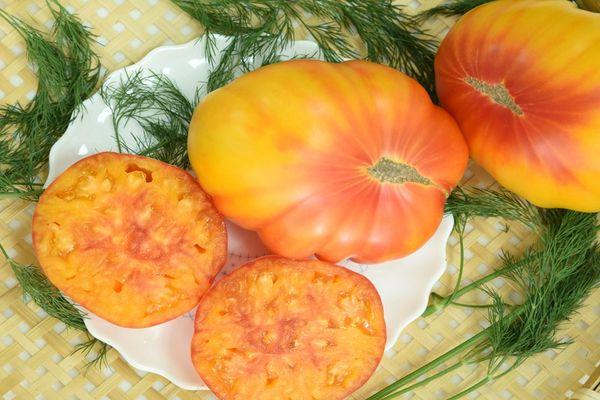
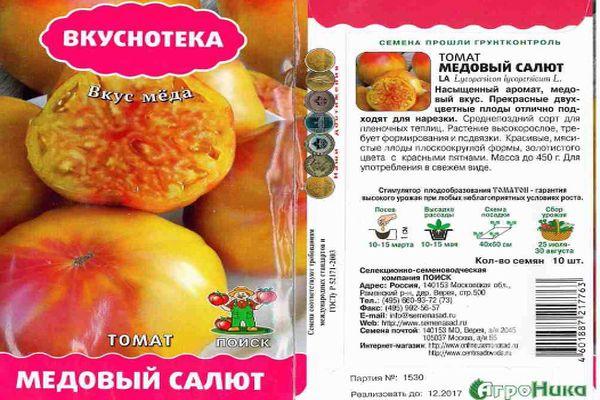
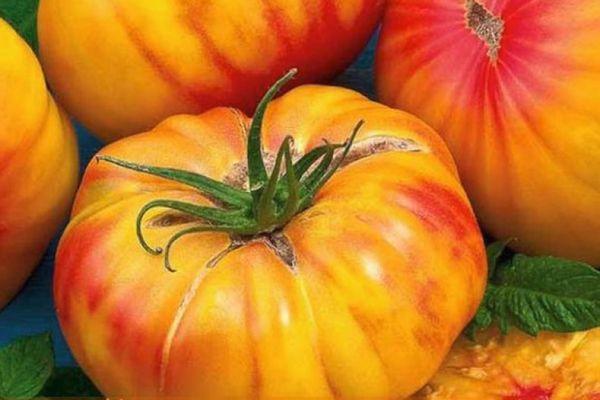
The Honey Salute tomato is used in salads. It has an unusual color: the fruits are golden with pink stripes and streaks. These color spots are characteristic not only of the tomato's skin, but also of the flesh, which glows yellow with crimson and yellow flecks, reminiscent of fireworks. Tomato Salute It tastes like honey, making it a favorite among children. As one breeder wrote, "I welcome the emergence of such hybrids, as they brighten life with unusual colors and flavors."
Some information about tomato
The characteristics and description of the Honey Salute tomato variety are as follows:
- The first fruits appear 120 days after germination.
- The hybrid bushes grow up to 160-180 cm. The plants must be tied to fixed supports or trellises.
- An average number of leaves appear on the bushes, with the first ovary developing at the height of 9-12 leaves, and the subsequent ones - after 2-3 leaves.
- Bushes are formed into 1-2 stems. Once the desired number of clusters has appeared, the growing point should be restricted.
- The fruit is shaped like a sphere, flattened at the poles. Ribbing is visible around the stalk. Each cluster can produce 6 to 8 fruits of varying sizes. The berry weight ranges from 0.3 to 0.45 kg.
- The skin of the tomato is tender, the flesh is juicy, has increased density and contains a large amount of sugar.
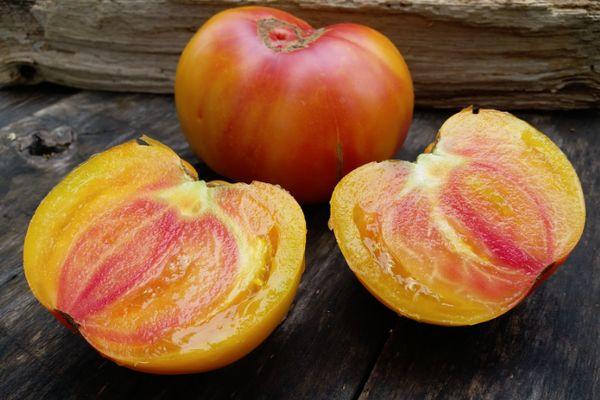
Reviews from farmers growing this variety indicate that the tomato yield reaches 6-8 kg per square meter of garden bed. However, when growing Honey Salute, the plants must be immediately tied to sturdy supports or trellises, otherwise the branches will break under the weight of the fruit.
This variety can only be grown outdoors in southern Russia, as it thrives in warm conditions and does not tolerate sudden temperature fluctuations or cold snaps. In the central and northern regions of the country, it is recommended to grow this plant only in greenhouses and hotbeds.
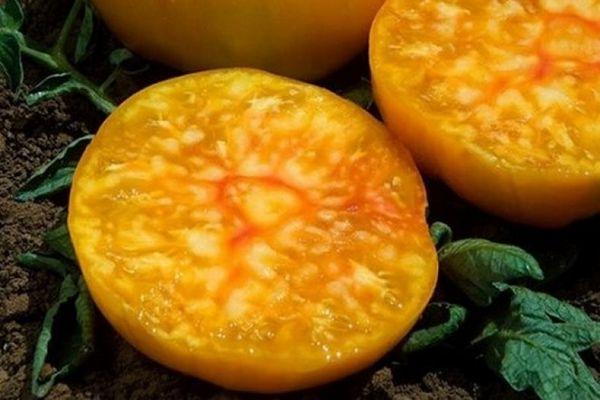
Tomatoes are used in salads, juices, vegetable slices, and sauces. These tomatoes cannot be preserved for the winter. They can be stored for 30-40 days at temperatures between 5 and 8°C. It is recommended to transport Honey Salute over short distances.
Germination of seeds for seedlings
If growing tomatoes in a greenhouse, the seeds are sown in the last ten days of February or early March. When planting seeds outdoors, this timeframe is extended by 14-15 days, to mid-March. For this variety, it's important to maintain proper temperature conditions and prune the tops of the plants promptly. Failure to do so can result in a loss of up to 40% of the harvest.
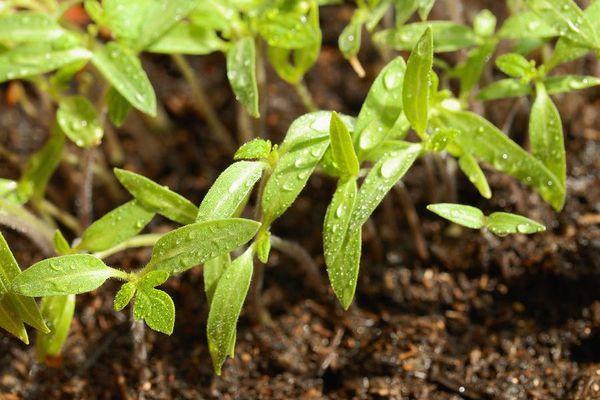
The seeds are treated with disinfectants (potassium permanganate, hydrogen peroxide). They are then sown in containers filled with tomato soil. The first sprouts will appear within a week. They should be watered with warm water and fed with organic fertilizers (manure, humus, peat). When the seedlings have 1-2 leaves, they are pricked out. They are planted in permanent soil in mid-May, when they are 60-70 days old.
The planting pattern is 0.4 x 0.6 m. If you plan to train the bush into a single stem, plant 4 plants per 1 m² of bed, tying them to supports. During this process, you should regularly remove side shoots and thin out the leaves in the lower parts of the bush.
If training is done with two stems, only one shoot is left, which grows below the first flower cluster. When 4-6 clusters appear, pinch off the growing points.
Caring for growing tomatoes
To increase root mass, the lower portion of the plants is hilled. Fertilizing is done once every 15-20 days using complex fertilizers containing phosphorus, potassium, and nitrogen compounds. Alternatively, you can use solutions of organic matter, such as a mixture of cow dung, manure, or peat. It is recommended to tailor the mixture to the specific needs of the plants.
Loosening the soil should be done once every 14 days. This will strengthen the roots and eliminate the risk of some garden pests. Watering should be done 2-3 times a week. It's best to do this early in the morning, before sunrise. Use warm water.
 Weeding eliminates the risk of tomato bushes becoming infected with late blight. It is recommended to carry out this procedure once every 7 days. Since Honey Salute has a long growing season, there is a risk of infection from various fungal and bacterial infections. To prevent these diseases, preventative measures are taken. The bushes are treated with fungicides.
Garden pests are killed using chemical poisons or folk remedies (copper sulfate, fly ash, soap solution).
Related posts:
 Description of the Salute tomato and cultivation techniques for the variety
 Description and characteristics of the dill variety Salute, care features and yield
 The best eggplant varieties for growing in a polycarbonate greenhouse: planting and care
 Description of the best tomato varieties for open ground and greenhouses in the Krasnodar region
 The best grape varieties for growing in the Urals, planting and care rules in summer
 When and how to properly transplant tomato seedlings, the best days in 2025
 Methods for planting and propagating cherries at home
 Description of the best varieties of black tomatoes for open ground and greenhouses