
The Qingdao tomato is not suitable for winter canning. It can only be used for processing into juices, ketchups, and tomato paste. A positive feature of this variety is its ability to ripen both on the vine and when stored in a cool place. However, the tomato's flavor remains virtually unchanged.
Technical data of the crop
The characteristics and description of the Qingdao variety are as follows:
- The harvest can be obtained 110-120 days after planting the seedlings in the ground.
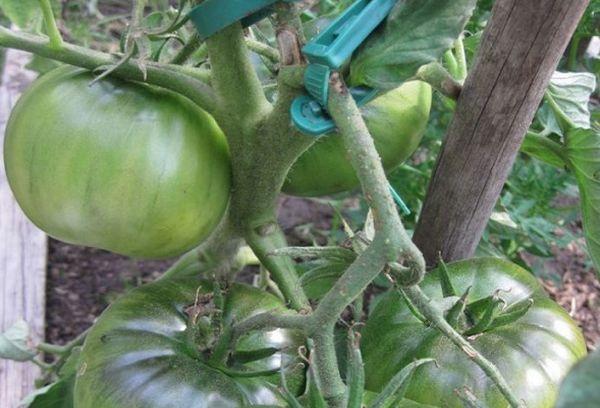
- The plant's height ranges from 120 to 130 cm. Therefore, it is necessary to tie the stems to supports and shape the bushes.
- The leaves on the plant are standard, colored in dark shades of green.
- A brush can produce from 7 to 9 tomatoes.
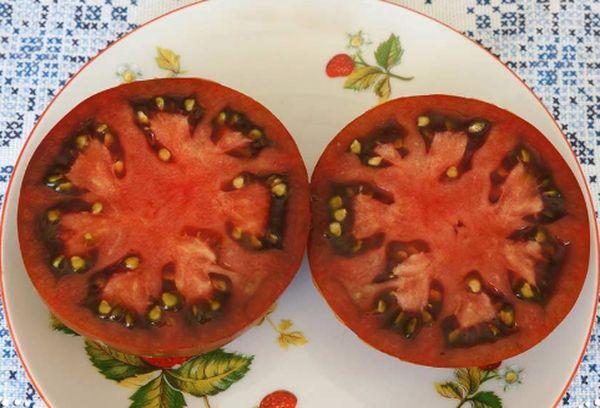
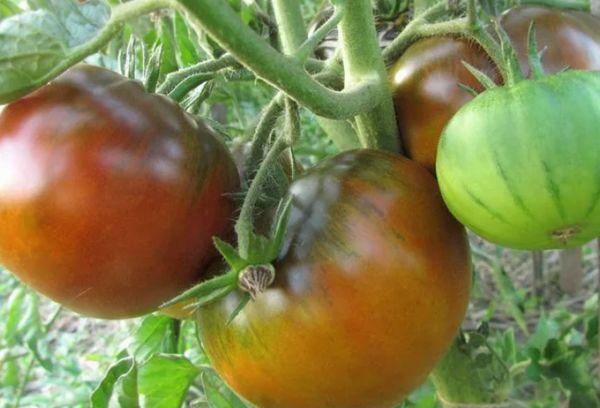
- The fruit is shaped like a slightly flattened sphere. The berries are dark shades of brown. The tomato is quite dense, despite containing 6-7 seed chambers.
- The berries weigh between 0.2 and 0.4 kg and are sweet in taste.
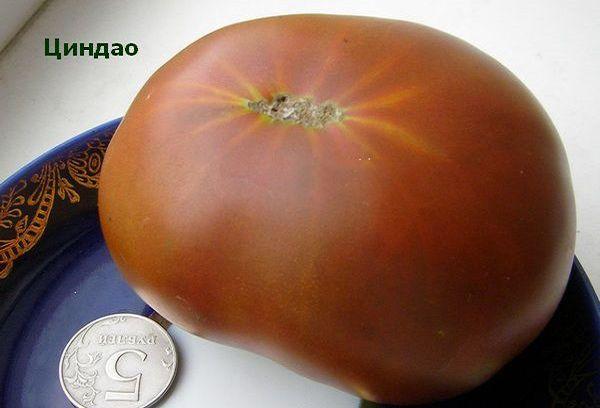
Reviews from farmers growing this tomato indicate that the Qingdao tomato yields approximately 9-10 kg of berries per bush. Since it is recommended to plant no more than 3 bushes per 1 m² of garden bed, a gardener can harvest 20-30 kg of fruit from the specified area.
The variety's advantages include its low maintenance and high yield. Gardeners note that the fruits ripen evenly, making harvesting easier. The dense skin of the berries prevents them from cracking.
Gardeners highlight the variety's drawbacks. Qingdao bushes are practically immune to disease, requiring treatment with special preparations to prevent fungal and bacterial infections. Without preventative measures, the harvest will be lost.
The fruits should not be stored for more than 3-4 days. Berries of this variety are practically impossible to transport. Therefore, it is best to grow them in areas near vegetable processing plants, including tomato processing plants.
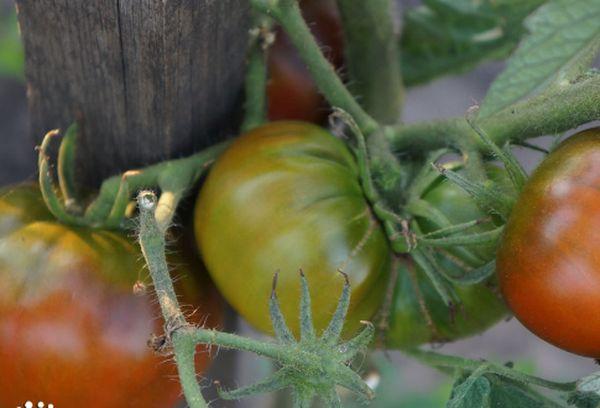
In Russia, Qingdao tomatoes can be grown outdoors in the southern regions of the country. In the central and northern regions, plastic greenhouses and well-heated greenhouse blocks are best for growing this tomato.
Growing the described tomato in a garden plot
To ensure a high yield, it is recommended to treat the seeds intended for planting in a weak solution of potassium permanganate. This will strengthen the immunity of the future seedlings and prevent the development of fungal infections. After the seedlings emerge, it is recommended to transplant them when they have two leaves. Fertilize the seedlings with organic fertilizers, such as manure or peat.
When the seedlings are 60 days old, they are planted in permanent soil. Before planting, the seedlings are hardened off for two weeks. Nitrogen fertilizer is added to the soil. The planting pattern is 0.6 x 0.6 m. The bush is trained into 2-3 stems.
To increase yield, remove the growing point on the plant. This allows for larger fruits. Water the tomatoes after sunset, using warm water. Fertilize the plants with complex mineral fertilizers twice during the growing season. The first application should be done when the bushes are flowering, and the second application should be done when the fruit appears.
Protection against garden pests (Colorado potato beetle, aphids, caterpillars of various insects) is achieved by spraying tomato leaves with chemical poisons. To eliminate parasites that damage plant roots, it is recommended to loosen the soil under the bushes twice a week.
If slugs appear in the garden, they can be eliminated by treating the soil under the bushes with ash powder. Regular weeding is recommended. Failure to do so can result in losses of up to 40% of the harvest.
Related posts:
 The best eggplant varieties for growing in a polycarbonate greenhouse: planting and care
 When and how to properly transplant tomato seedlings, the best days in 2025
 Characteristics of the Siberian Miracle tomato and tips for growing it in your garden
 Methods for planting and propagating cherries at home
 Description of the best varieties of black tomatoes for open ground and greenhouses
 The best grape varieties for growing in the Urals, planting and care rules in summer
 The health benefits and contraindications of black currants
 How to control carrot flies with medications and folk remedies

I only came across seeds of this variety for sale once. It's a truly amazing tomato. The fruits aren't all that big, but they're mostly very large, and the flavor is rich and sweet. I'll try to find some seeds and plant them this year.