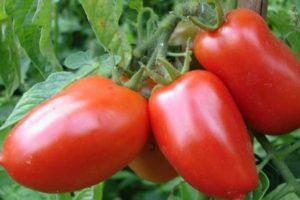
The Orange Heart tomato is rarely found in farmers' fields. That's a shame! It's one of the best salad tomato varieties. Gardeners have long been growing the Orange Heart in their plots. It's also occasionally found in private farms. However, owners of large plots of land tend to avoid it, focusing on the high profitability of growing the crop.
Farmers' markets sell a variety of tomatoes, but this one is rare. Customers praise its taste and admire its appearance. In recent years, farmers in the southern regions have turned their attention to the Orange Heart. The journey from field to store is short, and crop losses are minimal. Meanwhile, those living in the northern regions without a garden can only read about the variety's virtues.
Description of the variety
Orange Heart tomatoes were developed by Russian breeders. The variety was originally intended for fresh consumption. However, consumers have expanded the original recommendations: they are now used to make juices, pastes, and mixed vegetable preserves.
Features of the variety:
- created for cultivation in open ground (southern regions) and unheated greenhouses;
- average ripening period (from germination to the first berries it takes 95–100 days);
- tall (grows up to 1.8 m outdoors, up to 2 m in a greenhouse);
- the plant is powerful, the stems are thick and woody;
- leaf blade of medium size;
- the color of the tops is bright green;
- tests showed average resistance to the main tomato diseases;
- The plant is undemanding to the soil composition: it produces a harvest everywhere.
Farmers report that the maximum yield per bush is 6.2 kg. This is the yield for greenhouse cultivation. In open ground, the yield decreases.
What fruits grow?
Farmers are interested in quickly selling their tomatoes. Orange Heart is the best-tasting yellow salad tomato. Description of the berries:
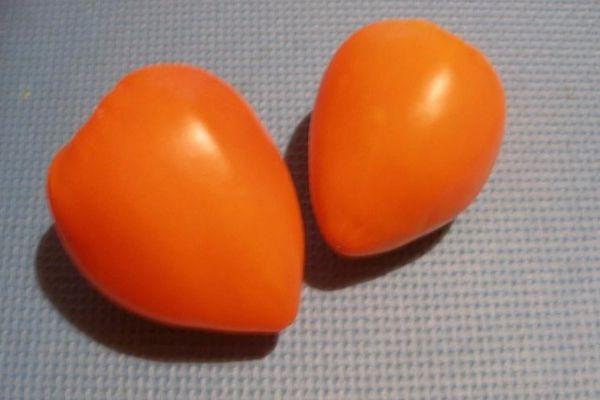
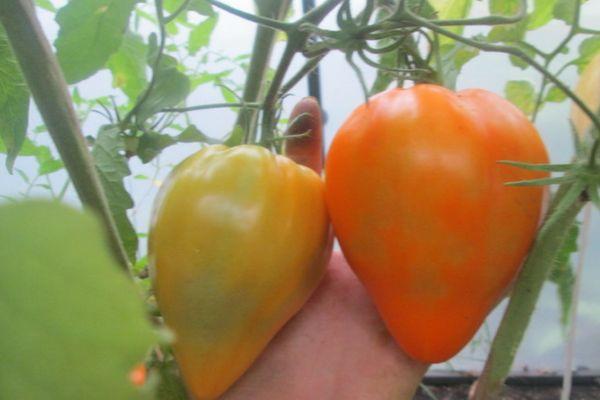
- the shape is round, slightly elongated, with a characteristic “nose” at the bottom;
- in a greenhouse, tomatoes gain weight over 350 g, in open ground - about 200 g;
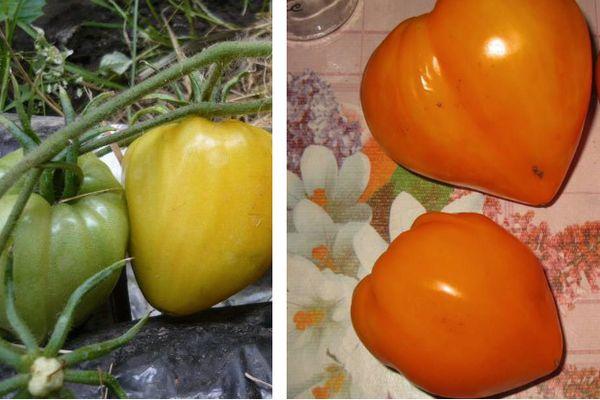
- the color of the ripe fruit is bright yellow, sometimes slightly orange;
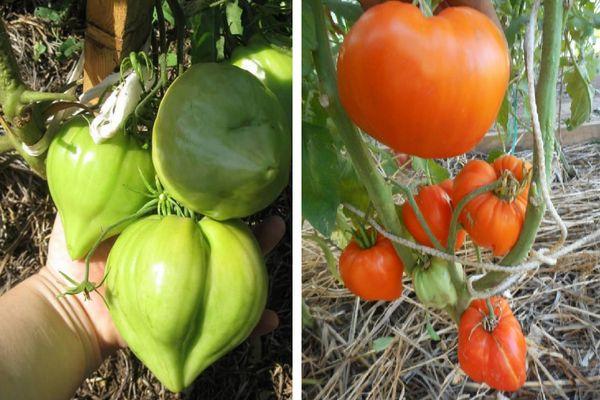
- an unripe fruit has a green spot in the area of the stalk;
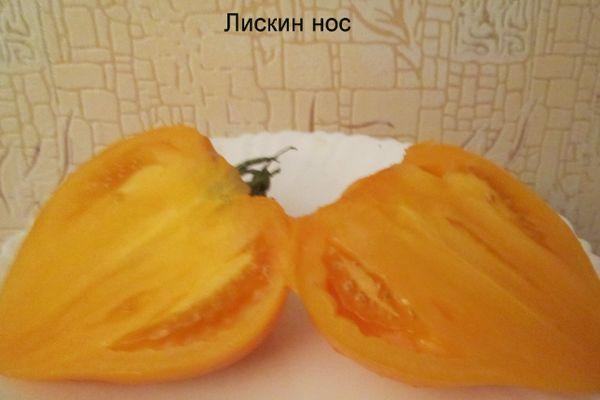
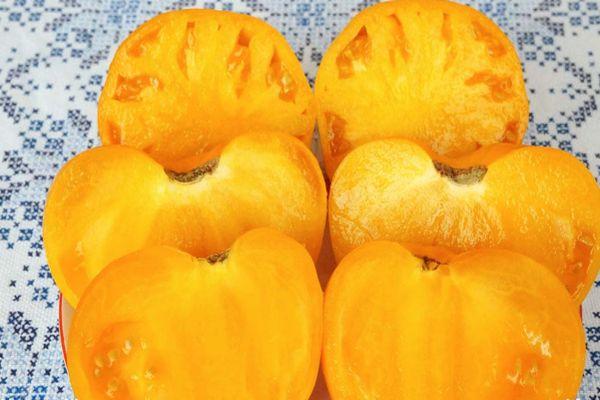
- the pulp is slightly juicy and dense;
- number of seed chambers - 3-4;
- few seeds;
- the skin is thin and easily damaged;
- The taste is sweet, the acidity is not felt.

Tomatoes don't store well. Their thin skins make transportation difficult. To preserve marketability, farmers growing Orange Heart should shorten the journey from field to store.
Growing
The variety is undemanding to soil conditions. It yields fruit in any soil. However, daytime temperatures should remain within 25 degrees Celsius. Farmers should follow agronomists' advice:
- Stratifying seeds for 2–3 weeks will help improve their resistance to climate conditions. Place the dried seedlings in the refrigerator's crisper drawer.
- Home-grown seeds require germination testing and disinfection. Germination is tested by placing the dry seed in a glass of water. Empty seeds will float. A dark pink solution of potassium permanganate is used for disinfection.
- The seedlings should be forced out 2–3 months before the expected planting in a permanent location.
- Plants need to be pricked out when the second true leaf appears. Elongated tomatoes should be planted deep down to the cotyledons.
- Orange Heart requires fertilization with organic and mineral fertilizers. Fertilization should be stopped two weeks before harvest.
- The bushes should be placed according to the following pattern: 50x60 cm. No more than 3 plants should be planted per square meter.
- Tomatoes need to be trained: it is best to grow them in 2–3 stems.
- The plant requires staking and moderate pinching. These measures will ensure uniform-sized fruits.
Orange Heart bears fruit for 1.5–2 months. It is recommended to regularly pick ripe fruits: green ones will ripen faster.
Care Features
Farmers in the southern regions grow this variety for personal consumption. Commercial cultivation requires prompt marketing of the harvest. Farmers in problematic areas are trying to plant tomatoes in unheated greenhouses.
Tomatoes are sensitive to soil and air moisture. In greenhouses, drip irrigation and greenhouse ventilation solve these problems.
The variety does not tolerate even a short drought: when watering is resumed, the thin skin cracks and the tomatoes lose their marketability.

Yellow tomato When temperature fluctuates, it sheds its ovaries. A sharp increase in temperature sterilizes the pollen. Covering the greenhouse with light-colored non-woven material (or whitewashing) will help protect indoor plantings.
Advantages and disadvantages
Farmers are studying the characteristics of the Liskin Nos tomato. The advantages are considered to be:
- original shape (resembles a fox's face);
- sweet taste;
- large size;
- fleshy pulp;
- undemanding to soil composition;
- buyers' interest.
But the disadvantages for large-scale cultivation are significant:
- non-compact bush;
- susceptibility to diseases and pests;
- low transportability;
- demanding climatic conditions;
- short shelf life;
- insufficient crop yield;
- impossibility of storage without refrigeration units.
Farmers are advised to assess the crop's cultivation characteristics and potential risks before planting.
Pests and diseases
Similar to orange tomato Pests are very fond of them. To identify pests, it is recommended to place sticky tape (fly traps) among the bushes. Daily inspection of stuck insects will allow you to select the right insecticide and reduce crop losses. The traps should be refreshed once a week.
To protect against fungal diseases, treatment with copper-containing products is recommended. Stop spraying three weeks before harvesting.
It is important to remember: strict adherence to growing rules will reduce the risk of variety disease.
Harvesting and storage
Liskin Nos has a prolonged fruiting period. It's recommended to pick the fruit slightly unripe, with a green spot remaining near the stalk. This will improve its transportability.
Tomatoes should be stored in single rows in plastic or wooden containers. A modern refrigeration unit ensures marketability.
Gardeners' reviews
Farmers' reviews of Liskin Nose are neutral. They praise the tomatoes' appearance and taste. They are disappointed by their poor transportability, low yield, and short shelf life.
Farmers are cautious about planting this variety outdoors. Greenhouse tomato growers report good yields when proper cultivation practices are followed.
Related posts:
 Description of the Ox Heart tomato variety, cultivation and care features
 Characteristics and description of the Bull's Heart tomato variety, yield and cultivation
 Description and characteristics of the Bull's Heart cherry variety, planting and care
 Description of the remontant raspberry variety Orange Miracle, planting and care
 Description of the Beauty's Heart tomato and cultivation of the variety
 Description of the Loving Heart Red tomato and its varieties
 Characteristics and description of the Ashgabat Heart tomato, cultivation features
 Description of the Buffalo Heart tomato and its cultivation in open ground