
Growing Pomisolka (cherry) tomatoes will appeal to those who appreciate small, sweet vegetables. The long clusters of bright red berries not only decorate the greenhouse while they grow on the bush, but they can also serve practical purposes.
General characteristics of the plant
An indeterminate bush with unlimited shoot growth. The plant requires support and training. For increased yield, it is recommended to grow the bush in two stems.

Pomisolka tomatoes are suitable for both indoor and outdoor cultivation. The variety's yield remains virtually unchanged even under adverse environmental conditions. Gardeners' reviews note a deterioration in the flavor of tomatoes grown outdoors during cold, rainy years.
The variety is resistant to Alternaria and tobacco mosaic. When grown outdoors, it is slightly susceptible to late blight in the second half of summer, but by removing the leaves at the bottom of the stems (up to 1/3 of the height), the grower can preserve the harvest.

Each bush can yield 5-7 kg of marketable fruit. Fruit appears throughout the summer, and in a greenhouse, until late fall. In open ground, it's recommended to pinch the shoot tips after 10-11 clusters have formed, approximately one month before the first frost. This will ensure that all the fruit reaches at least technical maturity by the end of the season.
Pomisolka tomatoes are an early tomato variety and begin to ripen 95-100 days after sowing. Ripening is uniform, starting from the base of the cluster.
Consumer qualities of fruits
The tomatoes are gathered in long, double-sided clusters of 20-40 ovaries. The fruits are uniform in size within the cluster, and each tomato weighs approximately 20 g. They are most easily picked in whole clusters. The fruits are spherical in shape, without ribbing or a pointed tip.
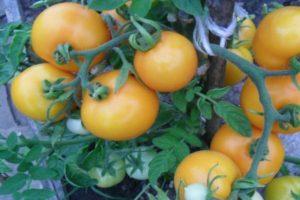

The fruit skin is very dense; the tomatoes are not prone to cracking or falling off when ripe. Heat treatment prevents the tomato skin from bursting, and all the fruits retain their attractive appearance. Ripe tomatoes are easy to transport and keep for a long time in a cool place. When harvesting unripe tomatoes (at blanched and technical ripeness), ripen them at room temperature.
The flesh is juicy and red. The fruits are very juicy, with a pleasantly firm texture. There are two seed chambers, each filled with numerous seeds. The flavor of a ripe tomato is very sweet, but depending on growing conditions, it may have a slight tartness. During dry seasons, the tomatoes are sweeter and more flavorful.
Pomisolka tomatoes are versatile. Small tomatoes can be used in vegetable salads just as successfully as larger varieties. Some sophisticated appetizers call for small tomatoes. But cherry tomatoes are at their best on a buffet table: they garnish canapés and sandwiches, and serve with elegant cocktails.
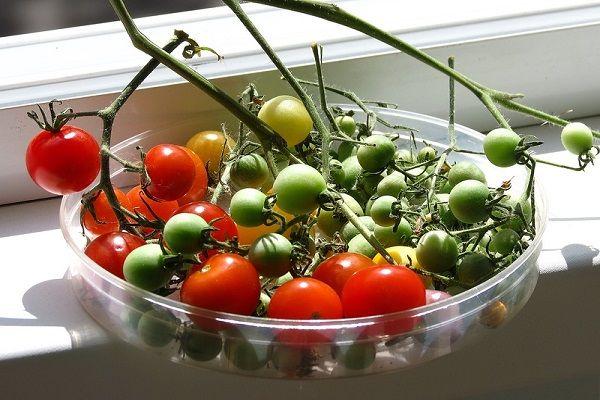
Mini tomatoes can be grilled and used as a topping for kebabs. They're also perfect for any dish that calls for regular red tomatoes: vegetable caviar, Italian sauces, borscht, and kharcho. The sweet, aromatic flesh makes a delicious gazpacho or hot tomato soup.
Surplus tomatoes are preserved for the winter, including in vegetable platters. Small tomatoes are easy to freeze whole. Due to their high sugar content, they are suitable for drying and making canned tomato sauces. Unripe tomatoes can be used to make exotic jams.
Cherry Tomato Cultivation Techniques
The specifics of sowing concern only the timing of tomato ripening: seeds for seedlings should be sown no earlier than 50-60 days before the expected transfer of the bushes to a permanent location.

Otherwise, both soil preparation and sowing are carried out according to the usual scheme:
- the soil mixture is made up of equal parts of sand, humus and garden soil with the addition of chalk (2 tablespoons per 10 kg of soil);
- the soil in the box is soaked in a strong hot solution of potassium permanganate for disinfection;
- the seeds are disinfected by soaking them in water, slightly tinted with potassium permanganate, for 30-40 minutes;
- sow shallowly, covering the seeds spread over the ground with 0.5 cm of dry sand or soil;
- Germinate at a temperature of +25°C under film or glass.
At the stage of 2-3 true leaves, seedlings need to be transplanted into separate pots. They have a high growth rate and can stretch out in a common box.

Transplant in mid-May (into a greenhouse) or early June (into open ground). Leave at least 40 cm between plants. It's best to plant the elongated seedlings in a 15-20 cm deep trench, placing the long stems in the trench so that the tip, with 4-5 leaves, remains above the soil. After 7-10 days, the tomatoes can be tied to a support.
To ensure good growth, nitrogen fertilizers (nitroammophoska and others) are applied at this time. After the first flower cluster appears, switch to fertilizing with phosphorus-potassium fertilizers or special tomato mixtures (Signor Tomato, Kristallon Tomato). Fertilizing is repeated after two weeks. During fruiting, do not water tomatoes with mullein infusion or bird droppings.
To form a vine with two stems, remove all side shoots until a single flower cluster appears. Leave one side shoot (a side shoot) above it, and continue to remove the remaining shoots as they appear on both stems.
Related posts:
 Description of the best varieties of black tomatoes for open ground and greenhouses
 The best eggplant varieties for growing in a polycarbonate greenhouse: planting and care
 What varieties of tomatoes are best to plant in a polycarbonate greenhouse?
 Description of the best tomato varieties for open ground in the central zone
 The best grape varieties for growing in the Urals, planting and care rules in summer
 The best and most productive tomato varieties for greenhouse cultivation in the Urals, with descriptions
 The best tomato varieties for growing in the Leningrad region for greenhouses and open ground
 Methods for planting and propagating cherries at home