
Black Pineapple is a tomato variety with exotic fruit coloring. It always finds its fans and garners numerous positive reviews: large-fruited, productive, incredibly tasty, and beautiful, it truly enhances the garden.
Appearance and yield
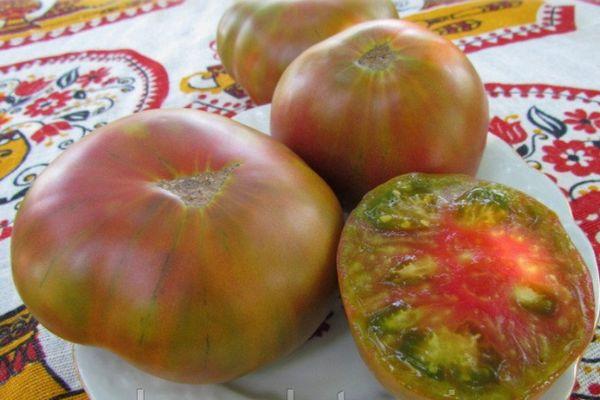
The original name, Black Pineapples, was given to the variety by Belgian breeders. However, the fruit's description describes its color as greenish-brown, variegated, reminiscent of real pineapples.
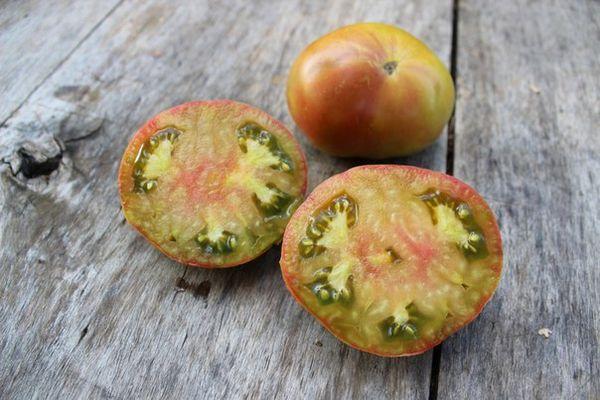
The original skin color is repeated inside the fruit: the dense, fleshy pulp contains veins of green, pink, brownish, and red. The seed chambers are most often light green, which can be confusing to gardeners who decide to save the seeds for sowing. However, the greenish color of the seed coats remains even at full ripeness. The suitability of the seeds for selection will have to be judged by the organoleptic properties of the fruit.
The flavor of a ripe Black Pineapple tomato is no less striking than its color. Its sugar content is quite high, making it sweet without a pronounced tartness. Its aroma is subtle, with a fruity or citrusy flavor. Its unusual color and pleasant flavor make Black Pineapple indispensable for salads and appetizers, as well as for eating fresh.
This variety is classified as a large-fruited tomato. These tomatoes are not suitable for whole canning, but they can be used for other preparations that require slicing or chopping. Black pineapple produces fruits with an average weight of approximately 500 g. The record for a single tomato is 950-1000 g.
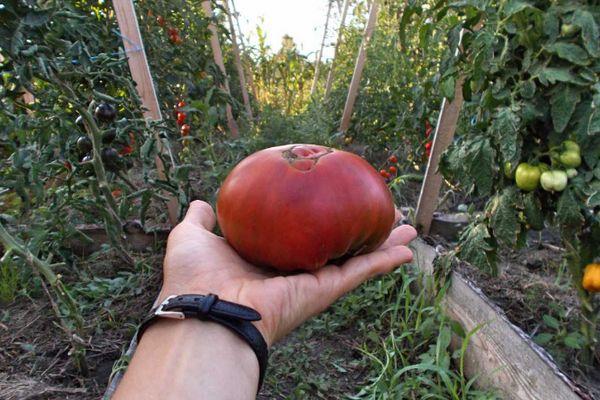
The variety's value also lies in its fruit's resistance to cracking. The dense skin and flesh contribute to good shelf life and resistance to mechanical stress during transportation. The average yield per bush reaches 10-12 kg, but this can vary depending on growing conditions (open or protected).
Plant characteristics
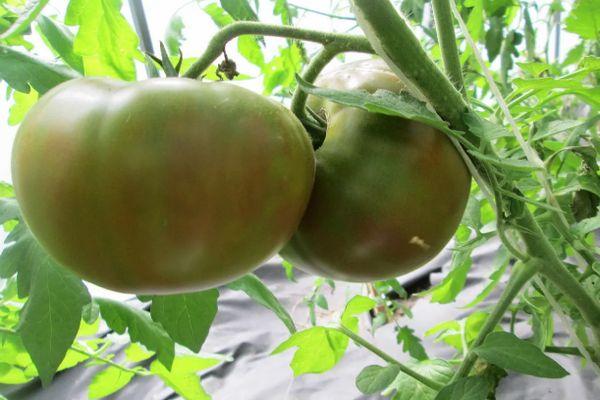
The bush is indeterminate, with unlimited growth. In a greenhouse, it is recommended to train it into a single stem and tie it to a trellis. In the open ground, train it into 2-3 stems, with tying required. This is an early-ripening variety, with fruits ripening 85-90 days after seed germination.
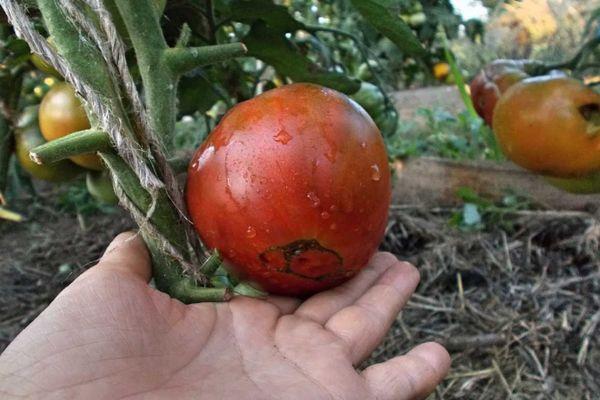
The plant reaches 1.2–1.5 m in height. The clusters form densely, reaching the very top, at small intervals. Each inflorescence can contain 5–7 fruits.
Plant characteristics note that the first tomatoes on a truss are the largest; subsequent ones are slightly smaller, but there are no small ones. The fruits are flat-round and slightly ribbed.
The following properties can be considered as disadvantages of the variety:
- The combination of tall growth and large fruits makes the Black Pineapple tomato demanding support;
- the bushes branch well and require pinching;
- To obtain high-quality sweet fruits, high air temperatures and plenty of sun are required during the filling and ripening of the fruits;
- in a cold summer, the harvest may be lower and the fruits will become more sour;
- Black pineapple is demanding in terms of fertilizing.
To achieve a good harvest and high-quality fruit in central Russia, you need to properly organize the cultivation of Black Pineapple tomatoes on your plot.
Agricultural technology of the variety
Despite the early ripening of the tomato, Black Pineapple is best grown from seedlings. Sow in April, approximately 60 days before planting. The seeds germinate within 7-10 days. During this time, high humidity and soil temperature (around 27°C) must be maintained. To achieve this, place the seedlings in a warm place and cover them with glass. Once the seedlings emerge, remove the glass.
To protect plants from black leg disease, watering can be done from a tray, and the soil surface can be generously dusted with wood ash. After 1-2 leaves have formed, transplant tomatoes to a distance of 7-10 cm. Plant them in the ground after the last frost has passed. They can be planted in a greenhouse in early to mid-May.
It is important to feed the plants correctly after planting:
- 7 days after transferring to the ground - with a solution of 10 liters of water and 1 tbsp. Nitrophoska (0.5 liters per bush);
- after 1-2 flower clusters have opened - 1 tbsp. Superphosphate and 1 tsp. Potassium sulfate for every 10 liters of water for irrigation (1 liter per plant);
- apply additional feeding after 6-7 days Potassium humate according to the instructions to the preparation or solutions of fertilizers Ideal, Signor Tomato, Agricola Vegeta and others (2 liters per plant);
- After the first tomatoes have set, add superphosphate (1 tbsp. per 10 l, 2-5 l for each bush).
To protect the crop from late blight in cold summers, you need to spray the ovaries with a light pink solution of potassium permanganate every 5-7 days.
Related posts:
 Description of the best varieties of black tomatoes for open ground and greenhouses
 TOP 40 New Year's 2020 Meat Recipes Using Pork, Beef, Chicken, and Lamb
 TOP 40 Hot Dish Recipes for New Year 2020: What to Cook
 Description of the Pineapple tomato and cultivation techniques for the variety
 80 Best Eggplant Varieties for Different Regions with Descriptions and Characteristics
 Characteristics and description of the Black Beauty eggplant variety, planting and care
 Description of the Black Prince strawberry variety, planting and care technology
 The 42 Best New Year's Dessert Recipes for 2020