
For those who don't have a personal garden plot, this is suitable tomato Lukoshko On the windowsill: Miniature plants can be grown on a balcony or even a windowsill. Mini tomatoes grow indoors both in winter and summer.
General characteristics of the variety
The bush is determinate; the main stem continues to grow until the plant forms 3-4 clusters with fruits and flowers. After this, growth ceases, and all the plant's energy is devoted to filling and ripening the fruit. The maximum height of the Lukoshko tomato on a windowsill is 30-40 cm.

The plant is miniature: low bushes, a small root system, small leaves, and tiny tomatoes. However, such a small bush produces a very high yield: a single plant can yield about 1 kg of cherry tomatoes. When growing Lukoshka on a windowsill, in a greenhouse, or in open ground, plant closely together, spacing the plants 30 cm apart.
Standard-type bushes with a sturdy trunk don't bend under the weight of their fruit and don't require staking or shaping. When grown indoors during winter, the plant can become overly elongated, causing the trunks to become thinner and droop.
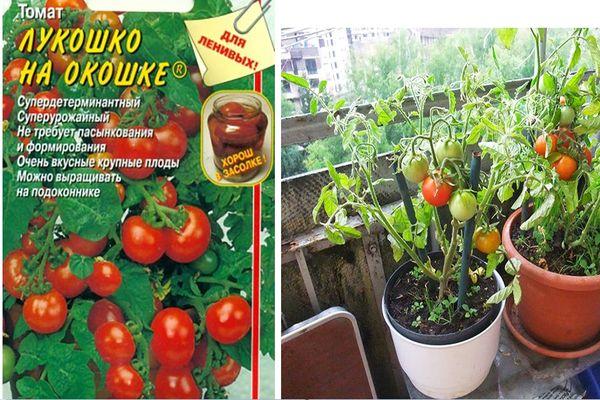
In summer, tomatoes grow like ground-grown plants on an open balcony, but require regular watering. The beautiful fruits can be grown in decorative baskets, making them ideal not only for salads but also for interior decoration.
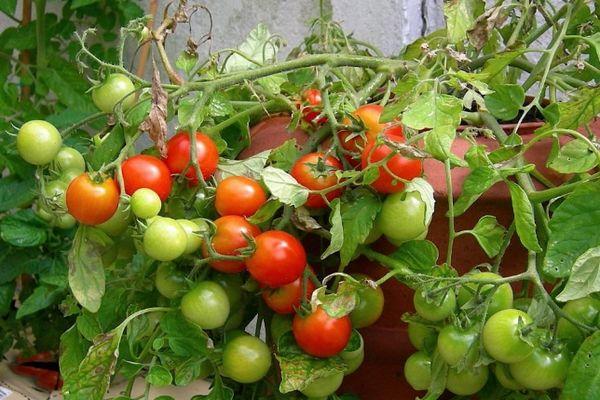
The Lukoshko variety is resistant to temperature fluctuations and cold precipitation. It is immune to tobacco mosaic virus and resistant to Alternaria and Fusarium wilt. The bushes are rarely affected by late blight, as the harvest occurs before it appears in garden plots. The fruits ripen early and uniformly, and mass harvesting occurs 85-90 days after germination.
Description of fruits
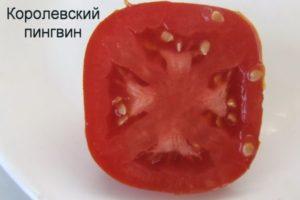
Miniature bushes produce 3-4 fruit clusters, each containing up to 10-12 identical, spherical tomatoes. The tomatoes weigh between 15-20 g. Gardeners describe Lukoshko na sveshke as a prolific fruiting variety: the bushes are completely covered with bright red berries.

Cherry tomatoes are highly prized for their flavor. The high sugar content and dry matter content of the pulp make these mini tomatoes very sweet and aromatic. These qualities are even more pronounced in hot weather with low moisture. The skin is very strong and somewhat rough. However, it doesn't crack when canned, and ripe tomatoes stored fresh will not spoil for 2-3 weeks.
Small, calibrated tomatoes are convenient for whole-fruit canning. Drying is another option: their excellent flavor allows for a product comparable to fine Italian preserves. Lukoshko Na Sashku cherry tomatoes can also be frozen for use in winter dishes calling for fresh tomatoes.
How to grow tomatoes on a windowsill and for seedlings
The first sowing for early consumption of fresh vegetables is done in January-February. It's best to sow the seeds in a separate tray, where they will germinate for about three weeks. When the plants have developed one to three true leaves, they are transplanted into individual containers.
To achieve the best results, it is convenient to use O. Ganickina’s method:
- transplant tomatoes into small pots;
- When the plants reach 1.5 months of age, transplant them into larger containers, where they will remain in the future.
With this technology, more air will reach the root system of Lukoshko tomatoes on the windowsill, and they will grow well and form strong bushes. To grow a winter tomato crop, phytolamps are required.

When growing tomatoes in pots on a windowsill, keep in mind that the plant does not tolerate stagnant water. Place a drainage layer of large pebbles or crushed stone at the bottom of the container. Any water collected in the tray should be poured out 30-40 minutes after watering.

Tomatoes growing in limited soil require ample watering and mineral fertilizer. Use room-temperature water for irrigation. Fertilizers are applied with the irrigation water, diluting the selected products (Signor Tomato, Agricola, Kemira, Kristallon) according to the instructions.
For planting in raised beds or a greenhouse, seedlings are prepared two months in advance. Sow in early April, scattering the seeds in furrows or directly on the soil surface. Cover them with a layer of dry soil no more than 0.5 cm thick. When 1-3 leaves have formed, the seedlings are pricked out and subsequently watered only on a timely basis. They can be planted in a greenhouse in mid-May, and in open beds in early June.
Related posts:
 Description of the Babushkino Lukoshko tomato and characteristics of the variety
 Description of the Mushroom Basket tomato and the rules for growing it in a greenhouse
 The best eggplant varieties for growing in a polycarbonate greenhouse: planting and care
 How to choose the best tomato varieties for growing in Belarus
 Methods for planting and propagating cherries at home
 Description of the best varieties of cluster tomatoes and growing rules
 The best and most productive tomato varieties for greenhouse cultivation in the Urals, with descriptions
 The best grape varieties for growing in the Urals, planting and care rules in summer