
The "Mushroom Lukoshko" tomato, described below, is grown in greenhouses. This variety was developed by Russian breeders. In the southern regions of the country, it is recommended to grow "Mushroom Lukoshko" tomatoes in the ground under a plastic cover. In other regions of Russia, well-heated greenhouse units are used for growing this variety. This tomato can be stored in a cool room for up to 20 days. Retailers readily purchase this variety from farmers, as the berries withstand long-distance transportation well.
Technical data of the crop
The characteristics and description of the Mushroom Basket tomato variety are as follows:
- After the first shoots appear, the harvest can be obtained in 100-110 days.
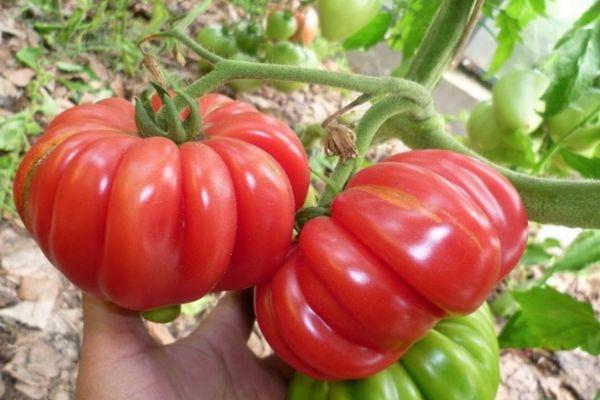
- The bushes of this tomato plant are 200-250 cm tall. They resemble vines, so the stems need to be tied to strong supports or trellises.
- The large number of leaves and side shoots forces farmers to remove unwanted side shoots. To ensure a healthy harvest, bush training is recommended.
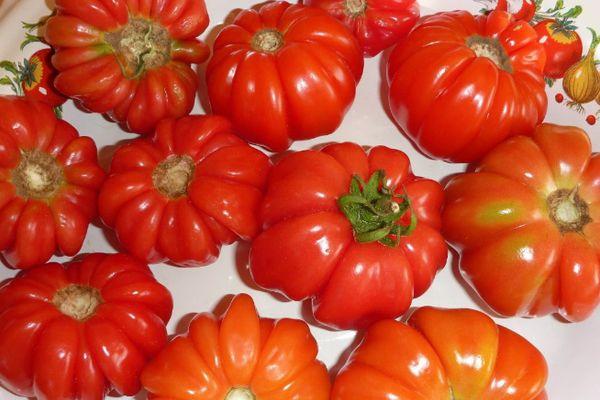
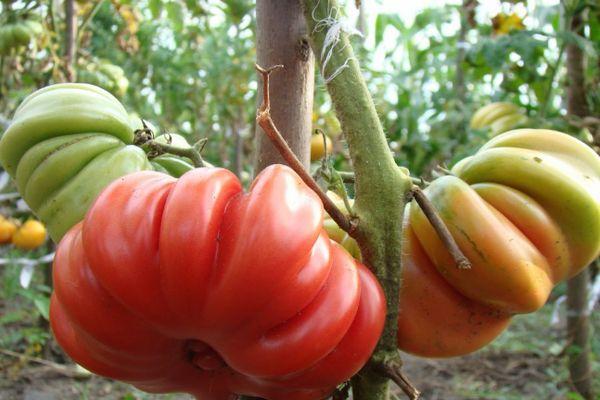
- The variety's description begins with the unique shape of its fruit. The tomato resembles a flattened sphere, the sides of which are decorated with numerous ribs.
- Ripe berries are a rich red color.
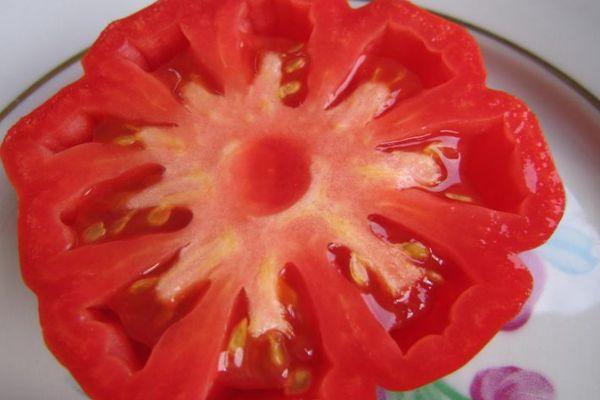
- Description of the internal structure of the fruit: a large number of voids (chambers) filled with seeds.
- Berry weight ranges from 0.25 to 0.5 kg. The largest fruits often develop on the lower branches of the bushes.
Reviews from gardeners growing the Mushroom Basket indicate that the tomato yield is 2.5-3.0 kg per plant. Gardeners note the plant's resistance to various nightshade diseases and garden pests.
But there are also some drawbacks: for example, the many empty chambers inside the tomato make it less juicy and somewhat dry in taste. The variety thrives in warm conditions, and in poor climates, the number of ovaries on its branches decreases sharply.
To grow bushes, it is necessary to use a large number of vertical trellises.
Mushroom baskets are eaten fresh and used in salads. Tomato slices are used in sandwiches and as a garnish for various dishes. It is not possible to extract tomato juice, paste, or sauce from this variety. Mushroom baskets should not be used for canning or pickling for the winter.
How to grow a tomato yourself?
After purchasing seeds, it is recommended to soak them in hydrogen peroxide or potassium permanganate for 10-20 minutes. This will increase the germination rate of the seeds and strengthen the immunity of future seedlings.
Seeds are sown in the first or second ten days of March. For this, a mixture of humus and turf is prepared and placed in individual trays. Before sowing, the seeds are soaked in a growth stimulant solution for 10 to 12 hours. When planting, each seed is placed at a depth of 15-20 mm. The trays are then covered with plastic wrap. The room temperature should be maintained at around 25°C.
Pricking out is done when the sprouts have 1-2 leaves. This step can be skipped if the seeds were planted in peat boxes.
Seedlings are planted in a permanent location in the greenhouse in the third ten days of May. Before planting, make holes in the soil and add wood ash and a complex mineral mixture containing nitrogen, potassium, and phosphorus. This will help the seedlings root better. One tablespoon of fertilizer is sufficient for each bush. Plants are spaced 0.6 x 0.7 (0.8) m apart. Bushes should be tied to vertical trellises immediately.
Caring for Mushroom Basket Plantings
It is recommended to water the bushes once every 6-7 days, using a moderate amount of warm, settled water. Cold water should not be used, as it causes massive fruit drop.
Mushroom basket is a heat-loving variety, but the air in the greenhouse should not be humid. Regular ventilation is essential, otherwise, a 25% yield loss is possible. To ensure healthy growth, gardeners should remove side shoots and lower leaves. If the tomato plants are not trained, they will grow excessively, turning the greenhouse into a jungle.
 It is recommended to fertilize plants 3-4 times per season. To do this, organic fertilizers and potassium nitrate are initially applied. After the fruit sets, fertilizers containing phosphorus and potassium are used.
When the first fruits develop, it is recommended to feed the bushes with complex mixtures containing nitrogen, potassium and phosphorus.
Although the Mushroom Basket is disease-resistant, in some cases the plants may be infected with gray mold or late blight. To prevent disease, regularly spray the seedlings with a weak solution of potassium permanganate or Fitosporin.
To control garden pests, mulch the soil with straw, peat, or humus, and ventilate the greenhouse regularly. If aphids or spider mites are found on the leaves, treat the plants with soapy water or an ammonia solution. Products containing celandine or pyrethrum can also be used.
Related posts:
 Description of the Babushkino Lukoshko tomato and characteristics of the variety
 How to choose the best tomato varieties for growing in Belarus
 Description of the best varieties of cluster tomatoes and growing rules
 Description and features of growing Lukoshko tomatoes on a windowsill
 The best grape varieties for growing in the Urals, planting and care rules in summer
 Methods for planting and propagating cherries at home
 Step-by-step recipes for making pickled saffron milk caps for the winter at home
 The best methods for growing grapes from seeds at home