The Orange Giant tomato is a variety of beefsteak tomato. This group includes plants with fleshy fruits in which the seed chambers are virtually invisible. These tomatoes can be very large, but most often weigh around 300 g. The Orange Giant is not a particularly large variety, producing medium-sized fruits.
Plant characteristics
The Orange Giant tomato variety has an indeterminate stem growth pattern. These tall, vigorous bushes can reach up to 2 meters in greenhouse conditions. In open ground, the plant height does not exceed 1.5 meters.
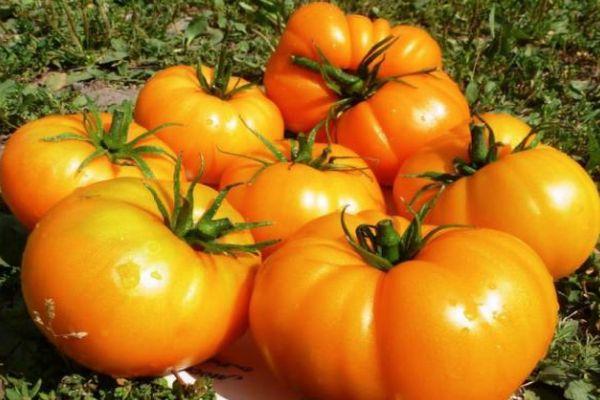
It's recommended to train Orange Giant tomatoes with 1-2 stems. This allows the gardener to control the bush's density by removing all side shoots. Tall tomatoes should be tied to a support. With vertical stems, the plants can be spaced more closely than usual. A 30x50 cm planting pattern is suitable for dense plantings. By planting 3 plants per square meter, you can achieve a good yield of Orange Giant tomatoes: up to 12-15 kg per unit area.
The variety's characteristics and description note that these tomatoes are early ripening: from sowing to harvest, they take 110-115 days. They bear fruit throughout the season, producing 5-6 fruit clusters over the summer. Some tomatoes do not ripen in open ground, but they can be harvested while still green (milky ripe). They ripen well indoors in crates.

Orange Giant tomatoes, described based on reviews from gardeners across the country, can be considered resilient to temperature fluctuations and sudden cold snaps down to +7°C. They also exhibit high stress tolerance. The variety easily recovers from brief cold spells in midsummer and maintains its yield during rainy seasons. In regions north of the Moscow region, greenhouse cultivation is recommended; otherwise, growers will not be able to harvest ripe standing vegetables until late July or August.
Like all modern varieties, Orange Giant is immune to various nightshade diseases. It is virtually immune to late blight and resists other fungi and tobacco mosaic virus. To prevent fungal infections, remove the lower leaves up to one-third of the plant's height.
Description of fruits
Orange Giant tomatoes form clusters of 4-6 round, slightly flattened fruits. Each fruit averages 250-350 g, but the lower clusters produce larger fruits, which can reach even greater weights (up to 600 g).
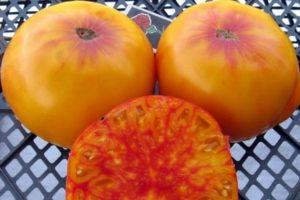
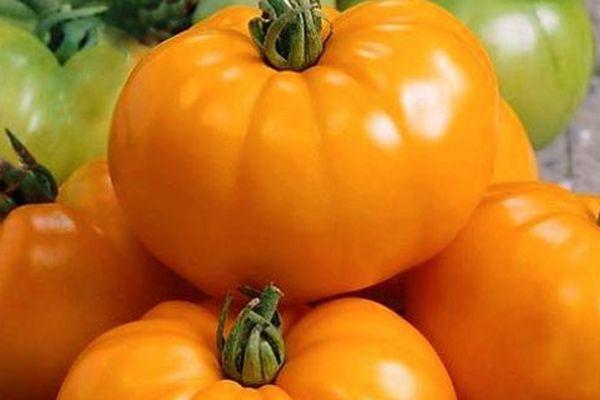
The tomato skin is firm but not rough. It's not prone to cracking, but during rainy seasons, the fruits can still be damaged by excess moisture and burst during ripening. When ripe, the tomatoes are pale green, without a dark spot near the stem. As they ripen, they acquire a rich orange hue, which gives the variety its name.
The flesh is tender, meaty, juicy, but quite dense. Its consistency is reminiscent of a ripe melon. The seed chambers are small, with a small number of seeds. The color is orange and uniform.
Orange Giant tomatoes contain a high amount of carotene in their pulp. This makes them particularly valuable for dietary and baby food. The fruit also contains beneficial lycopene, vitamins, and protein. The pulp's high sugar content gives it a pleasantly sweet flavor. The aroma is rich, slightly fruity. Excess moisture can cause a tart taste.

Orange Giant tomatoes are ideal for salads. They can be eaten fresh in salads and appetizers, or used as a decorative element on sliced dishes. Sliced, fleshy tomatoes are delicious on sandwiches and make a great hamburger topping.
Tomatoes can also be preserved for the winter. Large tomatoes aren't suitable for whole-fruit canning, but they can be included in winter salads and appetizers, or canned in wedges along with yellow and red tomatoes of similar varieties.
But the best thing you can make from beef tomatoes is beautiful and delicious tomato juice with a unique color. The sweet pulp is also perfect for delicate tomato sauces or lecho.
How to grow large tomatoes?
Sow seeds for seedlings in the usual manner, approximately 2-2.5 months before planting in the garden. Use store-bought seedling soil as a substrate, or create your own mixture using equal parts sand, humus, and garden soil. Disinfect the mixture.


You can harvest the Orange Giant variety's seeds yourself, leaving 1-2 tomatoes on the lowest branches. The tomatoes should ripen on the vine. Home-grown seeds should be soaked in a warm solution of potassium permanganate for 30-40 minutes. Store-bought seeds may already be treated; this information is on the label. Scatter the seeds over moist soil and cover with a layer of dry soil. Plant them at a depth of 0.5 cm.
Once the seeds have sprouted, the seedlings are transplanted into individual pots. Further care consists of watering and supplemental lighting, if necessary.
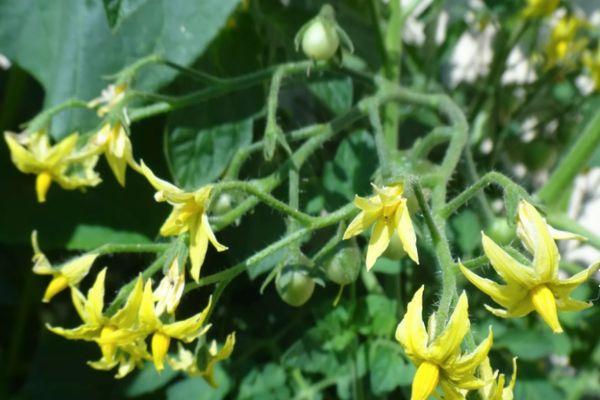 When planting in the garden, leave a distance of 30-40 cm between plants, and about 1 m between rows. Tie the tomatoes to a trellis. To grow a single-stemmed bush, remove all side shoots, leaving only the central stem. If you want to form a bush with 2-3 branches, remove all side shoots before the first flower cluster appears. Leave one shoot above the branch with flowers, which will be tied next to the main shoot. To form a third branch, leave one side shoot above the second flower cluster.
To obtain large fruits, no more than four ovaries are left on the trusses, close to the trunk, and the ends of the trusses are removed. For better fruit filling and growth, mineral mixtures containing potassium and phosphorus should be used. Organic and nitrogenous mixtures should not be applied during fruit growth and ripening, as this promotes the accumulation of nitrates in the tissues.
Related posts:
 Description and characteristics of Giant tomato varieties for growing in greenhouses and open ground
 Description and characteristics of the Pink Giant tomato variety, yield and cultivation
 Description of the Raspberry Giant tomato variety, cultivation and care features
 Description of the large-fruited tomato Giant Novikov and cultivation techniques
 Description of varieties of sowing peas and cultivation, to which family they belong
 Description of the best tomato varieties for open ground and greenhouses in the Krasnodar region
 Description of the large-fruited tomato variety Lemon Giant and growing instructions
 Description and characteristics of the sweetest tomato varieties for greenhouses and open ground