
Farmers with large grape plantations and smallholdings often encounter a disease called powdery mildew. If the pathogens aren't eradicated promptly, they can destroy the entire berry harvest. To combat these pathogens, gardeners use chemicals. Vivando, considered one of the most effective fungicides, provides maximum protection for vineyards.
Composition, existing forms of release and purpose
This new-generation fungicide contains only one active ingredient: metrafenone, a member of the benzophenone class of chemicals. One liter of Vivando contains 500 grams of the active ingredient. This systemic fungicide is available as a suspension concentrate packaged in 1-liter plastic canisters, making it particularly convenient for small plot owners. Vivando is manufactured by the German company BASF.
A new-generation fungicide designed to combat mildew in grapevines. After application, it provides protection for the berries throughout their entire growth cycle.
Mechanism of action
The active ingredient of this systemic fungicide penetrates leaf and fruit tissue, inhibiting fungal mycelial growth and stopping sporulation. One portion of the chemical migrates upward through the plant tissue after treatment, inhibiting the metabolic processes of pathogenic microorganisms. Another portion of the metrafenone is redistributed between plant surfaces, creating a gas cloud.
Advantages and disadvantages
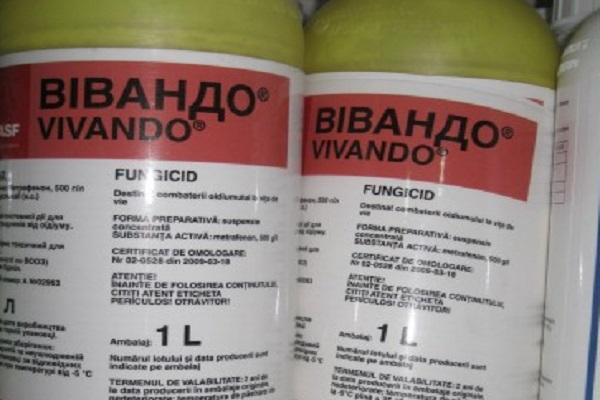
Many farmers are using the new systemic fungicide in their vineyards, and they have identified several advantages of the chemical.
One of the disadvantages is that a systemic fungicide can be used no more than twice per season.
Consumption rates
Apply 200 to 250 ml of the product per hectare of vineyard. Treatment can be continued throughout the growing season.
How to prepare a working mixture
It's recommended to prepare the working solution immediately before spraying the grapes to ensure it remains effective. Pour half the recommended amount of water into the sprayer and add the recommended amount of fungicide. Turn on the mixer and wait until the solution is completely dissolved. Then add the remaining water and mix thoroughly again.

After treatment, dispose of the remaining solution in accordance with safety regulations. Do not pour the chemical onto the ground or into water bodies.
Rules for using fungicide
The instructions for the Vivando fungicide recommend applying the product for the first time before flowering. A second treatment is carried out when the berries are closing. Spraying should be done in calm, dry weather. Although the fungicide is not susceptible to precipitation, it still requires time to penetrate the plant tissue. The waiting period after application is 10 days.
Precautionary measures
Working with any chemical requires safety precautions. Be sure to wear protective clothing and a scarf or cap. To prevent inhalation of fungicide vapors, use a respirator.
After finishing work, take a shower and wash all clothes. If the product accidentally gets into your eyes, rinse them with plenty of clean water and seek medical attention, taking the fungicide label with you.

Degree of toxicity
The systemic fungicide "Vivando" belongs to toxicity class 3. The product should not be poured into lakes or rivers. If there is an apiary nearby, it is advisable to notify the owner of the planned treatment to prevent a mass bee flight.
Possible compatibility
This chemical grape protection product can be used in tank mixes with other products. Before use, conduct a compatibility test using a small amount of each chemical.
How to store properly and expiration date
When stored properly, Vivando has a shelf life of 2 years. Store the fungicide in a dark storage area at a temperature no higher than 30 degrees Celsius. Keep the storage area out of reach of children and pets.
Similar means
There are no analogues of the chemical "Vivando" with the same active ingredient. It can be replaced with "Delan" or "Delavit."
Related posts:
 Instructions for using Falcon fungicide for treating grapes
 Instructions for use and composition of the fungicide Teldor, application rates
 Instructions for use and composition of the fungicide Fitosporin-M, application rates
 Instructions for use and composition of the fungicide Raek, application rates and analogues
 Composition and instructions for use of the fungicide Kumulus, application rates and analogues
 Types of garden fungicides and descriptions of the top 24 best, instructions for use
 Instructions for use and composition of the fungicide Fital, application rates and analogues
 Instructions for use and composition of the fungicide Shirlan, application rates and analogues