
Weeds in corn crops inhibit their development, reducing yields at harvest. Let's look at the capabilities of the Lumax herbicide, its action, advantages, and disadvantages. We'll also discuss how to properly prepare the solution, how to use it, and how to apply the herbicide according to the instructions. What is the product's toxicity level, is it compatible, and what are the storage conditions and shelf life? Alternatives are also available.
Composition, existing forms of release and purpose
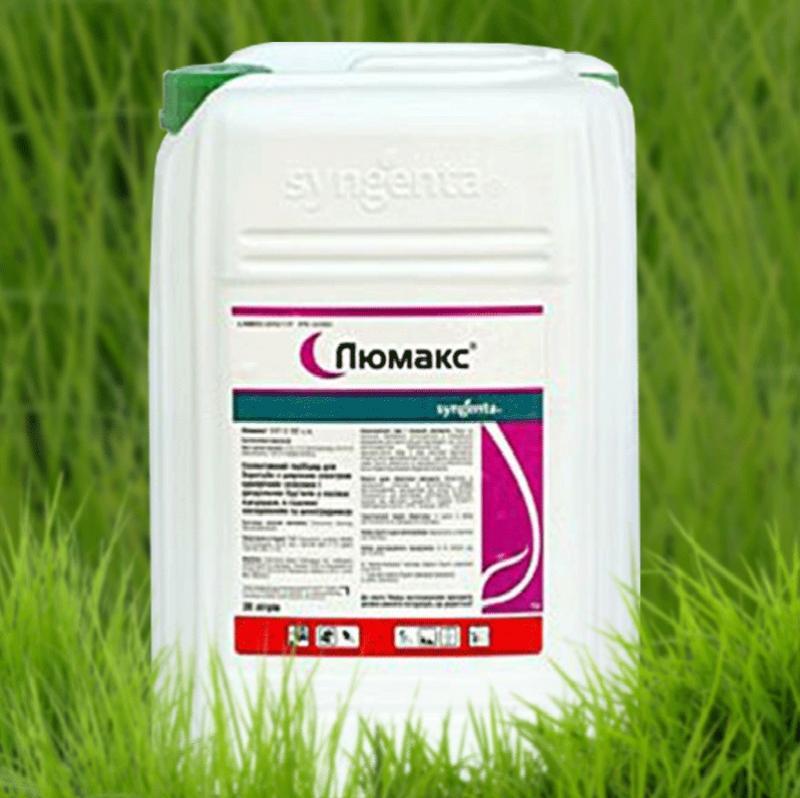
Lumax is a product of Syngenta, a well-known agricultural company. The herbicide is produced as a suspension emulsion, containing three active ingredients: s-metolachlor at 375 g per liter, terbuthylazine at 125 g per liter, and mesotrione at 37.5 g per liter. It is packaged in 5-liter plastic canisters. Each package contains four canisters.
This herbicide is designed to control dicotyledonous and grassy weeds in corn crops. It is applied pre-emergence and during early emergence.
How does the drug work?
Lumax is a three-component herbicide whose active ingredients are capable of killing virtually all common annual grasses and bicotyledonous weeds, including those resistant to other herbicides. Post-emergence spraying also suppresses perennial bicotyledonous weeds.
Advantages and disadvantages
Calculation of consumption
For pre-emergent spraying of corn (into the soil) to control first-year weeds with standard and minimum tillage, the application rate is 4 liters per hectare. For effective action, the soil must be well-prepared and free of large clods. To control perennial biennial weeds, the application rate is 3-3.5 liters per hectare. The degree of soil tillage is not important in this case. The solution consumption rate is 250-300 liters per hectare.

Preparation of the working mixture
To prepare a Lumax herbicide solution, mix the required volume of suspension with half the total volume of water. After dissolving, add the remaining water to the tank. Mix thoroughly. Standard field sprayers are suitable for application. The solution is prepared immediately before use.
Correct use of herbicide
When applying herbicide to early-emerging seedlings, pay attention to the development stage of grass weeds. They should not be allowed to overgrow; the grass should have no more than 1-2 leaves.
The instructions for use indicate that Lumax treatment is completely safe for corn.
All corn hybrids sown on all soil types can be treated. It is not recommended to grow beets of any kind or legumes in areas treated with Lumax the following season. After plowing, sunflowers, grains, alfalfa, rapeseed, soybeans, and sorghum can be sown.

Precautionary measures
When working with and spraying Lumax solution, wear protective clothing, gloves, and a respirator and goggles. Do not remove protective clothing until the end of the work. Clothing should cover all exposed parts of the body. If the product splashes on your skin, rinse with clean, warm water. If it gets into your mouth or eyes, rinse with water.
How toxic is it?
Lumax is a Class 3 herbicide. This class includes substances with low hazard to humans. Poisoning while handling the product is rare, but possible. If symptoms of intoxication occur, first drink water and take activated charcoal tablets (1 g per 1 kg of body weight). After a few minutes, induce vomiting. If there is no improvement, consult a doctor.

Is compatibility possible?
Lumax is compatible with pesticides and other herbicides used concurrently. It is recommended to check compatibility unless there are specific instructions for compatibility.

Storage conditions and periods
Store the herbicide at 0-35°C in warehouses specifically designed for agrochemicals. Keep the warehouse dry and dark. Store the herbicide in a sealed, lidded container. Dispose of any remaining product after the expiration of the shelf life (3 years). Store the prepared Lumax solution for no longer than 24 hours, and prepare a quantity no greater than the daily work requirement.
Analogues
Similar medications include "Varyag Trio," "Gerbisan," and "Sintmezo." They contain the same active ingredients and are therefore suitable as a replacement for the main medication.
Lumax protects young corn from weed infestation and, under normal conditions, can provide crop protection throughout the growing season. It can be applied pre-emergence and on young seedlings (up to 3 leaves). It destroys both green and germinating weeds. It is non-phytotoxic when the recommended dosage and application rate are met. The product is selective for many crops, even at twice the recommended application rate. By eliminating weeds in corn crops, yields increase, which can be seen when comparing yields from untreated fields.
Related posts:
 The best eggplant varieties for growing in a polycarbonate greenhouse: planting and care
 Top 40 DIY New Year's Baking Recipes for 2020
 The health benefits and contraindications of black currants
 The best grape varieties for growing in the Urals, planting and care rules in summer
 Methods for planting and propagating cherries at home
 How to control carrot flies with medications and folk remedies
 Descriptions of the 20 best cherry varieties for the Moscow region, their planting and care
 Gardo Gold herbicide instructions, dosage, and analogues