
Pesticides not only increase crop yields but also significantly save time on weeding. Tifi is a systemic herbicide used to protect crop seedlings from weeds. It has a selective action and is widely used in agriculture, covering both small plots and large areas.
Composition, dosage form and purpose
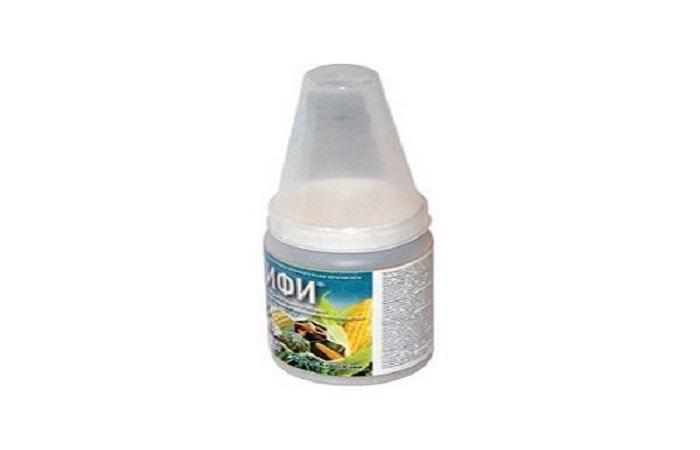
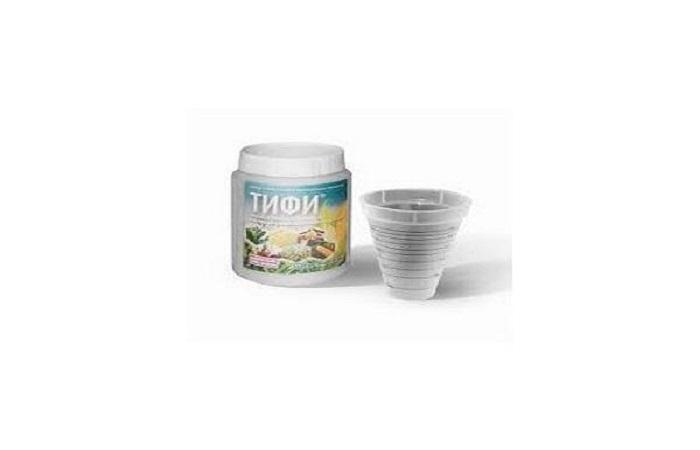
The product is available as water-soluble granules packaged in 100g bottles. The active ingredient is thifensulfuron-methyl. "Tifi" is a post-emergence herbicide. It is designed to control broadleaf weeds in barley, soybeans, winter wheat, and corn.
Operating principle
The herbicide works by inhibiting the production of a specific enzyme, which halts plant cell growth and division. The aqueous solution penetrates weed tissue when sprayed on foliage. Damaging symptoms appear after about a week, including the death of growth points, tissue necrosis, and chlorosis.
Advantages and disadvantages
Like any herbicide, Tifi has both positive and negative properties. Its advantages include:
- highly effective in destroying broadleaf weeds (black nightshade, amaranth, purslane, snakeweed and bindweed);
- the effect of the toxic substance becomes apparent within a few hours;
- non-toxic to crops of treated cultivated plants.
One of the disadvantages is that weeds become accustomed to the herbicide used under conditions of long-term use.
Calculation of consumption for plants
When diluting granules, consider the type of plants being treated and the type of weeds. It's important to follow the manufacturer's recommendations.
| A type of cultivated plant | Type of weed | Herbicide application rates | Features of application |
| Winter wheat | Annuals, dicotyledons | 0.015 | Spring spraying during the tillering phase |
| Corn | Annuals, dicotyledons | 0.01 | Spraying in the 3-5 leaf phase |
| Soybeans | Annuals, dicotyledons | 0.006 | Spraying in the 1-2 leaf phase |
How to prepare a working mixture
When preparing a working solution, follow the standard procedure. Preparing a stock solution in advance will simplify the process:
- a small container is filled with water in which the required amount of granules is dissolved;
- the stock solution of the herbicide is poured into the sprayer tank, which is half filled with water;
- The container is completely filled with water, stirring constantly.
It is recommended to prepare the working solution immediately before treating weeds.
Instructions for use
For weed spraying, it's best to schedule it in the morning, when there's no wind. The optimal temperature is 15-25°C. Do not add mineral fertilizers to the spray solution during drought or hot weather.
Safety precautions
Any herbicide is a pesticide. Therefore, when preparing the working mixture and during spraying, precautions must be taken:
- put on personal protective equipment (respirator, protective glasses and clothing);
- Do not smoke, eat or drink while spraying;
- If the herbicide solution comes into contact with the skin or mucous membranes of the eyes, it is advisable to wash it off with running water.
How toxic is it?
The product "Tifi" is classified as a Class III hazard substance. It is considered non-toxic to humans and insects. Therefore, it can be used for spraying vegetation near open water bodies or in areas with high groundwater levels.
Possible compatibility
Manufacturers allow mixing granules with other pesticides. Recommended products for mixing include Banvel, Octalon, and Super. Mixing Tifi herbicide with organophosphorus insecticides is not permitted.
Storage terms and conditions
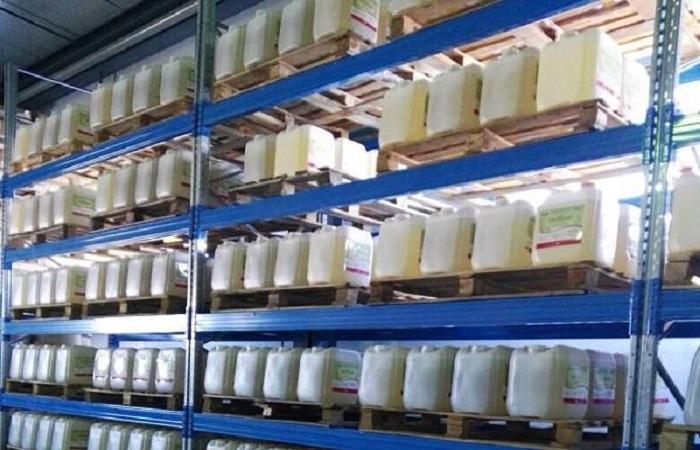
Since the granules are water-soluble, it is recommended to store the product in a tightly sealed container in a dry, ventilated area. The granules retain their effectiveness for 3 years from the date of production.
Similar means
Several medications based on thifensulfuron-methyl are produced. Popular analogues of "TIFI" include:
- "Orion";
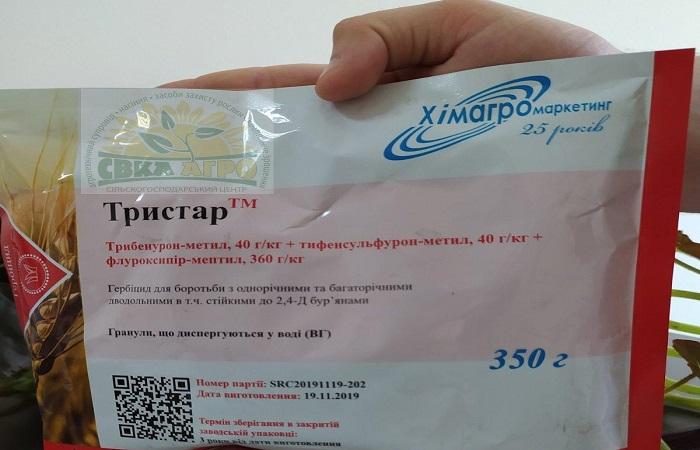
- Tristar is a three-component herbicide. In addition to thifensulfuron-methyl, the product contains granules of tribenuron-methyl and fluroxypyr-methyl. Advantages: compatible with most pesticides, resistant to rainfall, and no restrictions on crop rotation in subsequent seasons.
Farmers report increased yields of corn, soybeans, and wheat when using the herbicide "Tifi." To achieve effective results, it is important to apply the herbicide within the manufacturer's recommended timeframe.
Systemic herbicides do not inhibit the growth of cultivated plants. This is especially important, as killing weeds allows more moisture and nutrients to reach beneficial plants.
Related posts:
 Hermes herbicide instructions for use, dosage, and analogues
 Composition and instructions for use of the herbicide Ballet, application rates and analogues
 Instructions for use and composition of the herbicide Aksifor, dosage and analogues
 Instructions for use and composition of the herbicide Caliber, consumption rate and analogues
 Instructions for use and composition of the herbicide Callisto, dosage and analogues
 Instructions for use and composition of the herbicide Basis, application rates and analogues
 Instructions for use of the soil herbicide Merlin, dosage and analogues
 The spectrum of action and instructions for use of the herbicide Agritox, its consumption