
The use of effective herbicides on grain crops contributes to a high-quality grain harvest. Let's look at the composition of the herbicide "Kalibr," its mechanism of action, advantages and disadvantages, purpose, dosage, and consumption, as well as its application instructions. We'll also discuss the product's toxicity, compatibility with pesticides, storage conditions and time, and similar plant treatments.
Composition, dosage form and purpose
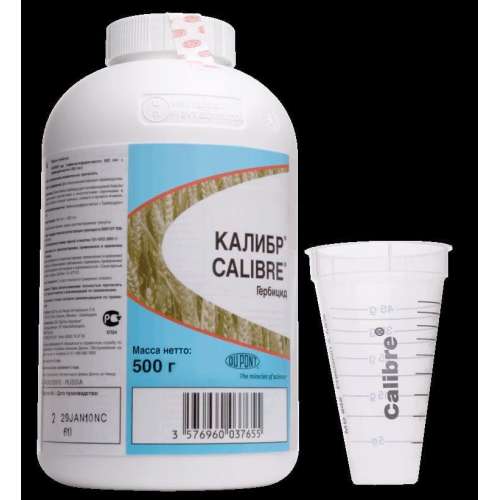
The herbicide "Kalibr" is produced by FMS Corporation as water-dispersible granules in 0.5-liter plastic jars. It contains two active ingredients: thifensulfuron-methyl at a concentration of 500 g per kg and tribenuron-methyl at a concentration of 250 g per kg. These substances belong to the sulfonylurea class. "Kalibr" is classified as a systemic pesticide based on its mode of penetration and a selective herbicide based on its mode of action.
It is used to treat spring and winter wheat and barley crops against annual and bilobate weeds, including species resistant to 2,4-D and MCPA. The herbicide also controls some varieties of perennial bilobate weeds.
Mechanism of action
The herbicide solution is absorbed into weed tissue through the leaf surface and transported through the blood vessels to the growing points. The substances inhibit amino acid synthesis by blocking the enzyme that regulates this process, within just three hours of application. Once growth is stopped, the weeds die within two to three weeks. Signs of herbicide action—discoloration and necrosis—become visible within five to ten days of application.
Pros and cons
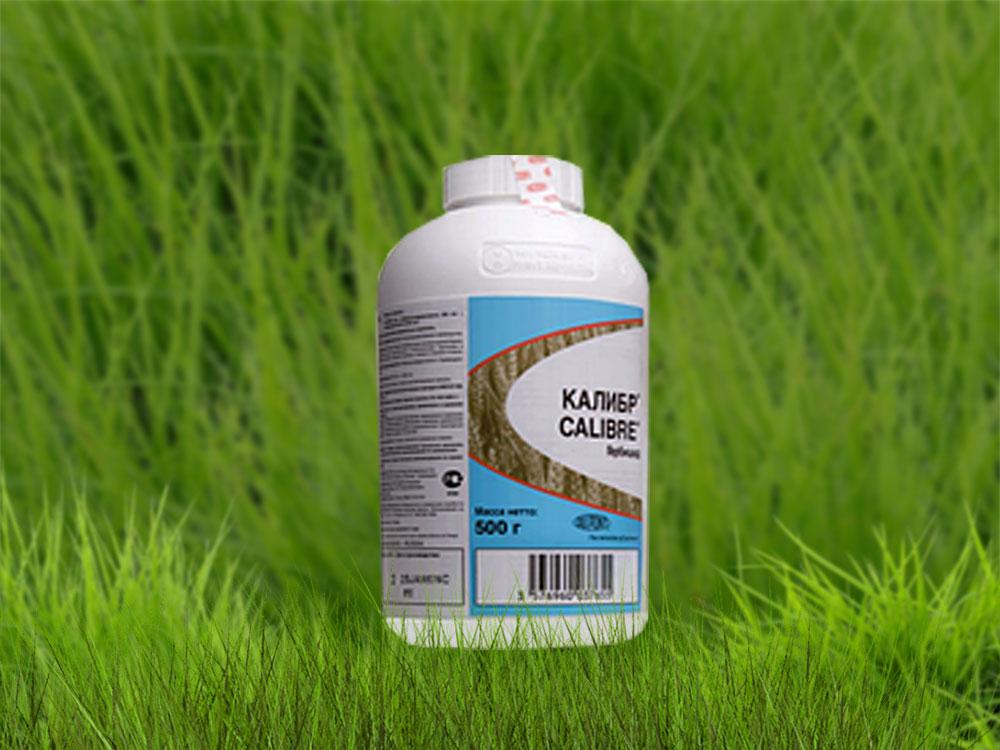
"Caliber" herbicide has the following advantages:
- can be used in case of severe weed infestation of crops;
- does not limit crop rotation;
- It can be used on plants at different stages of growth;
- does not suppress the cultivated crop;
- can be processed both by conventional sprayers and from airplanes;
- maintains high efficiency under adverse weather conditions;
- destroys herbicide-resistant and difficult to eradicate weed species;
- active substances do not accumulate in the soil.
The downside of the herbicide "Caliber" is its limited use - only on wheat and barley.
What crops does it work on and dosages
"Kalibr" is used to control annual bipartite weeds and some perennial weeds. For spraying spring grain crops in the 2-3 leaf-tillering phase (with the addition of "Trend-90" surfactant at a rate of 200 ml per hectare, if applied in hot, dry weather), the application rate is 0.03-0.05 l per hectare. The solution consumption rate is 200-300 l/ha; when spraying from an aircraft, the rate is 50-75 l/ha. If the weather does not permit early spraying, treatment can be carried out at the boot-forming stage of the grain crop. The dosage and consumption remain the same.
Winter wheat and barley are sprayed against weeds, including those resistant to 2,4-D and 2M-4X, with a solution prepared at the same concentration and the same application rate. In all cases, a single application is sufficient, and the waiting period is the same – 60 days.
How to prepare a working mixture
To prepare a solution of the "Caliber" herbicide, follow the standard procedure: first, dissolve the required volume of the product in a sprayer tank with half or a third of the volume of water, then stir to dissolve. Then, add the remaining water and stir again.
Instructions for use
It is recommended to apply the herbicide "Caliber" on warm and humid days; on cool days, a decrease in effectiveness can be expected.
Precautionary measures
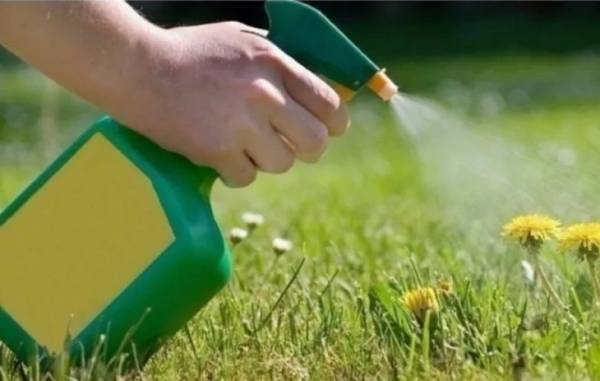
When working with the product, wear protective clothing that covers all parts of the body to prevent contact with the solution. Wear rubber gloves, and a mask, respirator, and goggles on your face. Do not remove protective equipment until you're finished working. Afterward, wash your hands and face with soap to neutralize the solution. If the solution comes into contact with your skin or eyes, rinse with plenty of water. If necessary, perform gastrointestinal lavage if the solution has been ingested and there are signs of poisoning.

How toxic is it?
"Kalibr" herbicide is classified as a moderately toxic agricultural product (Class 3 for humans and bees). When diluted at the recommended concentration and applied at the recommended rate, it is non-toxic to plants.
Contraindications for use
Do not use near water bodies. This product may cause poisoning to fish and aquatic organisms.

Possible compatibility
The herbicide "Kalibr" is well suited for tank mixing with many fungicides and insecticides used on grain crops to protect against diseases and pests. It can be mixed with the herbicides at full dosage or alternated.
Storage terms and conditions
"Caliber" can be stored for 3 years in unopened containers from the manufacturer. Storage conditions: dry, ventilated, and darkened area. The solution can be stored for 1 day.
Similar drugs
For agriculture, the following preparations are produced that are similar to "Caliber": "Arkan", "Aton", "Cayenne", "Classic Forte", "Kupazh", "Pixel", "Dublon Gold", "Status Max", "Harmony", "Alpha-Gart", "Basis", "Supercorn", "Tesis", "Tifi", "Allert", "Granstar Mega", "Shansti", "Trisil", "Akkurat Extra", "Express Gold", "TifilAgro", "Tiefens".
The herbicide "Kalibr" protects wheat and barley from annual and perennial weeds, including those that are difficult to eradicate. It demonstrates excellent effectiveness with just a single treatment thanks to its two-component formula. It has low toxicity to humans, bees, and plants.
Related posts:
 Description of the large-fruited tomato hybrid Main Caliber F1 and growing recommendations
 Hermes herbicide instructions for use, dosage, and analogues
 Composition and instructions for use of the herbicide Ballet, application rates and analogues
 Instructions for use and composition of the herbicide Basis, application rates and analogues
 Instructions for use and composition of the herbicide Helios, dosage and analogues
 The best eggplant varieties for growing in a polycarbonate greenhouse: planting and care
 Instructions for use and composition of the herbicide Aksifor, dosage and analogues
 Instructions for use and composition of the herbicide Express, consumption rate
