
- Composition and dosage form
- What weeds is it effective against and what is its purpose?
- Mechanism of action
- Pros and cons
- Calculation of consumption
- How to prepare a working mixture
- Terms of Use
- How quickly does it work and how long does the effect last?
- Precautionary measures
- Are there any restrictions on crop rotation?
- How toxic is it?
- Possible compatibility
- Storage rules and shelf life
- Analogues
Sunflower is a vital industrial crop, cultivated over vast areas in many countries. Few can imagine life without sunflower oil. Both adults and children love the seeds. Legumes grow very slowly in their early stages and require weeding. Hermes, an innovative, long-acting herbicide, can help these remarkable plants.
Composition and dosage form
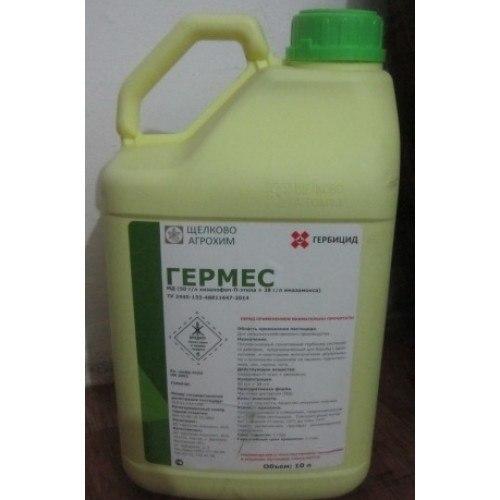
The herbicide "Hermes" contains two active ingredients: imazamox (38 g/l) and quizalofop-P-ethyl (50 g/l). They are available as an oil dispersion and are produced by Shchelkovo Agrokhim in 5- and 10-liter polyethylene canisters.
What weeds is it effective against and what is its purpose?
The herbicide "Hermes" controls annual dicotyledonous weeds and annual and perennial grass weeds. It is not sensitive to sunflower, soybeans, chickpeas, and peas, and is used for post-emergence treatment.
Mechanism of action
Quizalofop-P-ethyl penetrates the weed tissue through the leaf surface, moves toward the roots and growth points, and disrupts photosynthesis. The plant stops growing, changes color, wilts, and dries out. 90-98% of weeds are killed.
These organs ensure the growth of vegetative mass and roots, producing semi-finished products for the construction and renewal of various plant tissues. Imazamox inhibits the synthesis of the amino acid production catalyst, thereby disrupting the synthesis of proteins and nucleic acids. The growth and development of organisms harmful to the crop is inhibited.
Pros and cons
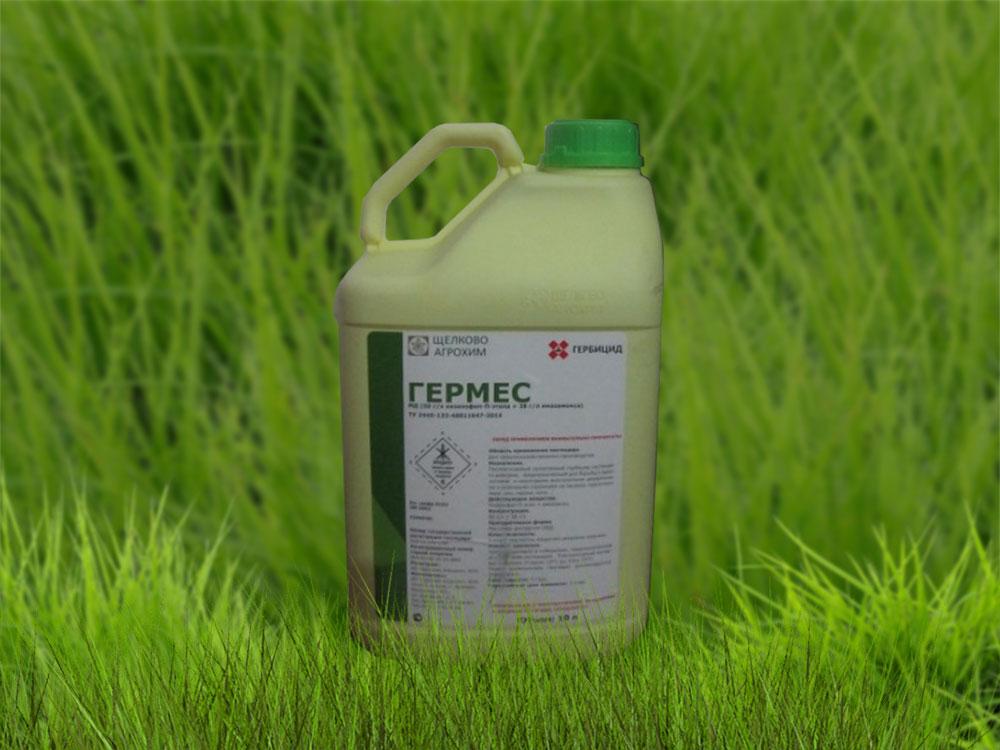
To eliminate any doubts about the benefits of chemical preparations, the advantages of the Hermes herbicide can be collected and formulated in one place.
A drawback of this herbicide is its phytotoxicity to crops at maximum application rates. Therefore, Hermes must be applied within the timeframes specified by the manufacturer's instructions.
Calculation of consumption
For 1 hectare of field area, 200-300 liters of working fluid are used.
| Culture | Weed | Application rate, l/ha | Spraying time |
| Sunflower, varieties and hybrids not sensitive to imidazolinones | Annual and some perennial dicotyledons and cereals | 0.9-1 | 2-4 leaves on the weed and 4-5 true leaves on the crop. |
| Peas for grain | 0.7-0.9 | 1-3 leaves for the weed and 1-3 true leaves for the crop. | |
| Chickpeas for grain | |||
| Soybeans | 0.7-1 |

How to prepare a working mixture
The mixture of the product and water separates quickly, so the sprayer tank is filled immediately before use. The following is the procedure for preparing the working solution:
- The tank is half filled with water.
- The entire dose of Hermes herbicide is poured in a stream while the hydro-mixer is turned on.
- Add the remaining water required to obtain the recommended concentration.
- Mix until completely homogeneous.
Continue stirring while spraying the preparation.
Terms of Use
Applying Hermes herbicide yields best results at the beginning of weed growth. Instructions for use:
- To carry out the treatment, choose a day when the wind speed is less than 4 m/s. The air currents should not be swirling, but should be directed in one direction.
- The ideal air temperature is 10-20°C. Higher temperatures are acceptable in cloudy weather. Be careful of sunburn on the crop as a result of spraying.
- Before spraying the pesticide, the soil must be well cultivated and free of plant residues.

How quickly does it work and how long does the effect last?
Weeds begin to feel discomfort within an hour after treatment. Their growth slows. After 5-7 days, the leaves lose their green color. Weeds particularly sensitive to Hermes herbicide die off first. After two weeks, the field is cleared of pests. The herbicide remains active for 4-5 weeks. In soils poor in organic matter and at moderate temperatures, its effect is prolonged.
Precautionary measures
An easily cleaned area is designated for preparatory work with Hermes herbicide and other chemicals. It is decontaminated after each use.
If crops are weakened for any reason, the manufacturer does not recommend treating them with herbicide.
Hermes is moderately hazardous to humans. Its toxicity is most pronounced when inhaled. Therefore, when working with the herbicide, avoid drinking, smoking, talking, eating, or taking deep breaths. Instead, wear a respirator in addition to protective clothing. Rinse the Hermes container with water several times to remove any residue from the solution. The container should then be taken to a recycling center. Do not use utensils that have been contaminated with the chemicals for household purposes.

Are there any restrictions on crop rotation?
The cleared field treated with Hermes herbicide can immediately be used to grow corn for silage. Four months later, winter grains and legumes are sown for forage or for incorporation into the soil. The following season, sunflowers, sorghum, and corn are planted. In the spring, sugar beets, any varieties of rapeseed, vegetables, grains, and industrial crops are sown.
How toxic is it?
Hermes herbicide application guidelines take into account the sensitivity threshold of the crops on which it is recommended for use. Sometimes, applying the maximum dose of the product causes a loss of chlorophyll in legume leaves. This becomes apparent 3-5 days after spraying. However, after the crop recovers, a more favorable weed-free environment compensates for this temporary disruption. A yield increase is still observed compared to an untreated field.
Brief contact of Hermes herbicide with skin or eyes does not cause irritation or subsequent hypersensitivity. However, in such a situation, it is recommended to immediately rinse the skin and eyes with plenty of water. Then apply baking soda or soap in water, rinsing thoroughly.

If the herbicide "Hermes" gets into the nasopharynx, the following symptoms of toxic effects are possible:
- loss of appetite;
- weakness;
- headache;
- increase in body temperature.
The worker experiencing these symptoms is referred to a doctor. Elevated concentrations of the herbicide in the air are observed within the treated area. Within 50 meters of the treatment area, there is no toxic hazard to bees or bystanders. Mechanized work on crops sprayed with Hermes herbicide is permitted three days after the end of the procedure. Manual work is permitted seven days after the application of the chemical. However, it is important to remember that the passage of machinery and any impact on the soil disrupts the protective herbicide screen and shortens its activity period.
Possible compatibility
Hermes herbicide does not react with neutral and slightly acidic solutions and is unstable in alkaline environments. Compatibility testing in tank mixes is performed by combining small quantities of the products intended for field treatment. If the substances react within half an hour, foam, flakes, or sediment will form.

Storage rules and shelf life
Pesticides should be stored in a designated area, inaccessible to unauthorized persons. It should be dark, ventilated, and located no closer than 400 meters from residential buildings, livestock yards, and barns. The shelf life of Hermes herbicide is 3 years from the date of manufacture. Store at temperatures ranging from -15°C to +35°C. Keep away from open flames.
Analogues
In order to prevent the emergence of weeds resistant to the herbicide "Hermes", it is recommended to alternate its use with preparations from other chemical groups.
| Culture | Competitor | Preparation | Method and time of application |
| Sunflower, vegetables, legumes | Annual cereals and the most common dicotyledons. | "Dual Gold 960 CE" | Spray before weed emergence, before or after crop sowing. In drought conditions, incorporation into the soil to a depth of 2-3 cm is possible. |
| Any | Annual and perennial dicotyledons and cereals (sow thistle, bindweed, spurge, couch grass). | Touchdown | Before sowing, crops are sprayed in damp and warm weather, when: perennial cereals have 4 or more leaves at least 10 cm in height; perennial dicotyledons are in the budding or flowering phase; annual cereals have leaves at least 5 cm long; annual dicotyledons have two true leaves. It proves its worth when used on steam fields. |
| Any | Annual and perennial cereals and dicotyledons. | Hurricane Forte | |
| Soybeans, peas, chickpeas, sunflower, others | Annual and perennial cereals. | Fusilade Forte | At temperatures between 10 and 30°C, spray at the 2-4 leaf stage for annuals and at a height of 10-15 cm for perennials. Apply during the period from germination to budding. |
Related posts:
 The best eggplant varieties for growing in a polycarbonate greenhouse: planting and care
 Methods for planting and propagating cherries at home
 Instructions for use and composition of the herbicide Aksifor, dosage and analogues
 Descriptions of the 20 best cherry varieties for the Moscow region, their planting and care
 Instructions for use and composition of the herbicide Basis, application rates and analogues
 Instructions for use and composition of the herbicide Target, dosage and analogues
 How to properly plant peas in a greenhouse and open ground
 Composition and instructions for use of the herbicide Ballet, application rates and analogues