
- Composition, existing forms of release and purpose
- What plants does it affect and how does it work?
- How quickly does it work and what are the symptoms of action?
- How long does the protective effect last?
- Advantages and disadvantages
- Calculation of consumption
- How to prepare a working mixture and the rules for its use
- How toxic is it?
- Is compatibility possible?
- How much and how to store correctly
- Similar means
No one doubts the necessity of pesticides, but due to their danger to human health, bees, and the environment, they cannot be applied repeatedly. Weeds, however, readily exploit favorable weather conditions and actively germinate after each rainfall. The systemic herbicide "Paradox" destroys not only pests in the growing phase but also those attempting to emerge after them.
Composition, existing forms of release and purpose
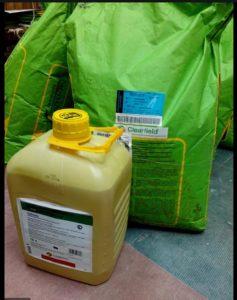
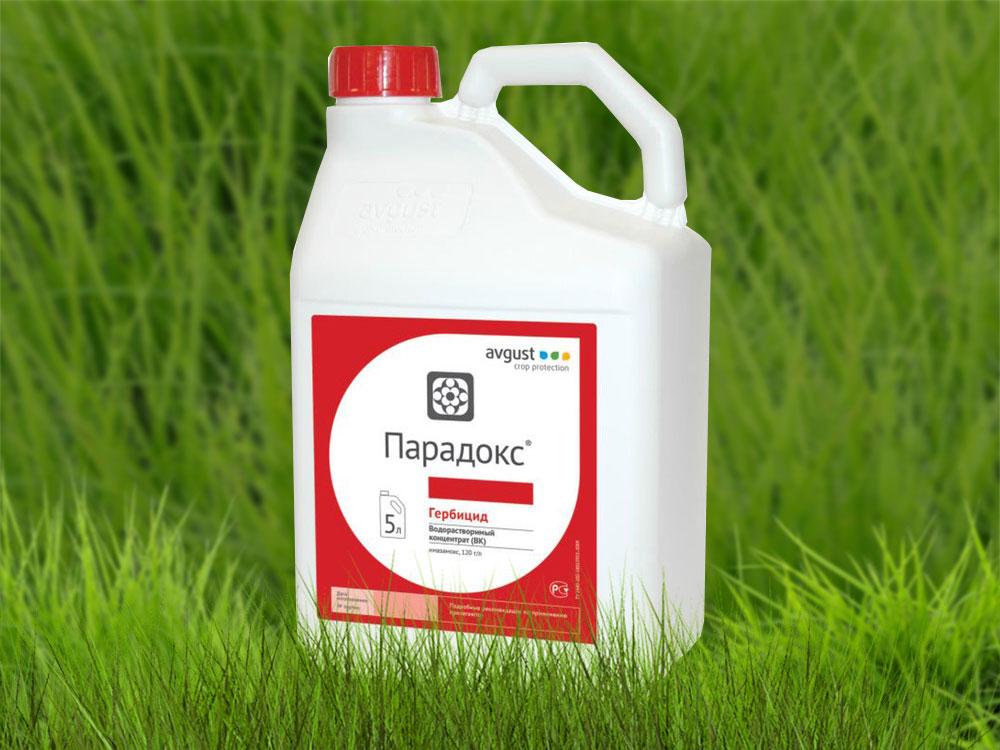
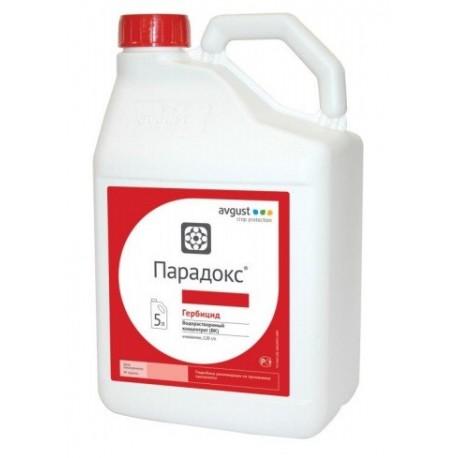
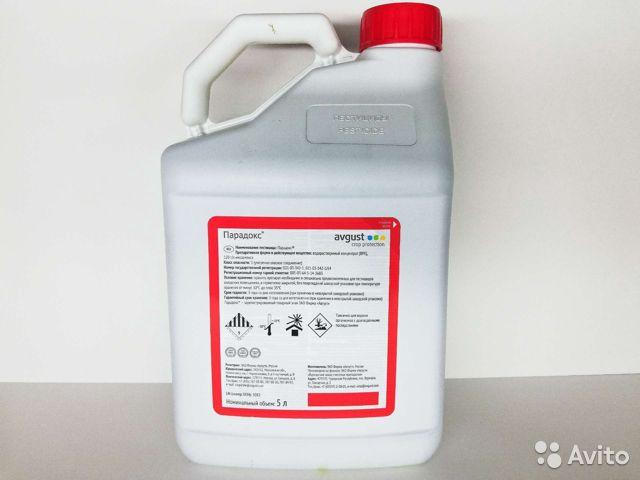
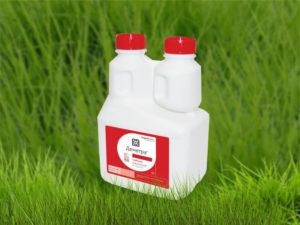
The herbicide "Paradox" is produced by the company "August" as a water-soluble concentrate. It contains the active ingredient imazamox (120 g/l). The product is packaged in 5-liter canisters. "Paradox" controls cereal and broadleaf weeds in crops.
What plants does it affect and how does it work?
A systemic herbicide spreads throughout the plant. It accumulates in tissues that synthesize building material for the growth of all parts of the pest and the replacement of aging cells.
Crops resistant to imidazolinones have acquired this property thanks to a modified metabolic system. They quickly eliminate these compounds from their bodies. Annual weeds lack this defense mechanism. Therefore, even robust plants with rhizomes, such as:
- ragwort;
- wild oats;
- common cocklebur;
- common hedgehog;
- species of foxtail and amaranth.
If applied at the wrong time, significant damage can be caused to yellow and pink sow thistles, creeping couch grass, and wormwood species. Complete death of these plants is possible.
How quickly does it work and what are the symptoms of action?
The Paradox herbicide disrupts weeds' regeneration and growth systems within a few hours. Visual signs of a sharp deterioration in pest health are observed 5-7 days after application:
- growth points turn brown;
- the leaves are turning yellow;
- individual shoots wither.
After a few more days, the plants turn brown or black, and the root system dies.
How long does the protective effect last?
In soils with high organic matter content and constant heat, the soil activity of the Paradox herbicide prevents new weeds from germinating for three weeks. With sufficient soil moisture and moderate temperatures in poorer soils, protection extends to four weeks. After that, the established crop itself prevents weeds from gaining space and sufficient light thanks to its expanded above-ground portion.
Advantages and disadvantages
The positive qualities of the herbicide "Paradox" can be summarized.
A disadvantage of the herbicide is its residual soil effect, to which most crops are sensitive. Without restrictions, traditional varieties are recommended to be planted three years after treatment with Paradox.
Calculation of consumption
To process 1 hectare of field, it is necessary to prepare 200-300 liters of working liquid.
| Culture | Weed | The rate of the herbicide "Paradox" | Spraying time |
| Soybeans, peas for grain | Annual cereals and dicotyledons, some perennials | 0.25-0.35 | 2-4 true leaves for weeds. 2-5 true leaves for crops. |
| Sunflower and rapeseed varieties resistant to imidazolinones | 0.3-0.4 |

The company "August" recommends mixing the herbicide with the adjuvant "Adju" of its own production, adding it in the amount of 0.1-0.2 liters for every 100 liters of working solution.
How to prepare a working mixture and the rules for its use
The water-soluble Paradox concentrate is diluted with water directly in the spray tank. Step by step:
- Half of the container is filled with water.
- The full dose of the drug is injected.
- The liquid is stirred for 4 minutes.
- The remaining water is added.
- Mixing with a hydromixer is continued for another 4 minutes.
- An adjuvant is injected.
- The hydro mixer works for 4 minutes.
The prepared working fluid must be kept uniform by stirring occasionally. Prepare the mixture while wearing protective clothing and begin spraying immediately.

Instructions for use of the working fluid:
- wind speed – less than 4 m/s, without turbulence;
- weather without precipitation;
- the stream is directed at the weeds so that it washes them from all sides;
- Avoid spraying people, tools and equipment, and neighboring plantings.
How toxic is it?
Although genetically modified varieties of soybeans and peas quickly remove the herbicide "Paradox" from their tissues, under certain conditions their growth can be slowed down by 1 week.
Compared to the losses in crop yields in fields infested with harmful plants, this negative impact from the pesticide seems insignificant.
The drug is moderately toxic to humans and bees. Acute poisoning is prevented with personal protective equipment (PPE) including an eye mask and a respirator. Those who are concerned about exposure should be aware of the symptoms:
- lacrimation and salivation;
- dyspnea;
- wheezing;
- bloody discharge from the nose.

Is compatibility possible?
The manufacturer recommends adding the herbicide "Korsar" (for soybeans and peas) to "Paradox" if there are large numbers of tall dicotyledonous weeds in the area. Adjuvants are added last to the mixture. After compatibility testing, other products also enhance the effectiveness of "Paradox."
How much and how to store correctly
The herbicide is usable for three years after production. The ideal storage temperature is 0-25°C. The name on the packaging must be clearly visible. The lid must always be tightly closed. The warehouse is ventilated and protected from sunlight. Keys to the premises are provided to the responsible person.

Similar means
The products listed in the table are suitable for replacing the pesticide. They are effective against similar harmful plants.
| Culture | Weed | Herbicide |
| Soybeans and peas | Annual and perennial cereals and dicotyledons | Pivot |
| Soybeans | Cereals and dicotyledons | "Geyser", "Fabian" |
| Sunflower, corn, soybeans, beets | Annual cereals and some dicotyledons | "Difront" |
| Sunflower, corn, rapeseed | Annual cereals and dicotyledons | "Labrador" |
Related posts:
 Composition and instructions for use of the herbicide Aristocrat, dosage and analogues
 Instructions for use and composition of the herbicide Lornet, application rates and analogues
 Hermes herbicide instructions for use, dosage, and analogues
 Luger herbicide instructions for use, dosage, and analogues
 Instructions for use and composition of the herbicide Corsar, dosage and analogues
 Instructions for use and composition of the herbicide Helios, dosage and analogues
 Composition and instructions for use of the herbicide Ballet, application rates and analogues
 Instructions for use and composition of the herbicide Volnik, dosage and analogues