
Every farmer wants to buy a pesticide and apply it to all their crops, without having to study the instructions for dozens of products and choosing the ones that are best for them. Volnik, a systemic herbicide, tackles the most harmful weeds and shrubby growth in one fell swoop, covering any crop.
Composition, existing forms of release and purpose
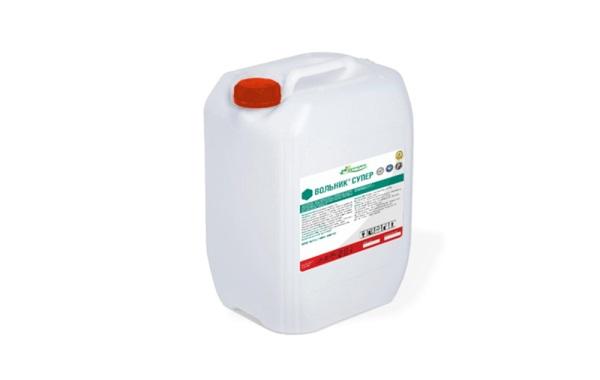
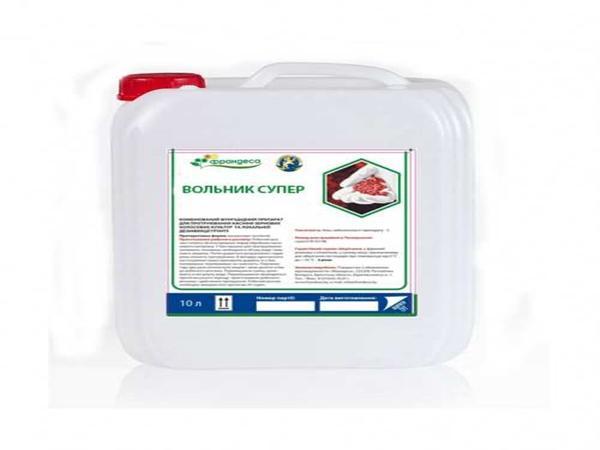
Volnik herbicide, containing glyphosate (540 g/l), is produced as an aqueous solution and packaged in 20-liter canisters. It is a non-selective pesticide that addresses a variety of weeds in fallow lands and fields prior to planting.
Applying Volnik during the active growing season clears access roads to gas and oil pipelines, power lines, and highways and railways. This herbicide can be applied at any time where overgrown trees, tall weeds, and the absence of cultivated plants are a problem.
Mechanism of action
Volnik is a systemic herbicide. By penetrating weed tissue, it blocks an enzyme essential for the synthesis of several amino acids. Without these amino acids, the plant cannot survive for long. The herbicide's effects are visible within 2-4 days on annuals and 7-10 days on perennials. Complete desiccation of all vegetation occurs by the end of the third week after application.
Advantages and disadvantages
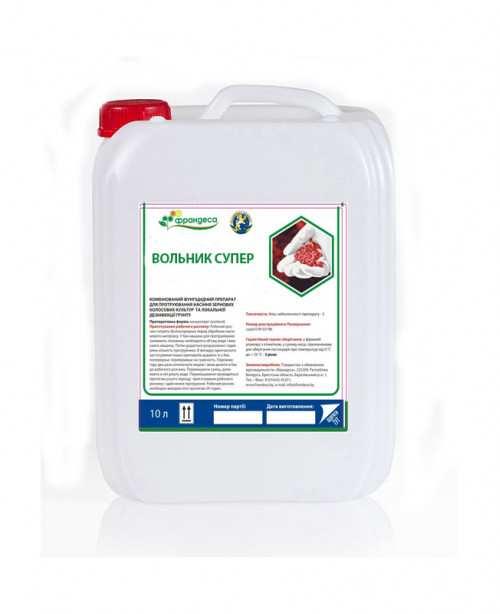
The herbicide "Volnik" is an aggressive substance that requires careful handling. After treating a field with this product, crops should be planted no sooner than two weeks later. When spraying orchards and vineyards, care must be taken to protect fruit trees and shrubs from the effects of "Volnik." However, the positive characteristics outweigh the negative ones. These include:
- high degree of stickiness, which prevents it from being washed off by sudden precipitation;
- aerial spraying is permitted;
- destroys even shrub growth;
- soluble in water;
- quickly neutralized in the soil.
- Can be used as a desiccant.
Calculation of consumption
To spray 1 hectare of territory, prepare 100-200 liters of working mixture.
| The object being processed | Weeds | Spraying time | Rate of herbicide "Volnik", l/ha |
| Corn, sugar beet | Annual and perennial dicotyledons and cereals | The weeds have sprouted, but the crops haven't. | 1.3-3.3 |
| Potato | Annual cereals and dicotyledons | 2-5 days before the emergence of crop shoots, on developing weeds. | 1-1.3 |
| Perennials | 2-2.7 | ||
| Fruit trees and shrubs | Annual dicotyledons and cereals | On growing weeds. Shield the crop from the product. | 1.3-2.7 |
| Woody fruity | Perennials | On vegetative weeds. | 2.7-5.3 |
| Grape | 2 times during May and June, on the above-ground parts of weeds. | 2.7 | |
| Fields allocated for sowing any crops | Annual cereals and dicotyledons | In the phase of active weed development. | 1.5-1.8 |
| Perennials | 1.8-3.5 | ||
| Large plants with strong stems and a powerful root system | 3.5-5.3 | ||
| Hayfields and pasture areas | Bush | June-August | 1.3-5.3 |
| Non-agricultural lands | Annuals and perennials | During the period of vigorous weed growth. | 2-4 |
| Sosnowsky's hogweed | The height of the pest is within 30 cm. | 4.1-5.1 | |
| Fallow areas, plots being prepared for sowing various crops | Annual and perennial herbaceous plants, woody and shrubby shoots | June-August | 1.3-5.3 |
| Crops and plantings of coniferous trees | After the culture has finished growing. | 1.3-5.3 | |
| Plantings of young deciduous trees | Deciduous shrub and woody growth | June-August. | 1.3-5.3 |
| Mixed young animals | After the growth of coniferous trees has ceased. | 1.3-5.3 | |
| Deciduous and mixed forests | Deciduous trees | In June-August, injections of foreign species into the trunks. | 0.2-0.4 g active ingredient/tree |
Perennial plants such as fruit trees, bushes and grapes must be protected from exposure to the herbicide "Volnik".
Preparing the working mixture and how to use it correctly
To select the concentration of the working mixture, determine the weeds growing in the area. Then, consult the table above. The working solution is prepared by mixing water and the required dose of Volnik herbicide in a mixing tank. Then, turn on the hydromixer. The mixing process lasts for 5 minutes.
For spraying, choose a dry, dry day with wind speeds of up to 4 m/s. Stir the solution again every five minutes.
Safety precautions
The herbicide "Volnik" is classified as hazard class 3. It poses moderate harm to humans and bees. Beekeepers are notified of the location and time of the upcoming event five days in advance. Signs with the "Danger" sign are posted at the boundaries.
The staff must be:
- instructed on the rules for handling the drug;
- trained to provide first aid;
- equipped with personal protective equipment.
Each worker wears protective coveralls, rubber boots, an eye mask, and a gauze mask or respirator over the nose and mouth. When eating, they must remain at least 200 meters away from the object being treated and the area where the solution was prepared. Before eating, they must thoroughly wash their hands and face with soap, avoiding contact with clothing and the dirty side of gloves.
After work, the area and containers used are thoroughly cleaned using a solution of soda ash.
How toxic is it?
The product is highly toxic to vegetation and aquatic life. People should avoid contact with the Volnik herbicide on their skin, respiratory tract, and, especially, eyes. If it comes into contact with the eyes, rinse thoroughly with water and then consult an ophthalmologist.

Is compatibility possible?
An alkaline environment reduces the product's activity. Volnik is compatible with dicamba and sulfonylureas. Many other products are also neutral to it. To ensure complete compatibility, it is recommended to pre-mix small quantities of the working fluids of the products of interest.
How much and how to store correctly
Volnik herbicide has a shelf life of 3 years from the date of production. Store at 0-30°C in a well-ventilated warehouse equipped with fire extinguishers, under lock and key.
Analogues
Despite its appeal due to its non-stop action, the Volnik herbicide must be alternated with other products. There are pesticides with different active ingredients that control a wide variety of weeds, including perennials and particularly hardy plants with large vegetative masses. Furthermore, they are selective for a relatively wide range of crops.
| Herbicide | Weeds | Culture |
| Lontrel-300 | Annual and perennial dicotyledons, including chamomile, knotweed, sow thistle, yarrow. | Wheat, barley, oats, sugar beet, strawberries, rapeseed, flax, ryegrass and other lawn grasses, foxglove, lavender |
| Lintur | Annual and some perennial dicotyledons | lawn grasses |
| Chistogryad | Dandelion, bindweed, sow thistle and others. | Vegetables, flowers |
Related posts:
 Instructions for use and composition of the herbicide Lornet, application rates and analogues
 Instructions for use and composition of the herbicide Puma Super 100, application rates
 Hermes herbicide instructions for use, dosage, and analogues
 Instructions for use and composition of the herbicide Corsar, dosage and analogues
 Instructions for use and composition of the herbicide Helios, dosage and analogues
 Composition and instructions for use of the herbicide Ballet, application rates and analogues
 Luger herbicide instructions for use, dosage, and analogues
 Instructions for use and composition of the herbicide Axial, dosage and analogues