
- Composition and existing forms of release
- What plants does it affect and how does it work?
- Advantages and disadvantages
- Calculation of consumption
- Preparation of working solution and instructions for use
- Precautionary measures
- How toxic is it?
- Is compatibility possible?
- How and how long can it be stored?
- Analogues
Farmers who plant crops in their fields must contend not only with diseases but also with weeds. If crops aren't treated with chemicals in a timely manner, weeds will choke the plants and rob them of nutrients. As a result, farmers will reap a meager, low-quality harvest. Among the selective chemicals, Pledge, a herbicide developed by Japanese specialists, has proven itself effective.
Composition and existing forms of release
The active ingredient of this selective herbicide is flumioxazine. It belongs to the chemical class of N-phenylphthalimides. One kilogram of the product contains 500 grams of it. The herbicide is manufactured by Sumiagro and sold as a wettable powder packaged in 1-kilogram sachets.
What plants does it affect and how does it work?
A selective herbicide designed to protect crops such as soybeans and sunflowers from grass and broadleaf weeds. Pledge is effective against the following weeds:
- ragwort;
- field bindweed;
- black nightshade;
- field mustard;
- all types of pikulnik;
- self-sown poppy;
- field pennycress;
- amaranth;
- Datura stramonium.
A single active ingredient in the herbicide targets weeds. After application, the weeds display characteristic symptoms of damage, including white spots, blackening, and necrosis of plant tissue. Furthermore, the herbicide solution forms a protective screen on the soil surface, killing young weed seedlings as they pass through.
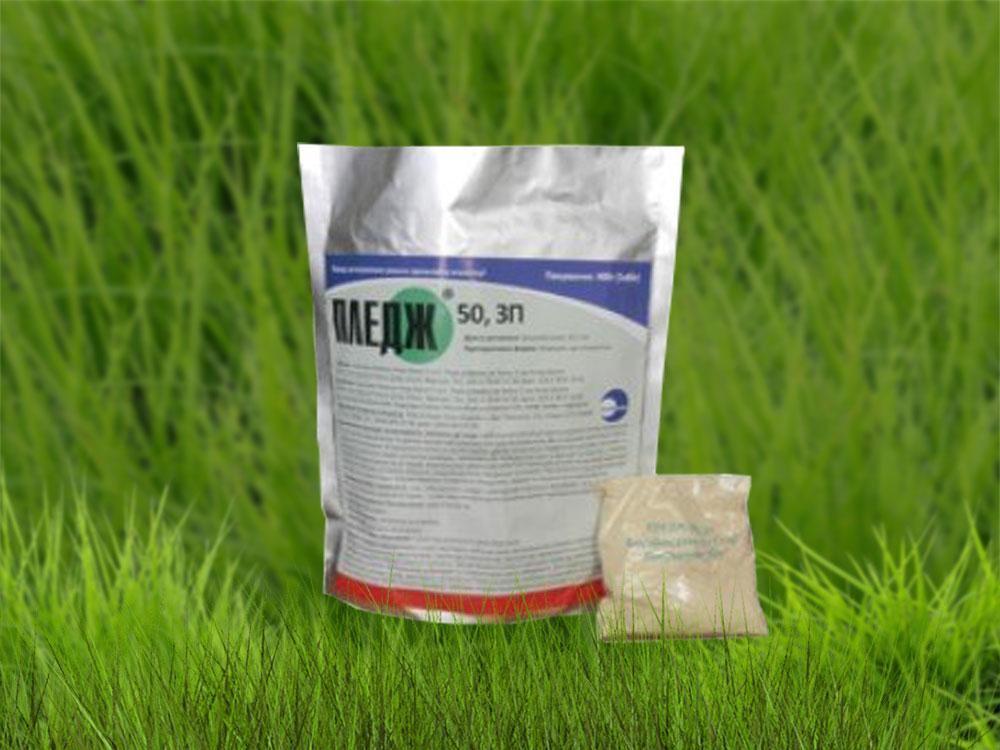
The active substance works by enhancing the oxidation of fats found in cell membranes. This results in irreversible changes and damage to the tissue structure of weed-causing plants.
Advantages and disadvantages
Farmers who tested the herbicide's performance in their fields identified several advantages of the product.


Farmers point out the relatively high cost and low effectiveness of the product from the Japanese manufacturer when dealing with heavy infestations of fields as disadvantages.
Calculation of consumption
To achieve the expected result, it is necessary to adhere to the manufacturer's recommended consumption rates of the chemical product.

The calculation of the preparation for different plants is presented in the table:
| Cultivated crop | Weeds | Herbicide rate | Working fluid consumption |
| Sunflower and soybeans (pre-emergence application) | Cereals and dicotyledonous annuals | From 100 to 120 grams, depending on the degree of contamination | From 200 to 300 liters are used per hectare |
| Sunflower and soybean (post-emergence application) | Cereals and dicotyledonous annuals | 80 grams | The application rate per hectare of field is 200 to 300 liters. Treatment is carried out at the 2-4 leaf stage of the plant. |
Preparation of working solution and instructions for use
Prepare the working solution on the day you plan to treat the fields, as it loses its effectiveness over time. Fill the sprayer tank halfway with clean water and add the herbicide at the rate specified in the instructions. Turn on the agitator and wait until the solution is completely dissolved. Then add water and mix thoroughly again.

Spraying is carried out using tractor-mounted sprayers. This is done either in the morning or evening. Wind speed on the day of treatment should not exceed 4 m/s.
Sugar beet and fodder beet cannot be planted in fields where Pledge herbicide was applied for 12 months.
Precautionary measures
When working with chemicals, observe safety rules to avoid harm to health:
- The body is protected by a work suit and the head by a scarf.
- Put rubber gloves on your hands.
- The respiratory organs are protected with a respirator.
- After finishing work, they take a shower and wash all their clothes.
- Any remaining working solution must be disposed of according to safety requirements. Do not pour the chemical into nearby bodies of water or onto the ground.
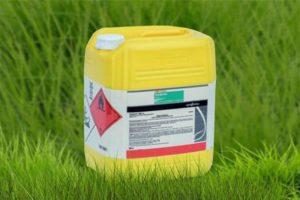

If drops of the working solution accidentally get into your eyes, rinse them with clean water and seek medical attention. If the chemical is swallowed, take activated charcoal and seek immediate medical attention, taking the medication label with you.
How toxic is it?
The herbicide's instructions indicate the chemical's toxicity level. To avoid problems, avoid using the product near bodies of water. It has a toxicity level of 2 for humans and 3 for bees.
Is compatibility possible?
The ability to combine the herbicide with other chemicals depends on the application method. For pre-emergence treatments, use with products containing acetochlor and dimethanamide is permitted. For spraying at the seedling stage, combining it with other chemicals is strictly prohibited.

How and how long can it be stored?
The shelf life of Pledge herbicide is 24 months from the date of manufacture, provided the original packaging is intact. It is recommended to store the chemical in a dry, dark storage area where the temperature does not exceed 35 degrees Celsius. It is also important to limit access to the product from children and animals.
Analogues
If necessary, "Pledge" can be noticed with a drug such as "Impulse".
Related posts:
 Hermes herbicide instructions for use, dosage, and analogues
 Instructions for use and composition of the herbicide Aksifor, dosage and analogues
 Luger herbicide instructions for use, dosage, and analogues
 Instructions for use and composition of the herbicide Basis, application rates and analogues
 Instructions for use and composition of the herbicide Callisto, dosage and analogues
 Instructions for use and composition of the herbicide Fabian, application rates and analogues
 Instructions for use of the soil herbicide Merlin, dosage and analogues
 Instructions for use and composition of the herbicide Pivot, dosage and analogues