
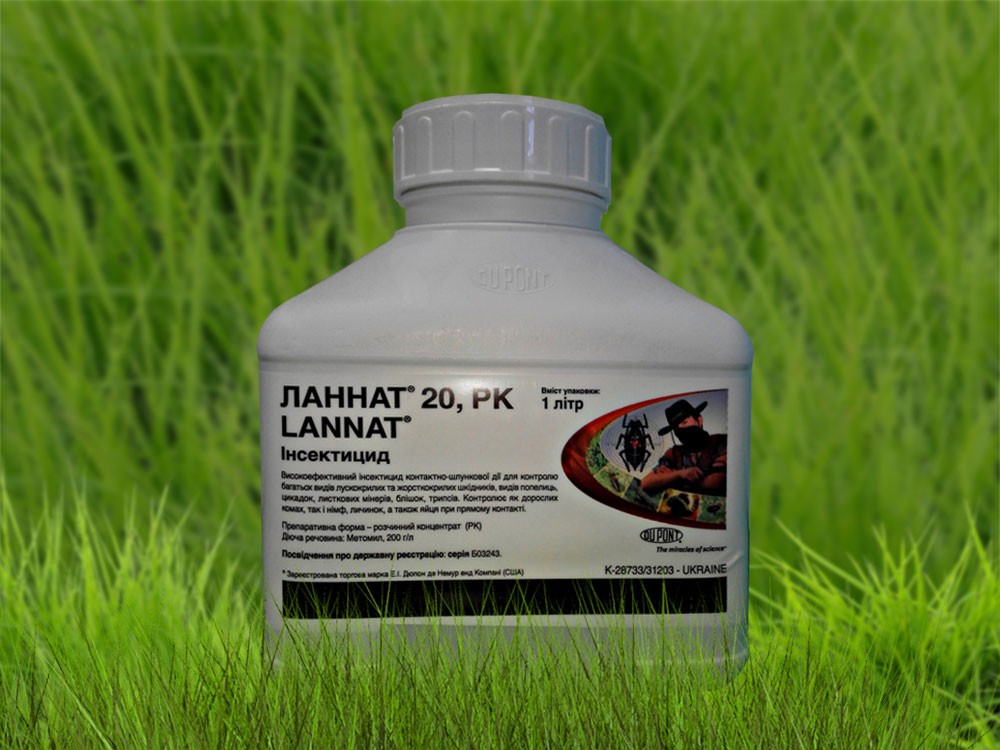
"Lannat" is the name of a new product developed by American specialists. DuPont is believed to be its manufacturer. The insecticide is highly effective and acts quickly. Furthermore, it is resistant to precipitation, decomposes quickly in the environment, and does not accumulate in berries and fruits. Furthermore, pests do not develop tolerance to the product.
Active ingredient and dosage form
The drug is a single-component product. Its active ingredient is methomyl. One kilogram of the drug contains 250 grams of the active ingredient. The liquid form contains 200 grams of the substance.
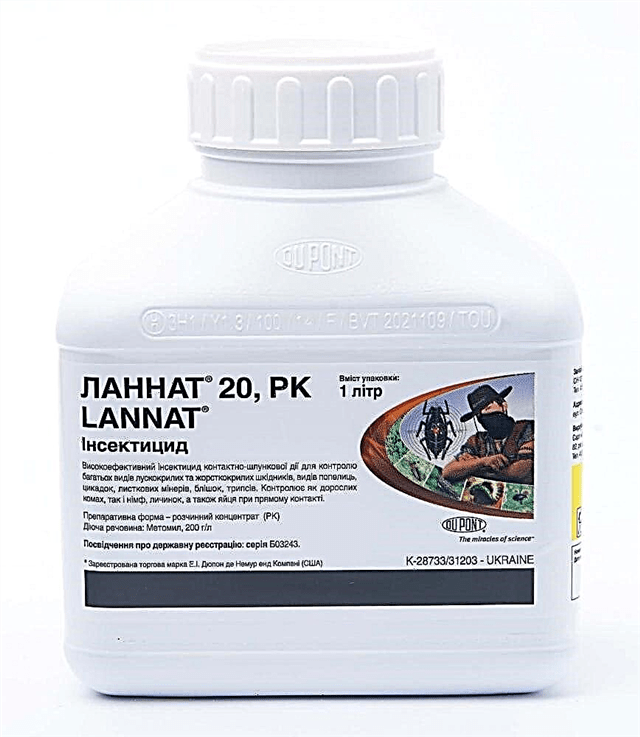
Lannate is available as a white crystalline powder. A liquid concentrate with a slight sulfurous odor is also available. For consumer convenience, it is available in various sizes. The powder is sold in foil-wrapped containers of 200 and 1000 grams. The liquid concentrate is available in 1000 and 5000 milliliters.
Mechanism of action on pests
The active ingredient in this product is methomyl, which belongs to the chemical class of carbamates. The product acts on pests through contact. Since the substance is absorbed by tissue, it can also have an intestinal effect on parasites when they consume treated plants.
Methomyl also has the ability to migrate translaminarly through crops. This allows it to combat even difficult-to-eradicate pests that live on the underside of leaves. Its mechanism of action against parasites is based on the inhibition of a specific enzyme, cholinesterase. It also inhibits the hydrolysis of acetylcholine. As a result, this substance accumulates and interferes with the normal transmission of nerve impulses to the parasite's muscular system.
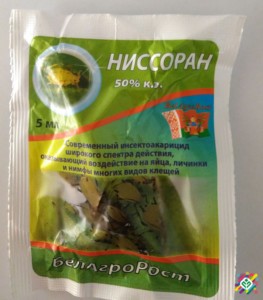
After this, the pests begin to spasm and convulse. The next stage is paralysis and death. "Lannat" successfully controls a wide range of Lepidoptera and Coleoptera insects. The product helps kill adults, larvae, and nymphs. Its insecticidal effect also extends to the eggs laid by plant pathogens.
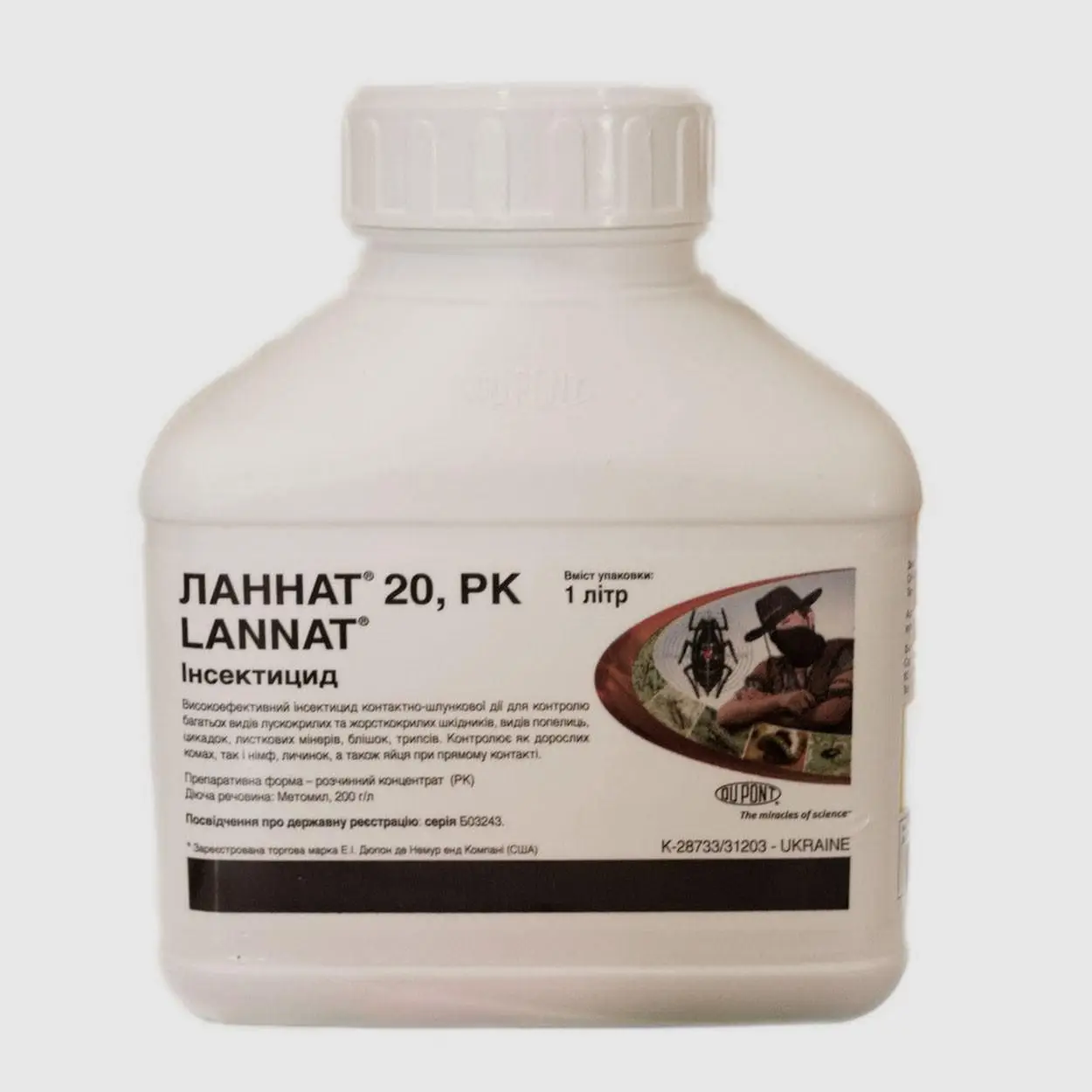
The main advantages of the insecticidal preparation include the following:
- cumulative effect – this makes it possible to deal with parasites for several days after treatment;
- rapid penetration of plants and parasites;
- spraying 3 times during the season - this must be done at intervals of 21 days;
- application in hot and cool weather – this makes it possible to use the composition from spring to autumn;
- the possibility of mixing the drug with pesticides and other insecticidal substances;
- destruction of gnawing and sucking insects - this also applies to thrips, leaf miners and cicadas;
- resistance to precipitation;
- decay time is 4-6 days;
- rapid recovery of beneficial insects after treatment.
Purpose
The insecticidal solution can be used to treat vegetable crops, melons, fruit and berry plants, and certain oilseed crops. It is also often used to protect ornamental plants.
The product can be used to treat cabbage, peas, and carrots. It is also suitable for spraying onions and tomatoes. Farmers use the product on soybeans, vineyards, and sunflowers. It can also be used on fruit trees.
This insecticide helps control a wide range of pests. It is particularly effective against aphids, cabbage moths, cutworms, and onion flies. It also effectively kills codling moths, thrips, and leaf rollers. It also helps get rid of white butterflies, geometer moths, and leafhoppers.
Rules of use and calculation of consumption
To ensure maximum effectiveness, the instructions for use must be followed. Specific dosages are listed in the table:
| Culture | Dosage | Pests | Processing Features |
| Apple | 1.4-1.8 | Leaf rollers, codling moth | Spray during the growing season. 600-1200 liters of working solution are required per hectare. |
| Grape | 0.8-1 | Grape leaf roller | Spraying is required during the growing season. The application rate should be 600-1000 liters per hectare. |
| Onions, excluding the plant grown for its greens | 0.8-1.2 | Thrips, onion flies | Treatment is carried out during the growing season. 200-400 liters of working solution should be used per hectare. |
| Cabbage | 0.8-1.2 | Cabbage moth, aphids, moths, cabbage whites | Treatment is carried out during the growing season. The application rate is 200-400 liters per hectare. |
| Tomatoes grown in open ground | 0.8-1.2 | Cotton bollworm | Treatment is carried out during the growing season. The application rate is 200-400 liters per hectare. |
| Peas | 0.8-1 | Pea weevil, codling moth, aphid | Treatment is carried out during the growing season. 200-400 liters of working solution should be used per hectare. |
| Peas | 0.8-1 | Tuber weevils | Plants need to be treated during the growing season, using 100-200 liters of working solution per 1 hectare. |
What can it be combined with?
"Lannat" should not be combined with Bordeaux mixture, iron, or lime-sulfur solution. It should also not be used with highly alkaline solutions. However, weakly alkaline solutions should be used immediately after preparation to prevent loss of properties.
How and how long to store
The insecticide should be stored in a dry, dark place. The temperature should be between 10 and 40 degrees Celsius. Store away from heat sources, medications, and food. The shelf life is 2 days from the date of manufacture.
What to replace it with
This insecticide has no analogues in terms of its active ingredient. Other effective insecticides include Avant, Koragen, and Ridomil.
"Lannat" is a popular insecticide that helps control common pests. It is used on a wide range of agricultural crops.
Related posts:
 Instructions for using green soap against plant pests and its composition
 Instructions for use of Siliplant and the composition of the fertilizer, pros and cons
 Instructions for use of the insecticide Avant, purpose of the pesticide and composition
 Causes and treatment of eggplant pests and diseases, how to combat them at home
 Methods of dealing with caterpillars on apple trees, how to treat them correctly and what is the best way to do it
 Instructions for using Fitosporin for cucumbers and processing rules
 Instructions for use of the insecticide Borey and the composition of the drug, analogues
 Instructions for use of the Clipper insecticide, composition of the preparation, dosage
Lannat has not been producing DuPont for a long time now, and Ridomil is not an insecticide at all...