
- Description of the drug Lightning
- Composition and active ingredients
- Toxicity
- Release form
- Insecticide activity spectrum
- Efficiency
- How does the drug affect the Colorado potato beetle and its larvae?
- Preparation of working solution
- Potato Processing Instructions
- Deadlines
- Spraying rules
- Speed and duration of exposure
- Security measures
- Can it be combined with other products?
- Price
- Duration and storage rules
- Substitutes and analogues
- Gardeners' reviews of Molniya
Lightning is an effective insecticide for controlling garden pests. It is most often used to treat potato plants against Colorado potato beetles. The insects are killed within half an hour. Reviews of Lightning's use against Colorado potato beetles vary. Gardeners generally agree that it is one of the most effective insecticides available.
Description of the drug Lightning
Molniya is suitable for treating all types of plants. It is used to combat pests such as aphids, Colorado potato beetles, flies, spider mites, and others. Its versatility and rapid action have made it a popular choice among gardeners.
Composition and active ingredients
The main active ingredient in Molniya is pyrethroid lambda-cyhalothrin. Pyethroids are chemical analogues of pyrithrins, which are common in nature, including in the flowers of some chamomile varieties. Naturally occurring pyrithrins have been used to control harmful insects for five hundred years.
Toxicity
Lightning belongs to the third group of hazardous products. When treating plants with this product, it is necessary to use specially cleaned containers and personal protective equipment. The product should not be used near rivers and ponds, as it is toxic to aquatic life. Also, due to the danger to bees, the product should not be used near apiaries to avoid killing the insects.
Release form
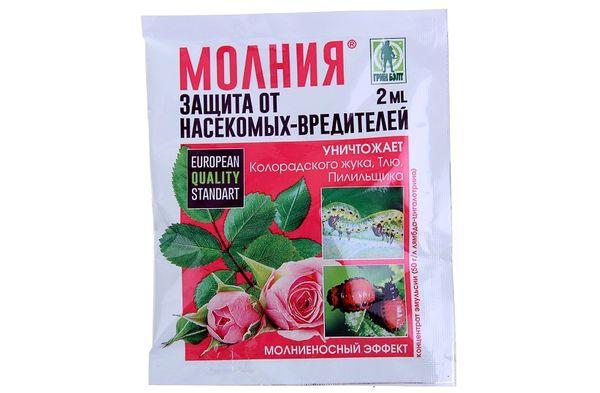
Lightning is available in two-milliliter ampoules and ten-milliliter bottles.
Insecticide activity spectrum
The product is suitable for all crops. It helps control pests in wheat, barley, peas, and other crops.
Efficiency
The product acts quickly and effectively. Most insects die within half an hour of administration.
How does the drug affect the Colorado potato beetle and its larvae?
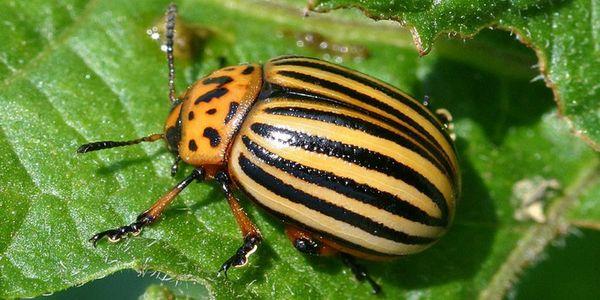
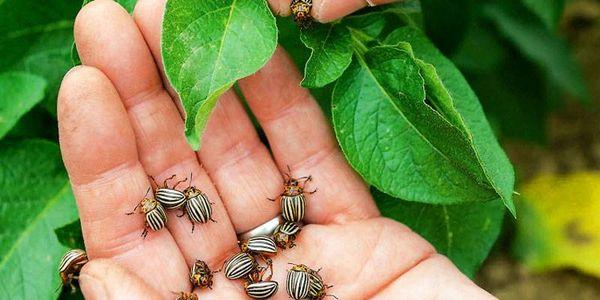
Once lambda-cyhalothrin enters the pest's body, it rapidly affects its nervous system cells, triggering their intense activation. As a result, the cells depolarize, and the insect loses control of its muscle activity, becoming disoriented. Feeding activity ceases. The beetle first stops moving and feeding, and then becomes paralyzed and dies.
Preparation of working solution
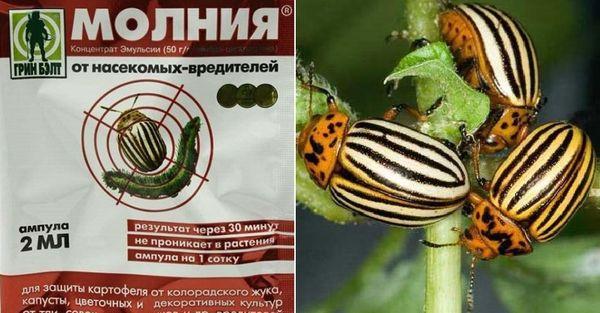
The working solution should be prepared immediately before treatment, as it is crucial to adhere to the expiration dates of the product. Carefully observe the dosage of the product. For an area of fifty square meters, ten liters of solution containing one two-milliliter ampoule will be required. First, dilute two milliliters of the product in two liters of water, then top up with water and treat the plants with the resulting solution.
Potato Processing Instructions
Before spraying potatoes with Molniya, consult the instructions for use included with each package. They provide specific recommendations for spraying each major crop against specific pests.
Deadlines
Potato plants should be sprayed with a Molniya solution during the growing season. It's best to do this in the evening. Avoid spraying during rainy weather; the air should be warm and dry.
Spraying rules
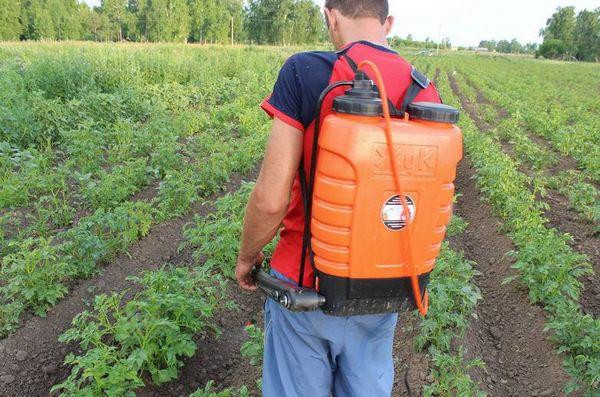
Spraying should be done while wearing protective clothing. Avoid contact with skin. The solution itself should be prepared immediately before use, following the proportions specified in the instructions.
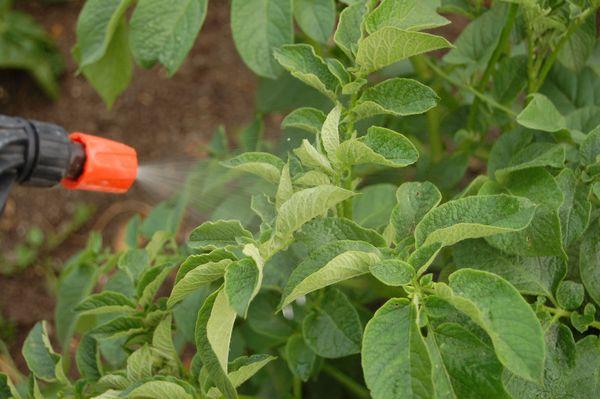
The plant needs to be evenly moistened with the solution. For this, it's best to use a sprayer that produces a fine mist, ensuring the solution reaches both the tops and roots of the plant, as well as both sides of the leaves.
Speed and duration of exposure
As mentioned above, Lightning is characterized by its rapid action on insects. The drug enters the victim's body instantly and kills them within tens of minutes by paralyzing their nerve cells.
The product's instructions state that its active effect is guaranteed to last for fourteen days, during which it actively protects the area from insects. However, in practice, this period is longer, lasting up to three weeks from the date of spraying.
Security measures
Since Lightning is classified as a Class II hazard to humans, certain safety precautions must be followed when spraying. When spraying plants, wear protective clothing, gloves, goggles, and face and respiratory protection masks and masks. Avoid smoking, eating, drinking, or chewing gum during treatment to avoid ingesting the solution.

The solution is stored in separate, dedicated containers, which must be thoroughly washed after spraying. The water used to rinse the containers should not be discharged into the sewer system. It should be disposed of in designated toxic waste disposal facilities.
After spraying, clothing should be washed immediately. Also, thoroughly rinse eyes and respiratory tract, and wash hands with soap.
Can it be combined with other products?
Lightning is compatible with many common plant treatment chemicals. However, it should not be used simultaneously with strong acidic or alkaline chemicals, as this may harm or even kill plants.
Price
A two-milliliter ampoule of Molniya currently costs between fifteen and twenty rubles. A ten-milliliter bottle costs eighty rubles. Molniya is available at any specialty gardening store.
Duration and storage rules
As stated above, the Lightning solution is not intended for long-term storage, so it must be prepared immediately before plant treatment, carefully measuring the amount to avoid leaving residue. Unused ampoules and vials should be stored only in their original packaging, not transferred to other containers, to avoid mixing up the products. Store in a dry, cool, closed area at temperatures between -12 and 30 degrees Celsius.
Pesticides should be stored in a designated area, away from food and flammable materials, and out of the reach of children and animals. If properly stored, the product's shelf life is up to three years from the date of manufacture.
Substitutes and analogues
The closest analogue of Lightning is considered to be Karate. Its active ingredient is also the pyrethroid lambda-cyhalothrin.
Tanrek is also effective against various garden pests, including locusts, Colorado potato beetles, and whiteflies.
Take a look Also
Mospilan is considered a good alternative. This product is used against Colorado potato beetles, weevils, and bedbugs.
Prestige, a product developed in Germany, is effective against the Colorado potato beetle. It contains the insecticide imidiacloprid and the antifungal agent pencycuron. This product is classified as hazard class 3 and is used at a dose of one milliliter per kilogram of potatoes.
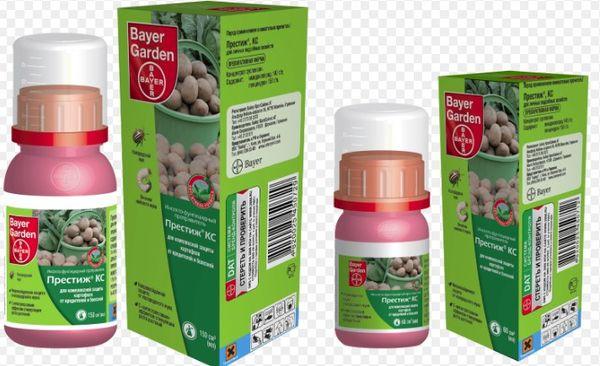
Potatoes are treated with Prestige solution before planting: the tubers are sprayed with it in advance. Beetles, once they begin to feed on the Prestige solution, quickly die without even laying eggs. The solution does not penetrate new tubers forming on the plant.
Tabu contains the same imidiacloprid. It protects plants from the Colorado potato beetle and other pests and can be used in conjunction with fungicides. The solution is prepared at a rate of eight milliliters per liter of water. One liter of the prepared solution is enough to treat one hundred kilograms of tubers. The substances in the product create a thin, durable pink film around the tuber, preventing insecticide penetration.
Tabu is used to treat tubers directly in the planting holes, as well as to spray bushes. Ten milliliters of solution containing four milliliters of the product is required for a 100-square-kilometer area.
Gardeners' reviews of Molniya
Most gardeners who used Molniya to treat their potatoes against Colorado potato beetles were satisfied with the product's effectiveness. They found it to be extremely effective and fast-acting. It provides excellent protection for both vegetable and flower crops. It is equally effective against Colorado potato beetles, aphids, mites, and other insects that prey on plants in the garden.
Related posts:
 Instructions for use of the Colorado potato beetle repellent Commander
 Types of garden fungicides and descriptions of the top 24 best, instructions for use
 Instructions for use of the Kalash remedy for the Colorado potato beetle, how to dilute
 Pre-plant potato treatments for Colorado potato beetle
 Instructions for use of "Sonnet" against the Colorado potato beetle and its composition
 Instructions for using Fitosporin for cucumbers and processing rules
 Causes and treatment of eggplant pests and diseases, how to combat them at home
 Types of fungicides for cucumbers in a greenhouse and instructions for use