
- Why do cucumbers need to be supported in open ground?
- General rules for tying cucumbers
- When should the procedure be performed?
- Which way should cucumbers be twisted when tying them up?
- Necessary equipment
- Frame
- Hooks
- Ropes
- Methods and technology for tying cucumbers in an open area
- Vertical garter of cucumbers
- Horizontal garter of cucumbers
- Garter net and other methods
- Pyramid
- Barrels
- Simple garter on a natural trellis
- Arch garter
- V-shaped garter
- Which method to choose depending on the variety
- New method "slip knot" and "loose loop"
- Common mistakes when gartering
- Is it possible to grow cucumbers without garters?
Vegetable growers need to know how to properly tie cucumbers in the open ground. This procedure is recommended for many reasons. Staking plants reduces their exposure to infection, reduces the risk of damage to the vines, and increases the yield. There are many staking methods, each requiring specific guidelines and the use of different equipment.
Why do cucumbers need to be supported in open ground?
Experienced gardeners strongly recommend staking cucumbers. The vines twine over long distances, clinging to any support along the way. This increases the risk of damage to the plants, resulting in reduced yields.
The garter procedure is characterized by the following positive aspects:
- vines growing along a support take up little space on the land, which allows you to plant another crop nearby;
- hanging cucumbers are easier to collect, they are all in sight;
- leaves and stems do not touch the ground, therefore the risk of infection is reduced;
- more shoots with ovaries are formed, which leads to an increase in the yield;
- Beds with vertically growing vegetables are easier to care for (it’s easier to water, loosen the soil, and apply fertilizer);
- it is easier for pollinating insects to get to each flower;
- air and light penetrate unhindered to all parts of the plant.
If cucumber vines are left in the ground, they grow rapidly. This increases the risk of fungal infection. The quality of the fruit decreases, as they become deformed, wrinkled, and waterlogged.
General rules for tying cucumbers
Some recommendations will help you carry out the garter procedure without errors:
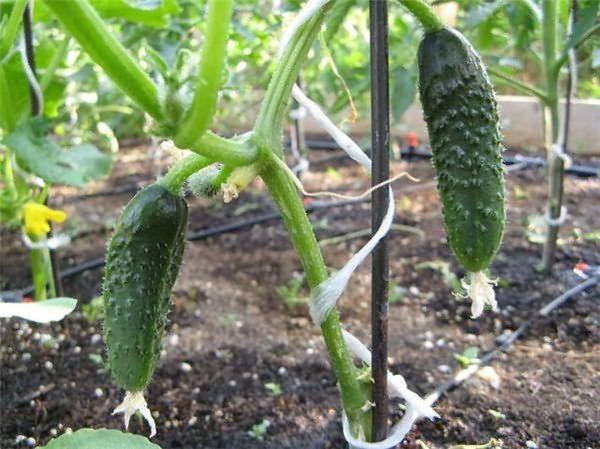
- The support for tying must be installed in advance, as soon as the first shoots appear.
- It's not recommended to tie the stem with thin ropes. They can cut into the plant tissue and cause wounds. It's best to use strips of fabric 4.5 cm wide.
- It is better to wrap the rope under the first pair of leaves.
- It is better to tie overgrown side branches to additionally installed supports so that they do not climb along with the central stem.
- Once the stem reaches 2 meters, pinch off the top. Otherwise, the stem will continue to grow, inhibiting the growth of the side branches.
By following all these rules, you will be able to avoid mistakes and reap a bountiful harvest of delicious cucumbers.
When should the procedure be performed?
Staking begins only when the stem reaches 33 cm in height. This is 21 days after planting. During this time, 5-6 leaves will have appeared. The procedure can be performed later, but this increases the risk of stem damage. Staking is best done early in the morning.

Which way should cucumbers be twisted when tying them up?
As the cucumber vines stretch, the plant should be assisted in climbing the support. The stem is wrapped around the support clockwise. The vine won't be able to curl on its own, as it's attached to the support by tendrils, not the stem. If left unattended, the top of the plant may break.
Necessary equipment
To make the work easy and quick, and to ensure that the materials do not harm the plant, you need to prepare and find out everything in advance.
Frame
The supports used for tying the cucumbers are made of metal or wood. The height of the frame posts should be at least 220 cm. In addition, pegs are needed; in some tying options, these are supposed to be installed near each cucumber plant.
Hooks
The device will help adjust the rope's length. Metal hooks are selected for tying the twine and securing the net to the garden bed.
Ropes
Special plastic fasteners are available in stores, but cotton fabric strips 5.5 cm wide and up to 17 cm long are also a good option. Nylon or other slippery materials are not recommended.
Methods and technology for tying cucumbers in an open area
There are both classic and unusual methods for tying up cucumbers. The main thing is to follow all the recommendations in the instructions for the procedure.
Vertical garter of cucumbers
The vertical version of the garter is convenient:
- Two long poles are installed near the garden bed.
- A rope or wire is stretched between the posts at the top, or a wooden crossbar can be made.
- The result is a U-shaped structure.
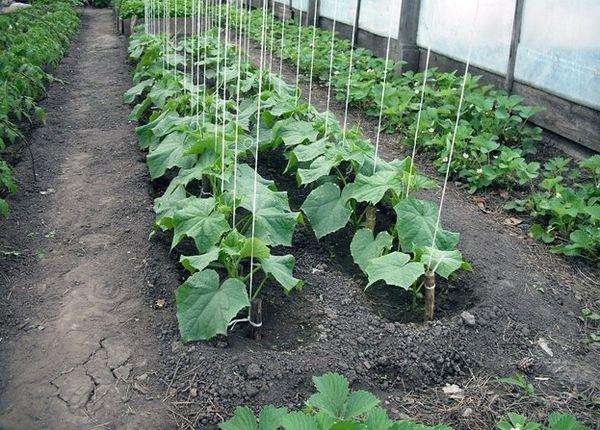
- Then, a peg is dug in near each bush, a rope is tied to it, and it is pulled to the previously installed crossbar.
With the vertical growing method, it is possible to obtain a large harvest of cucumbers, since the plant receives enough light and air.
Horizontal garter of cucumbers
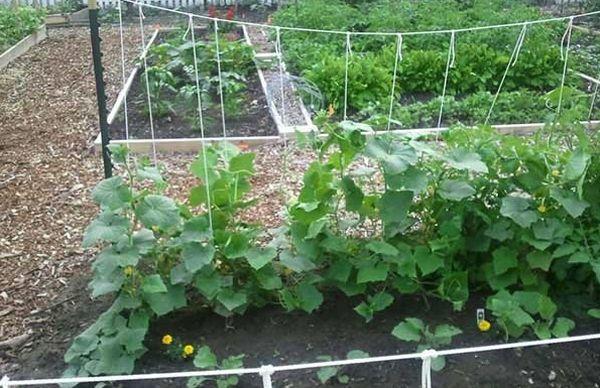
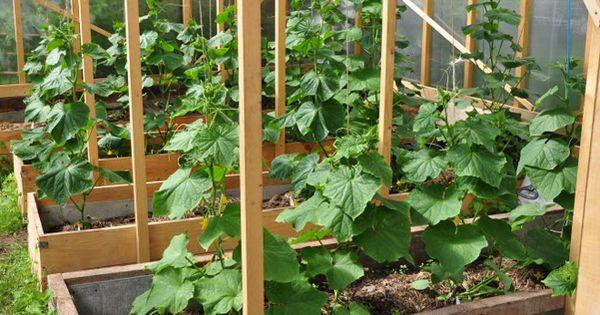
Simply create horizontal support. Install tall supports at a distance from each cucumber bed. Stretch ropes between them at 27 cm intervals. Growing vines will curl up onto the new horizontal tiers. Vertical ropes can also provide additional support.
When growing horizontally, it's important to monitor the stem tip. As soon as it begins to outgrow the support, pinch it off. Otherwise, the vine will bend downward and shade the plant.
Garter net and other methods
A large-mesh net can be attached to the two installed supports. Growing shoots will cling to the net with their tendrils, moving upward.
The mesh can be made from various materials:
- Plastic mesh is durable. The material is resistant to rain and sudden temperature changes. It doesn't heat up in the sun, so it won't damage the green parts of the plant.
- Wire construction is considered durable and strong, but the material is subject to corrosion.
- Rope nets are easy to assemble and store and take up little space. Synthetic fiber is best.
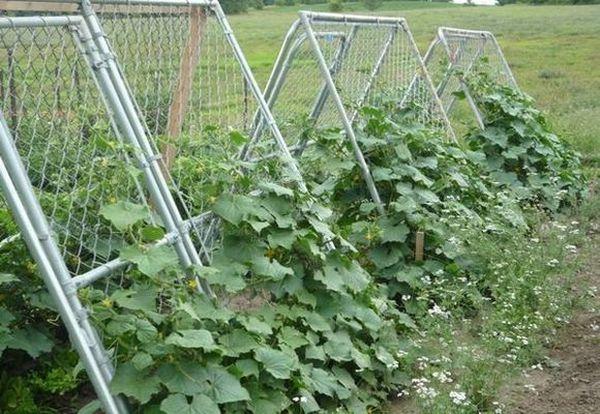 Tip: Avoid using fine-mesh netting for staking, as this type of support will interfere with the normal development of leaves and fruits.
Another method of staking is blinding. The central stem is secured to the support, and side branches longer than 50 cm are removed. If the plant is simultaneously pinched and side shoots are removed, all nutrients are directed toward the development of the main stem and fruit formation.
Pyramid
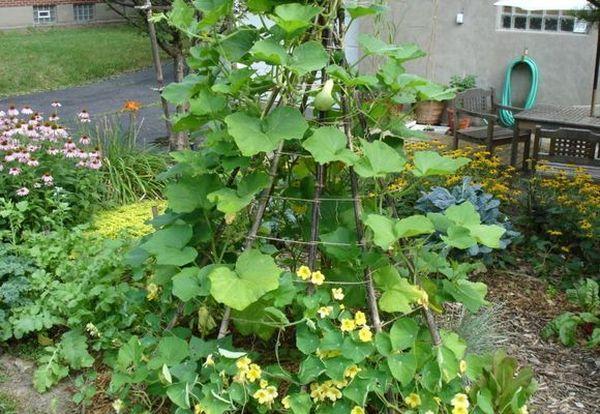
Staking cucumbers in a pyramid shape saves space and creates multi-tiered beds. The structure is constructed from wooden stakes or metal rods.
Stakes are installed around the flowerbed and tied at one point at the top. Cucumber bushes are planted around them. Another option is to install a support at least 310 cm high in the center of the flowerbed. Stake stakes are driven into the ground near each sprout and tied with rope. The ropes are connected at one point on the central pole.
Barrels
An interesting option cucumbers are grown in barrelsThe container should be tall and capacious (at least 200 liters). Prepared fertile soil is poured into the barrels and cucumbers are planted. As the vines grow, they will hang freely down the sides of the container. A large pot can be used instead of a barrel. This arrangement looks beautiful in a garden.
Simple garter on a natural trellis
A fence can be used as support. Cucumbers are planted along the fence and tied with ropes. Corn planted in a garden bed, a nearby tree, or the wall of a building can serve as support for the cucumber stems.
Arch garter
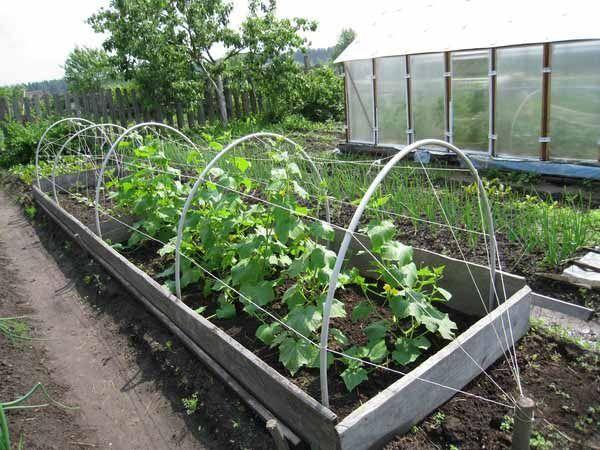
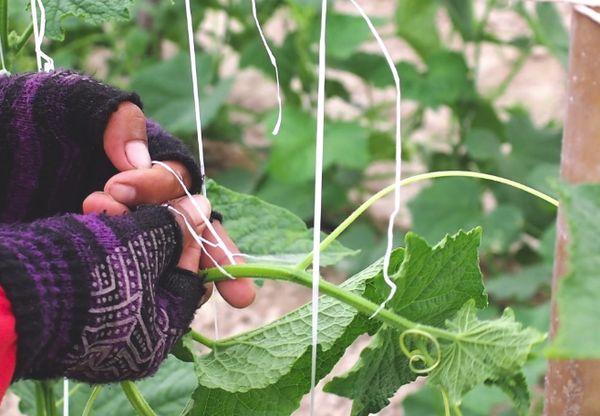
Plastic or metal arches are installed over the cucumber bed. Stakes are driven into the ground on both sides of the bed. Then, horizontal ropes are strung between the arches in several rows, and their ends are tied to the stakes.
V-shaped garter
A U-shaped frame is installed on both sides of the bed. Two ropes are lowered from the top crossbar to each bush and secured at the base. The bush is then divided into two sections, attaching one stem to one rope and a side shoot to the other.
Which method to choose depending on the variety
When choosing a garter method, it is important to consider the variety grown in the garden bed:
- Vertical tying to a trellis is suitable for hybrids and small-fruited bee-pollinated varieties of cucumbers.
- For cucumber varieties that don't produce side shoots, installing vertical supports is impractical. The effort, time, and materials spent on installation will not affect the yield.
- For strongly climbing cucumbers, the horizontal tying option is well suited.
- Garters on arches, nets, and vertical trellises are suitable for cucumbers with a cluster type of ovary formation.
Before installing supports, study the characteristics of your variety. Consider the stem growth pattern, leaf and fruit size, and other characteristics.
New method "slip knot" and "loose loop"
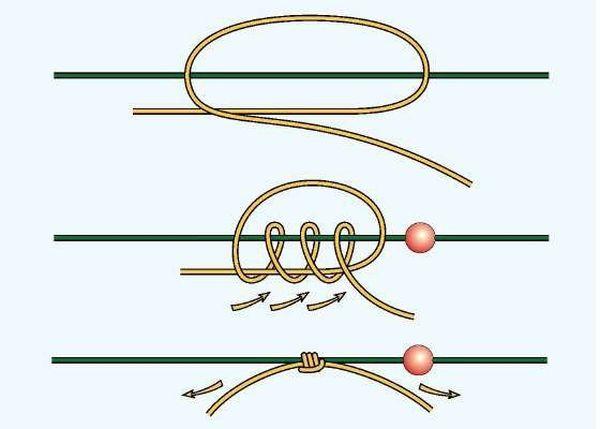
As the cucumber vine grows, it becomes necessary to shorten the supporting rope. Using a slip knot eliminates the need to cut off the remaining rope and retie it to the frame. Wrap the end around the trellis, loop it around the rope several times, and tie it in a figure-eight knot. This creates a knot that slides easily along the base, and the length can be adjusted.

A more difficult method is the loose loop. A wire is stretched between two supports. A string or rope is attached to it. The end of the string should reach the ground. It is wrapped around the plant, making two knots between the leaves for each turn. It's best to tie the loose loop under the first pair of true leaves.
The growing cucumber top is again tweezed. This procedure is usually performed every two weeks. If the cucumber vine is not tweezed enough, it will hang down and break the next time it is tweezed.
Common mistakes when gartering
When gartering, you should avoid common mistakes:
- Overgrown stems should not be touched, as there is a high risk of damage and reduced yield. In this case, cucumbers are left to grow without support.
- Avoid tying the stem to the support too tightly. As the stem grows, it thickens, the number of leaves increases, and the plant's nutrient supply is disrupted where it's tied.
- Avoid using thin rope, stiff twine, or plastic ties for tying. These devices can damage the plant and cause it to dry out.
- Failure to twist the top in time will cause it to fall down and even break.
If you organize care correctly, follow the general rules and recommendations of experienced gardeners, you can avoid many mistakes.
Is it possible to grow cucumbers without garters?
Growing cucumbers without tying them to a support is possible, but in this case, gardeners will face many inconveniences and problems:
- Gradually growing shoots will cover the roots of the bush, which will complicate the procedure of watering and fertilizing.
- Light and air do not reach the lower tier of plants in sufficient quantities, reducing yield and increasing the risk of infection.
- Not all fruits are visible, so they often overgrow in the garden. Cucumbers often become soiled and susceptible to pests.
To harvest a good crop of delicious and crunchy cucumbers, you need to follow proper agricultural practices. A recommended technique is tying the plant to a support.
Related posts:
 Description of unusual methods for planting and growing cucumbers
 Description of the best varieties of Chinese cucumbers, planting, growing and care
 How to properly plant cucumbers in open ground with seeds, and at what depth
 TOP 30 best determinate cucumber varieties with descriptions
 How to care for cucumbers in open ground from planting to harvesting
 How to plant cucumbers in open ground under film: timing and cultivation technology
 How to make a cucumber trellis with your own hands from scrap materials
 Why cucumber leaves are drying out and what to do, how to treat them in a greenhouse and in the ground