
Cucumbers are among the most popular garden crops. They are grown in open ground and greenhouses. A cucumber trellis is a convenient way to support the vines, which cling to everything nearby, while simultaneously reducing the space required for the garden bed.
Purpose of trellis for cucumbers
Cucumber stems grow up to 2 meters and have tendrils that can twine around foliage, the stems of neighboring plants, and fences. Trellis provide organization to cucumber beds and protect other plantings from creeping vines..
But this isn't the main advantage of trellis cultivation. Its primary purpose is to increase yields and provide better growing conditions for cucumbers. What does raising cucumber vines on trellises help achieve?
- increase in yield (by 50-80%);
- more convenient processing of stems - pruning, removing excess ovaries, shaping bushes;
- protection against fungal diseases and pests.
Raising the garden bed significantly saves space, as cucumber beds can take up a significant portion of the plot. Beautiful trellises become a true highlight of the garden, serving as a divider or hedge.
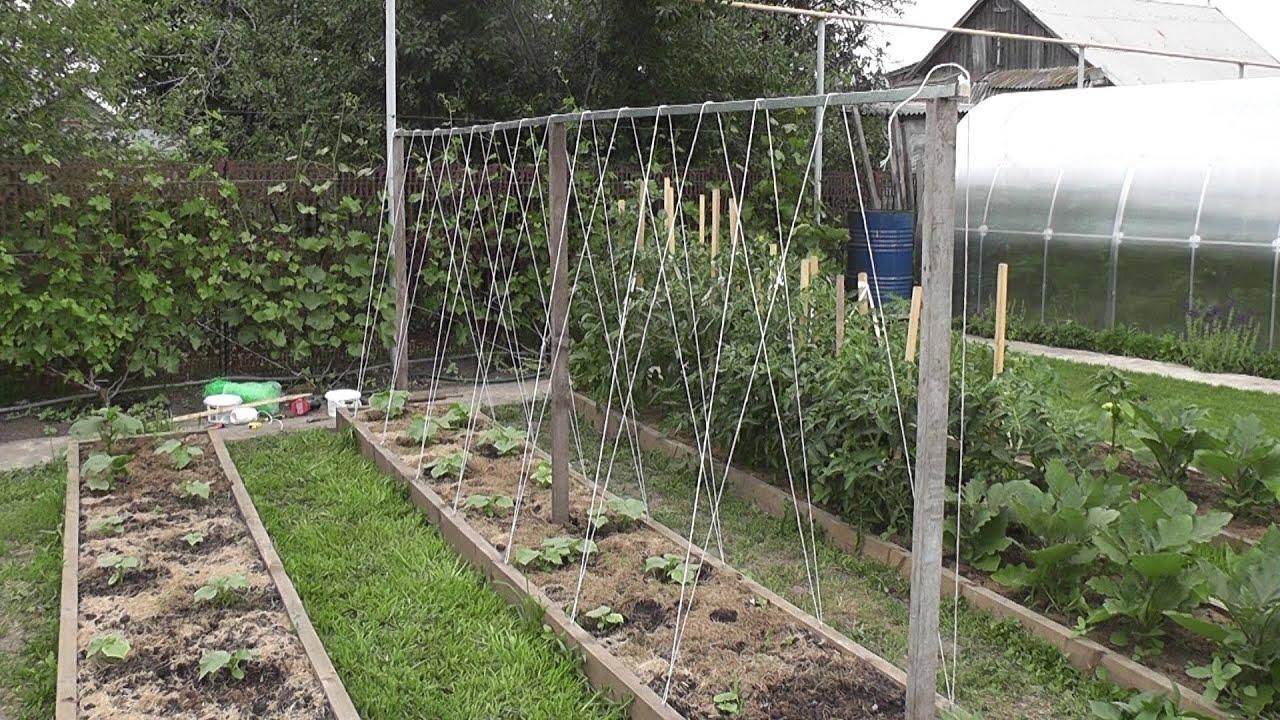
Advantages and disadvantages of trellises
Heat-loving cucumbers have tendrils to cling to supports; they are genetically programmed to grow upward. Vertical supports provide this ability. Growing cucumbers on trellises offers a number of advantages:
- Uniform supply of solar heat and light to all fruits and stems, ventilation and access of fresh air to the greens and roots.
- Protection against soil-borne pests and diseases caused by soil-borne pathogens. If infestation occurs, simply approach the entire plant on the trellis for treatment.
- Ease of care – fertilizers and water for irrigation are delivered directly to the roots. The green part doesn't get wet or come into contact with unwanted substances.
- The cucumbers themselves are clean, dry, and evenly illuminated, which significantly improves the taste and decorative qualities of the fruit.
- Plant stems do not bend, intertwine or twist during watering and harvesting.
Another significant advantage of trellises, as many gardeners cite, is the ease of harvesting. Climbing through dense beds, bent over, and scraping your hands on prickly leaves and stems is necessary when planting horizontally. On large plantations, this becomes a serious problem.
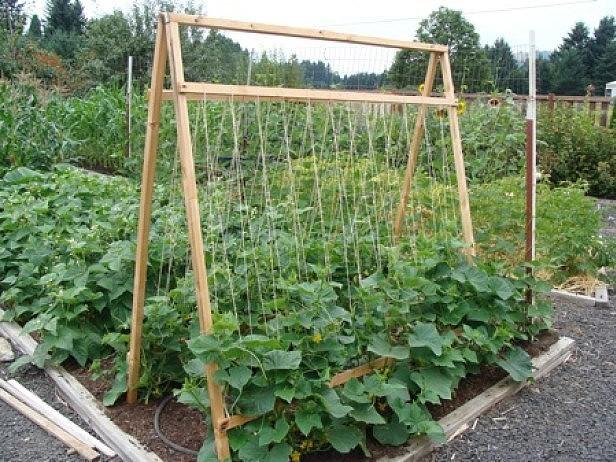
When harvesting, some cucumbers cannot be found; they are often discovered after they have reached enormous sizes.
Experienced gardeners point out the following disadvantages of this method:
- costs, material and labor, for the installation of trellises, maintenance and care of the structure itself;
- the need to tie the vines to the trellis in a timely manner so that they do not break or creep to the side;
- more frequent watering and fertilizing.

The soil dries out faster because it's not protected by the green part. Regular watering is especially important in hot regions and during dry, sunny weather. The beds should be mulched.
Types of supports
Most gardeners take a creative approach to creating cucumber trellises. They use a variety of materials, creating complex or very simple structures from scrap materials.

Types of cucumber trellises by shape:
- rectangular;
- hut type;
- round;
- arched;
- on a stretched mesh between the supports;
- horizontal - the stems are partially raised upwards and placed on openwork supports, for example, a ladder.
It's worth noting that the main problem with permanent trellises is the need to grow cucumbers in one place for a long time. This requires annual soil renewal and especially careful fertilization.
Non-permanent trellises for cucumbers, for example, on a tire, can be easily moved to a new location every year.
How to make a cucumber trellis yourself
Let's look at how to make a convenient support for cucumbers yourself. Typically, gardeners rely on available materials and their own construction skills.
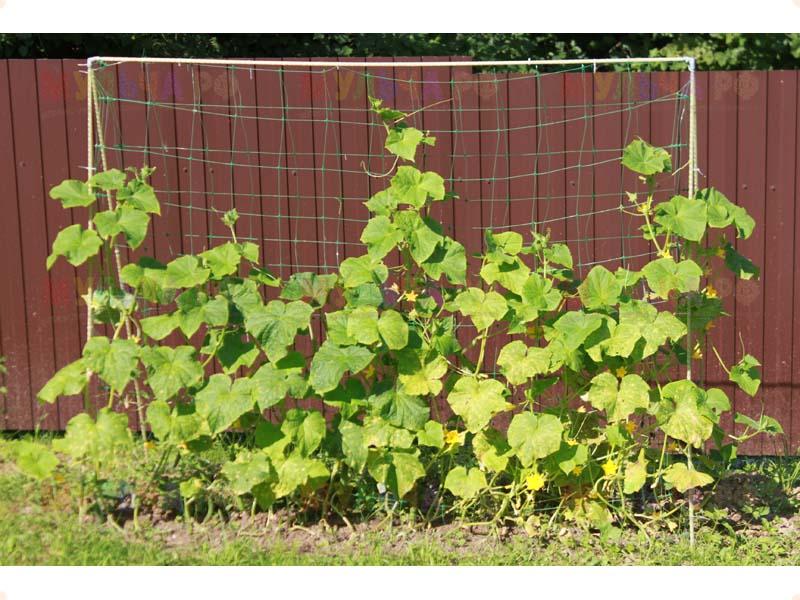
Simple rectangular
The base of this structure is made up of beams up to 3 meters long. The typical height of the structure is 2 meters, which is how tall cucumber stems grow. Preparing the frame:
- Corner supports are made from 50-millimeter diameter beams, driven 70-80 centimeters into the soil. The length of the bed and the distance between corner supports is 5 meters.
- To prevent the structure from collapsing under the weight of the vines, the corner posts are reinforced with guy wires.
- The intermediate posts are deepened by 50-60 centimeters, their thickness is less – 40 millimeters.
- After installing the frame, it is important to properly tension the wire - 2 millimeters thick, the first row at a height of 20 centimeters, the next ones at 30-40 centimeters.
The top wire should be thicker – at least 3 millimeters, since it will support most of the weight when the cucumbers begin to grow and ripen.

Important: wooden elements of cucumber structures must be treated with drying oil and fungicides to increase service life and protect against fungi.
Made from lumber
With enough quality lumber, you can create a beautiful trellis that will securely hold the vines and make it easier to grow cucumbers outdoors.
The work scheme is as follows:
- Corner supports are dug into the ground (beam thickness – 50 millimeters, depth – 70-80 centimeters). They are reinforced with wire anchors.
- Every 1-2 meters, additional posts with a smaller diameter are made.
- A crossbar is placed between the corner supports on top and secured firmly to it, allowing the lattice slats to be attached to it. If desired, you can create a drawing so you can cut the slats to the correct size right away.
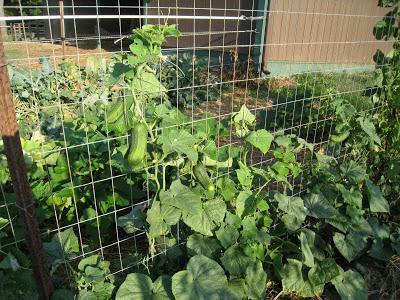
The lattice mesh size is 15 centimeters, and the slats are sufficiently wide – 3 millimeters. With good woodworking skills, this cucumber pergola can become a beautiful addition to your dacha.
Made of metal profile
Metal structures are more durable and, if properly secured, will serve for a long time as a tie for cucumber stems. The base is made of rebar over 2 meters long. They are driven into the ground along the edges of the bed.

The easiest way to attach the top crossbar is to weld it with a welding machine. If this isn't possible, the edges are twisted together with wire or thick cable. In this case, the frame won't be very secure.
Metal stakes are driven into the ground between the supports to attach the wire mesh. The stakes should be spaced 15 centimeters apart. Wire is attached to the top pipe, side supports, and stakes to create mesh sizes of 15-20 centimeters.
 Advice: all metal parts are painted and treated with anti-corrosion agents.
From the tire
A homemade cucumber trellis made from scrap materials (tires and wheels) is compact and convenient. A large-diameter tire is cut lengthwise and laid on the ground. The center is filled with prepared soil for the cucumber bed and the tire. A metal rebar is inserted into the center to attach the wheel rim.
The bicycle wheel is stripped of its tire and spokes, leaving only the rim. It is secured to the top of the rebar with wire.
The soil is covered with burlap, and cucumber seedlings are planted in the slits. If cold weather is expected, agrofibre is used for cover. Wire is stretched through the spoke holes and the tire.
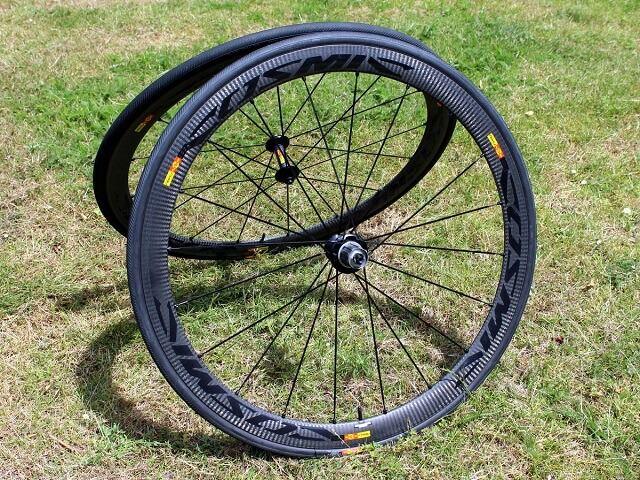
Once the cucumbers have grown up around the structure, it resembles a canopy or a hut with a rounded top. These growing stands are portable and can be moved to another location the following year, creating a beautiful garden setting.
From a special mesh
For the device of support Several types of nets are used for cucumbers:
- trellis;
- plastic made of polycarbonate;
- metal.
Each type has its own specific features in fastening and material care, which can be found in the instructions.
Installation rules:
- reliable supports are installed along the edges - pipes (metal or plastic), wooden poles;
- make intermediate posts for additional rigidity;
- a lath is fixed on top with a spacer and a net previously strung on it for fastening cucumber vines;
- The sides of the mesh are attached to the supports with wire or twine, stretching without sagging.
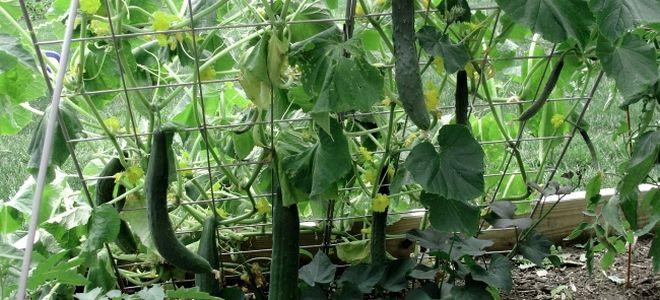
The lateral supports require stretching and significant recessing.
Peculiarities of planting and growing cucumbers
Caring for cucumbers grown on a trellis involves the usual set of agricultural practices, which also includes staking. Growing cucumbers in a greenhouse and in the open field differs slightly.
In open ground
One of the key elements of a good harvest is the correct placement of cucumber beds—west-east—to ensure uniform daylight exposure. Crop rotation rules must also be considered. The best predecessors are cabbage, legumes, and tomatoes.

Pre-boarding activities:
- installing a trellis for cucumbers;
- planting neighbors to protect from winds - corn, sunflowers;
- Soil preparation – digging, watering with potassium permanganate for disinfection, adding organic fertilizers, raising the bed by 20-30 centimeters with nutritious soil.
Trellis are constructed based on the capabilities and available materials. The planting pattern for cucumber seedlings depends on the type of bush: heavily branched plants should be spaced 30-40 centimeters apart, while weakly branched plants should be spaced 25-30 centimeters apart. The distance between trellises is about a meter. Gardeners often use black plastic for planting, slitting it to accommodate the seedlings.
In most regions, seedlings require insulation—they are covered with plastic film, creating greenhouse-like conditions. Once the young plants have established themselves and the weather has warmed up, the plastic film is removed and the stems are secured.
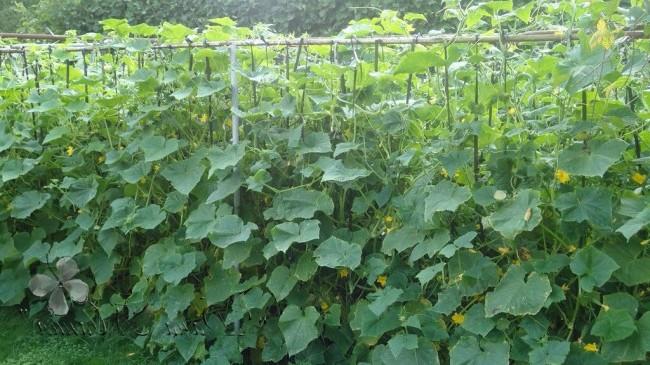
Rules for tying up seedlings:
- mandatory tying to the trellis below the first leaf (real);
- each node is secured with a rope, wrapping it around the stem in the internode area;
- with horizontal planks - the whip is tied with a polypropylene or cloth rope without pinching the stem and knots.
Pinching, or removing unnecessary stems and nodes, is done every 10 days. The specifics of female flower formation are described in the descriptions of varieties and hybrids. When planting cucumbers on trellises, remember the variety growing in the bed so that pinching improves yield. A mandatory part of care is fertilizing four times a day with a change of fertilizer.
In the greenhouse
Basic rules for growing cucumbers in greenhouses on trellises:
- the choice of planting time is determined by the ability to maintain the recommended temperature;
- It is easier to maintain humidity in a greenhouse, but ventilation and airing are required;
- plantations should not be thickened to ensure air passage;
- carrying out activities for better pollination;
- pinching – according to the recommended patterns;
- timely harvesting of fruits and removal of defective specimens to increase the yield and preserve the strength of the plant.

Cucumbers require warmth and moisture, so greenhouses typically yield larger crops and have a longer fruiting period. Fertilizing the plants four to five times per season is essential for a high-quality and abundant harvest.
Planting cucumbers on trellises significantly increases the yield. This is the only way to properly shape the bush, removing any unwanted growth. Pinching is difficult or impossible in horizontal beds. In greenhouses, cucumbers are always grown on trellises., which is one of the main reasons for higher yields.
The cost of trellises always pays off with high-quality, tasty cucumbers, extended periods of active growth, and increased yields.
Related posts:
 TOP 30 best determinate cucumber varieties with descriptions
 Description of unusual methods for planting and growing cucumbers
 The best eggplant varieties for growing in a polycarbonate greenhouse: planting and care
 Step-by-step instructions on how to make a grape trellis yourself
 Description of the best varieties of Chinese cucumbers, planting, growing and care
 How to make a tomato trellis with your own hands?
 How to properly plant cucumber seedlings in a greenhouse and care instructions
 Description of the best varieties of bee-pollinated cucumbers, rules for their formation and care